
 +965 2292 4888


Daily Economic Update
22.02.2026
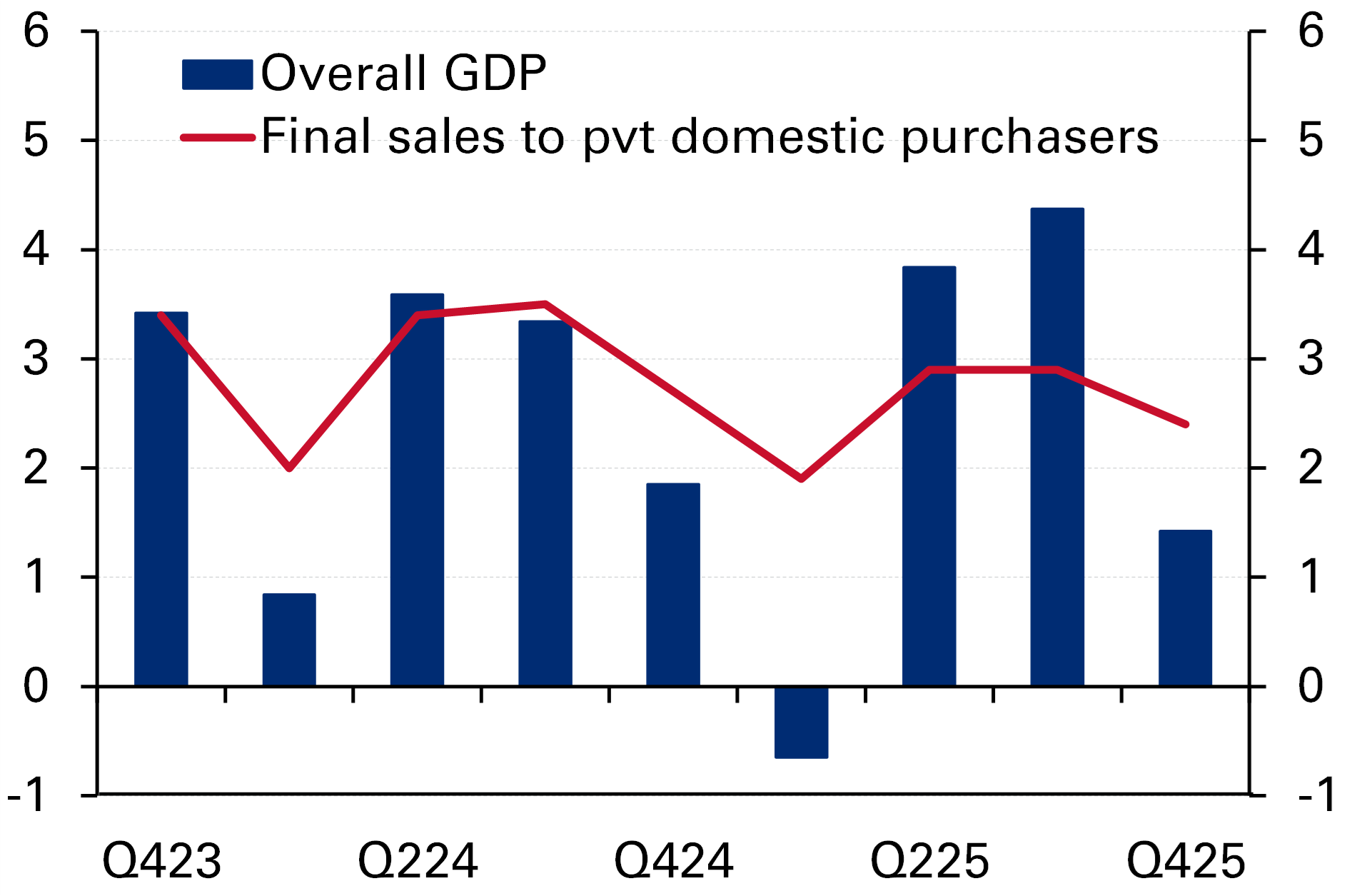
US: Q4 GDP growth misses forecasts but full-year 2025 growth a resilient 2.2%; December’s PCE inflation above expectations. GDP growth in Q4 slowed sharply to 1.4% (annualized) from 4.4% in Q3, missing estimates (3%), impacted by the record-long government down during the quarter. The Bureau of Economic Analysis said that the reduction in government services due to the shutdown subtracted about 1% from GDP. Consumer spending moderated to 2.4% from 3.5%, while Federal government non-defense expenditure shrank by over 24%, but growth in business investment quickened to 3.7% from 3.2% amid an ongoing AI/tech spending boom. A core measure of the underlying economy, final sales to private domestic purchasers, eased but remained relatively robust at 2.4% versus 2.9% in Q3. On a full year 2025 basis, the economy grew by a resilient 2.2%, but slower than the 2.8% rise in 2024. Looking ahead, sustained AI-related capital spending, continued robust household spending supported by elevated equity markets, and a fiscal boost should help the economy stay resilient in 2026. Meanwhile, PCE inflation in December came in hotter than expected as the headline rate increased to 2.9% y/y from 2.8% in November and the core rate accelerated to 3% from 2.8%. Finally, the S&P Global February flash PMIs eased for both manufacturing and services to 51.2 and 52.3 from January’s 52.4 and 52.7, respectively, on weakening demand and dampened activity amid bad weather conditions.
US: Supreme Court strikes down reciprocal tariffs; Trump reimposes a temporary 15% baseline tariff on all nations and vows to introduce more through separate methods. The Supreme Court on Friday rendered Trump’s reciprocal and fentanyl-linked tariffs enacted through an emergency power act (IEEPA) illegal, saying that the president exceeded his authority given to him by Congress under the act. Lower courts had previously made these tariffs void but kept them in place pending appeals in the Supreme Court. However, sectoral tariffs and duties already in place from Trump’s first term were unaffected by the latest court ruling. The top court also left the decision related to the refunds of already collected custom duties to lower courts. Some estimates put the amount that is subject to refunds at around $175 billion. President Trump immediately reimposed a temporary 10% baseline tariffs on all trading partners effective February 24, and later increased that to 15%, saying these tariffs were “fully allowed, and legally tested,” falling under section 122, which doesn’t require congressional approval and allows for a maximum of 15% tariff rate for a maximum period of 150 days. The period can be extended but requires approval from Congress, which is unlikely given Congress’ majority stance on tariffs. He also instructed the administration to explore other sections such as 301, which would enable him to impose tariffs on nations subject to an investigation by the US Trade Representative on trading partner(s’) unfair trade practices. Trump also mentioned that trade deals signed with many countries would remain in place though may be replaced by tariffs enacted through other mechanisms. Treasury Secretary Bessent stated that given other legal options to reintroduce tariffs, overall custom revenues in 2026 will be “virtually unchanged” (with total custom duties running at around $28 billion per month now) from 2025 levels, while stressing that the refund process of already collected tariffs would be messy and could take years. These developments have reignited trade-related uncertainty while the latest blow from the Supreme Court will certainly weaken Trump’s most-(ab)used bargaining tool. Given Trump’s determination to build the tariff wall through other legal means, the tariff situation may eventually settle to be broadly similar to the pre-Supreme Court decision, but uncertainty is higher in the interim. What will change is the ease by which Trump can both levy tariffs as well as use them as a threatening tool. Most partners, which had earlier signed trade deals with the US, responded in wait and watch mode, awaiting clarity before taking further actions. Amid these developments and weak economic data, markets’ reaction on Friday varied, with the S&P 500 rising 0.7%, but the US bond market reaction broadly muted.
UK: Business activity robust in February, while January’s retail sales growth hits a 20-month high. The S&P Global flash composite PMI in February increased to 53.9 from January’s 53.7, the fastest expansion since April 2024, as the manufacturing gauge rose to 52 from 51.8 in January (the highest level in 18 months) while the services measure eased slightly to post a still robust reading of 53.9 from 54. The survey cited that demand conditions sustained stronger improvement in both domestic as well external sectors, with rising sales pipelines. While input price inflation moderated slightly but was still above the series’ long-run average, the output price index increased for the third consecutive month to the highest since April 2025. However, employment continued to shrink for the 17th straight month. Along with robust PMI readings in January and February, indicating a further recovery in the operating environment, retail sales volumes in January increased by 1.8% m/m (4.5% y/y) from 0.4% (1.9% y/y) in December, the fastest growth since May 2024. Following a weak performance in the second half of 2025, the UK economy seems to have started 2026 on a stronger footing, especially after fading uncertainty post-government budget that saw no major imminently applicable tax increases and supported by BoE’s previously delivered as well as further anticipated policy interest rate cuts.
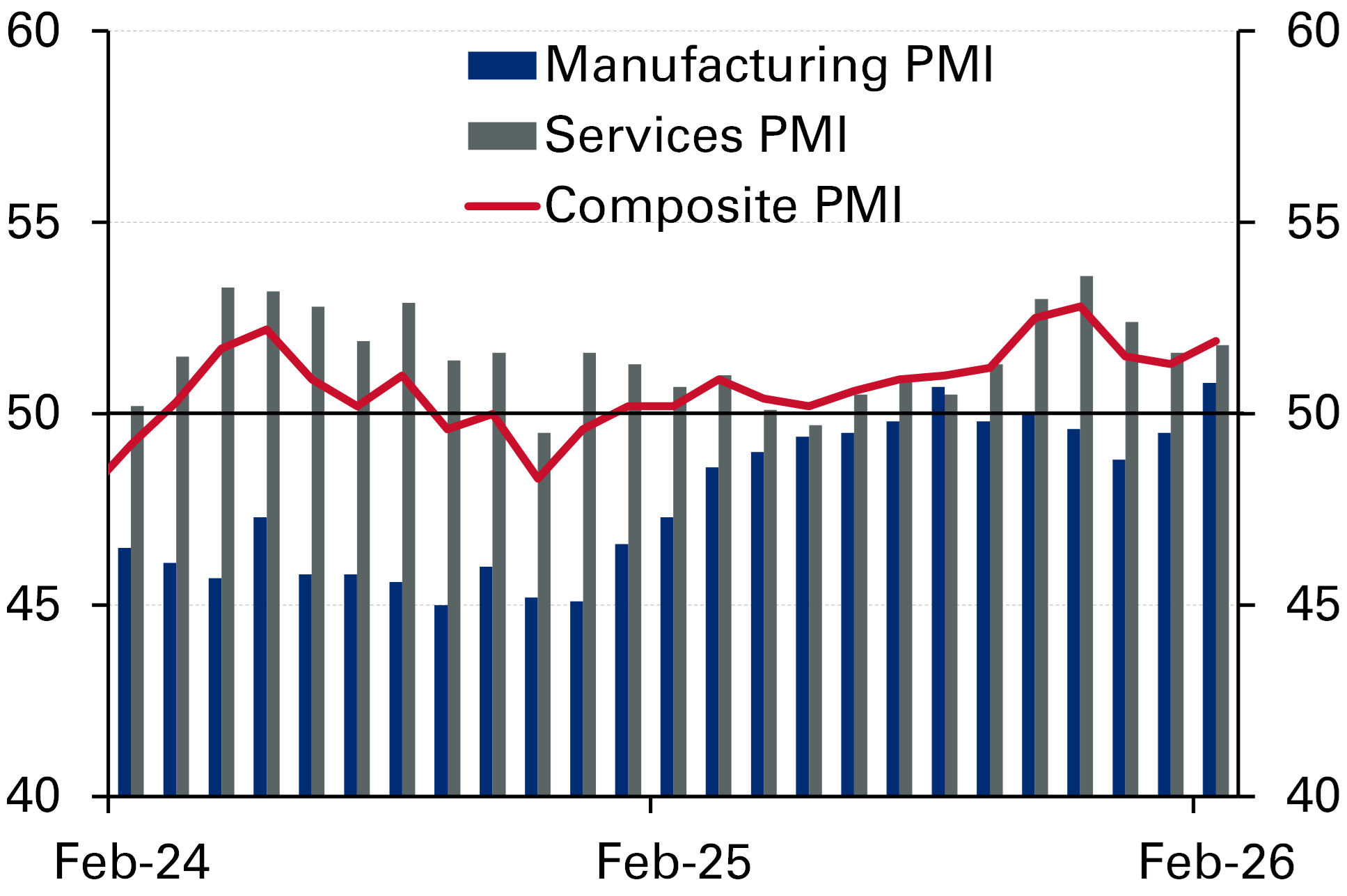
Eurozone: February composite flash PMI above expectations driven by manufacturing. The Eurozone’s flash PMI for February pointed to firmer economic momentum as manufacturing showed a clear improvement, with the manufacturing index rising to 50.8 (from 49.5 in January)—its highest level since June 2022— beating expectations and moving back into expansion territory. Output growth was among the strongest seen in the past four years, supported by a similarly high level of business optimism. Meanwhile, the services sector also strengthened modestly with the PMI edging up to 51.8 in February from 51.6 in January. The composite flash index increased to a three-month high of 51.9 in February from 51.3 in the previous month.
Oman: Inflation eased to 4-month low in January. The annual inflation rate eased to 1.4% in January 2026, down from 1.6% in December, reaching its lowest level since September 2025. The slowdown was driven by softer increases in food & non-alcoholic beverages (0.9% from 1.1% in December) and in clothing & footwear (0.1% from 0.2%). Transport prices declined (-0.3% from 2.8%), while costs for housing & utilities, communication, and education remained unchanged. Meanwhile, certain categories saw faster price growth, including furnishings & household equipment (2.6% from 2.4%), miscellaneous goods & services (13.2% from 10%), restaurants & hotels (5.9% from 2.6%), and health (1.7% from 0.1). Recreation & culture prices also rebounded, rising 1.1% after a 0.1% dip. On a monthly basis, consumer prices increased by 0.3%, following a 0.1% decline in December 2025.