
 +965 2292 4888


Daily Economic Update
15.01.2026
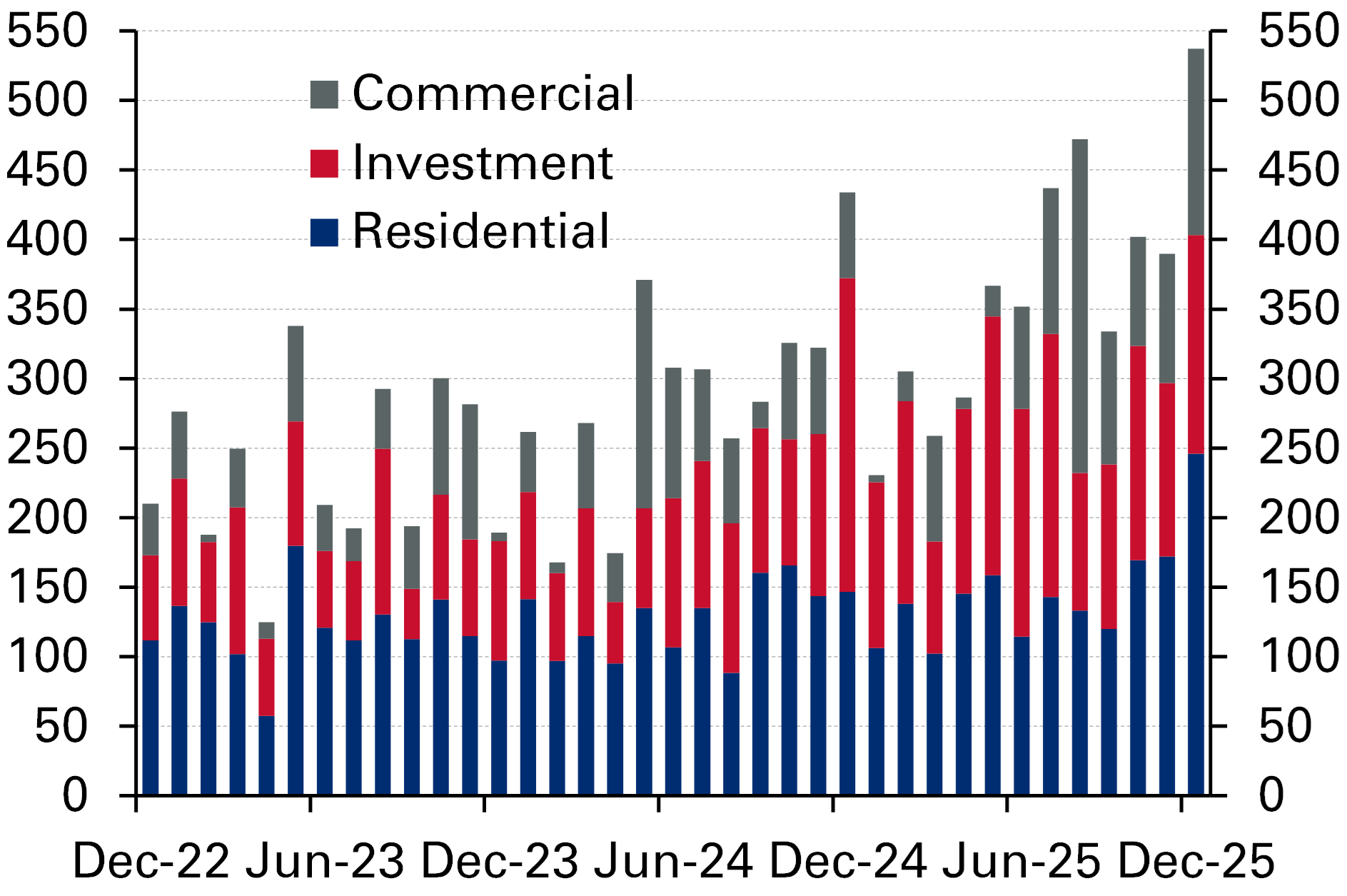
Kuwait: Real estate sales hit historic high in 2025, with strong end to the year. Annual figures released by the Ministry of Justice show that the value of real estate sales in Kuwait in 2025 reached KD4.4 billion, up almost 26% on 2024’s figure and the highest figure on record. Both the investment (apartment) and commercial sectors performed strongly, with sales rising by 39% y/y and 28%, respectively, while residential sales, the largest sector, increased by 14.3%, helped by robust activity in the Sabah Al-Ahmad coastal area during August and December especially. Inferring from the annual data, December’s sales looked to have stood at a super-strong KD537 million (+24% y/y), which is also the highest month on record. Also, the volume of transactions in December, at 590, was the highest in two and a half years. December’s increase was driven primarily by residential sales, which climbed to a multi-year best of KD246 million (+68% y/y) on the back of the above-mentioned Sabah Al-Ahmed coastal development worth KD80 million. Higher activity may have partly reflected sellers looking to offload empty plots (‘white’ lands) as the residential land monopoly law came into effect this month (January 2026). Commercial segment sales also posted strong gains in December, reaching KD134 million (+116% y/y), thanks to sizable deals in the Al-Farwaniyah, Hawalli, and Al-Jahra governorates. Meanwhile, investment sector sales advanced to KD157 million (+26% m/m but -30% y/y). We expect the strong momentum observed in 2025 to carry through into 2026 in line with the broad improvement in Kuwait’s non-oil economy, potentially further monetary easing, and also with support from new and forthcoming legislation including (i) the aforementioned residential land monopoly law, which should encourage development and promote more efficient land allocation, (ii) the decree permitting listed companies with foreign shareholders to own non-private residential property (this had drawn substantial institutional investor interest in 2025 as seen in the increase in value of Boursa Kuwait-listed real estate companies), and, most importantly, (iii) the keenly-anticipated real estate financing law.
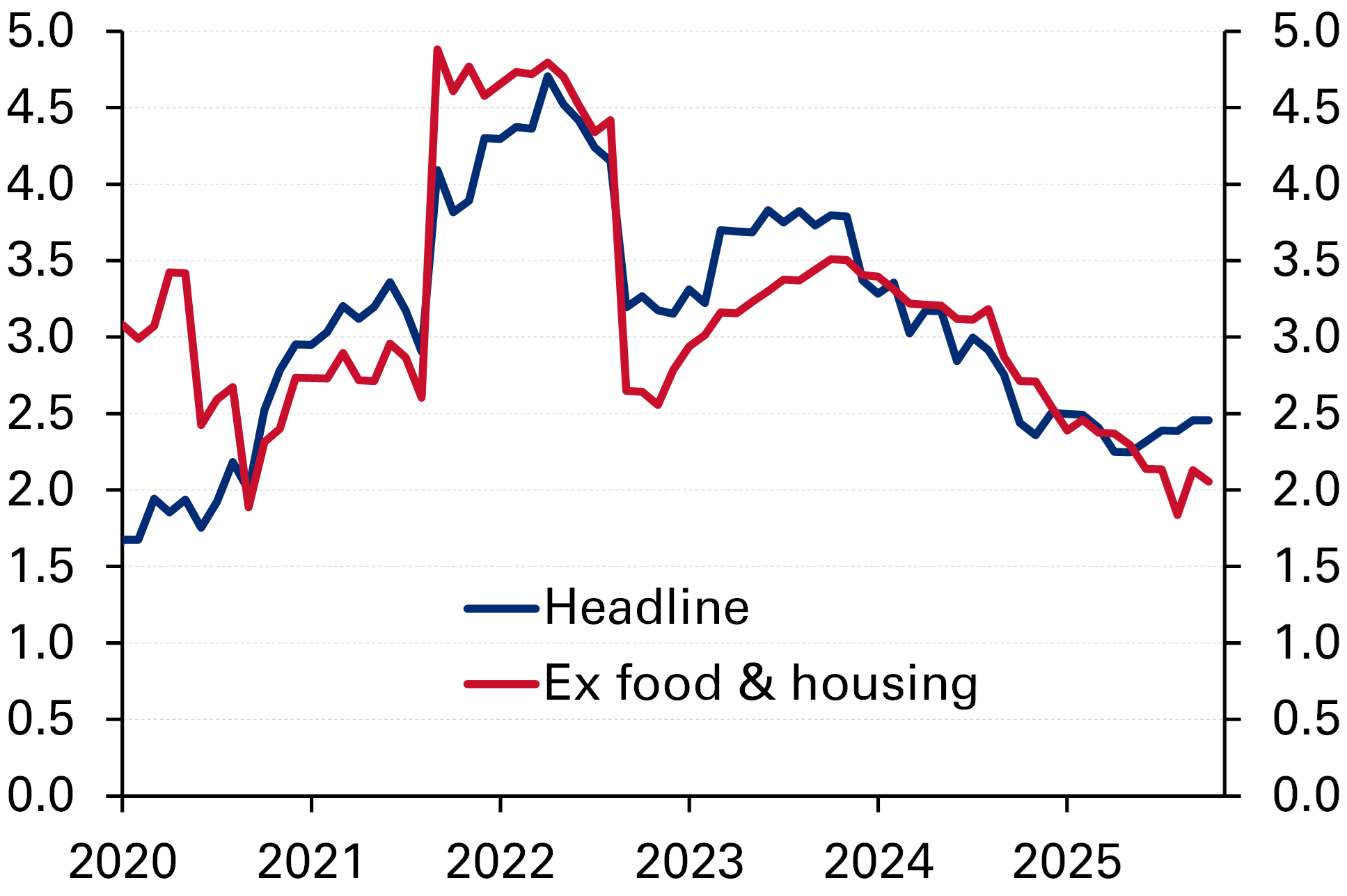
Kuwait: Inflation steady at 2.5% in October, despite rising jewelry prices. CPI inflation stood at 2.5% y/y in October, unchanged from September, and keeping inflation in the narrow range of 2.3-2.5% recorded through the preceding 12 months. A gauge of core inflation, which excludes food and housing, was also steady versus September at 2.1%, having generally trended lower through 2025. The underlying details in the survey were broadly muted. The month-on-month index change of 0.1% was one of the lowest seen in recent years. Moreover, year-on-year inflation was either unchanged or fell in all index components other than one – the miscellaneous goods & services segment, which rose to an elevated 6.5% y/y. The latter was linked to surging jewelry prices, almost certainly due to the rising prices of gold and silver (which have risen further since). The CPI figures are backed up by recent PMI surveys, which show firms’ output prices rising but at a still modest pace towards the end of last year. A combination of decent economic growth but a still sluggish consumer sector is expected to contribute to a broadly unchanged low-to-moderate inflation picture this year, having averaged an expected 2.4% in 2025.
Egypt: The Ministry of Finance eyes $1–1.5 billion Eurobond issuance as market conditions turn supportive. The Ministry of Finance is preparing to return to international debt markets this month with a planned Eurobond issuance of $1–1.5 billion, aiming to take advantage of the sharp improvement in Egypt’s risk profile at the start of the year. 5Y credit default swaps on Egyptian sovereign debt have fallen to below 270 bps, their lowest level in around six years, signaling a meaningful narrowing in risk premiums. This repricing has translated into a notable rally in Egypt’s international bonds, with yields declining by around 300–400 bps y/y. The improved market backdrop offers the government a timely opportunity to refinance at a lower cost, which should help ease debt service pressures that continue to absorb a large share of public spending. According to government sources, the issuance size could be increased to as much as $2 billion if investor demand proves strong, reflecting renewed appetite for Egyptian risk amid improving macro fundamentals and a more accommodative global rate environment. In parallel, the ministry is also planning to issue an equivalent of $500 million in green samurai bonds before the end of the fiscal year in June. This move aligns with Egypt’s strategy to diversify its external financing sources, lengthen debt maturities, and broaden its investor base while reinforcing its commitment to sustainable finance.
Oil: Prices fall after Trump de-risks Iran strike prospect; OPEC sees solid oil demand growth in 2026-27. Brent futures dropped this morning in Asian trading to around $64.4/bbl at the time of writing following President Trump’s remarks yesterday that “the killing in Iran is stopping”, which seemed to signal that the president would—at least for now—hold off on striking the Iranian regime in support of the demonstrators. Oil’s fall this morning looks to have ended a run of 5 consecutive days of gains for Brent that had propelled the marker up to its highest level ($66.5/bbl) since late September and a year-to-date increase of 9.3%. Meanwhile, OPEC, in its just-released December oil market report, kept its 2026 oil demand growth forecast unchanged at 1.4 mb/d (y/y), an increase on its growth estimate of 1.3 mb/d for 2025. This would see total annual world oil consumption reach 106.5 mb/d in 2026. In a first look at its 2027 forecast, OPEC projects demand growth to ease slightly to 1.3 mb/d. On the supply front, OPEC secondary source data showed that aggregate OPEC+ crude production fell by 238 kb/d in December to 42.8 mb/d on lower output in Kazakhstan amid Ukrainian drone attacks on Black Sea shipping and export terminals.
US: Retail sales resilient in November, Fed officials cautious on the policy rate path ahead. Retail sales in November increased by 0.6% m/m after falling 0.1% in October, as car sales rebounded recovering from an expiration of tax incentives on electric vehicles in October. A core measure of sales (excluding auto, gasoline, building material and food services) rose by 0.4% from a downwardly revised increase of 0.6% in October, signaling continued resilience in consumer spending during Q4. Despite being suppressed by the record-long government shutdown in October-November, underlying economic growth appears to have remained solid in Q4. Separately, wholesale price rises strengthened in November, with both headline PPI and core PPI inflation rising to 3% y/y from 2.8% and 2.9%, respectively, in October, primarily driven by goods. Meanwhile, several Fed officials struck a cautious tone on the interest rate path ahead of the FOMC January 27-28 meeting. Minneapolis Fed President Neel Kashkari (a voting member) highlighted that “the economy has been more resilient” than expected while inflation has remained above the 2% target. He criticized the latest threat on undermining Fed independence, saying, it was “really about monetary policy” and the new Fed Chair, when appointed, “gets one vote and the best argument wins,” dismissing the possibility of an outsized influence on the FOMC’s overall decision-making process. Philadelphia Fed President Anna Paulson (also a voting member) saw “inflation moderating, the labor market stabilizing and growth coming in around 2% this year” that underscore “some modest further adjustments to the funds rate would likely be appropriate later in the year.” New York Fed President John Williams (a voting member), earlier in the week, emphasized that “monetary policy is now well positioned to support the stabilization of the labor market and the return of inflation to the FOMC’s longer-run goal of 2%.” However, Fed Governor Stephen Miran, whose term expires soon, continued to be isolated in calling for substantial interest rate cuts. Miran believed that the Trump administration’s deregulation agenda would boost productivity and growth “without putting upward pressure on inflation,” supporting the need for “a more accommodative stance of monetary policy.” For now, the market pricing signals a near certainty of a hold at the FOMC’s upcoming meeting.
Japan: Producer price inflation softens in December, in line with expectations. The producer price index (PPI) increased by 2.4% y/y in December, matching consensus estimates and moderating from November’s 2.7% print. This increase represents a 20-month low for the PPI, which has been above 2% since May 2024. The y/y increase is being driven mostly by non-ferrous metals and agricultural products, with the latter still affected by a poor harvest that caused the price of staples like rice to almost double in 2025. The moderation in PPI will be welcomed by the Bank of Japan as it continues to gauge economic conditions, given that the bank has previously highlighted the PPI as a factor affecting their decision making.