
 +965 2292 4888


Daily Economic Update
04.02.2026
Kuwait: KPC to invite international firms to develop offshore oil and gas fields. Prime Minister Ahmad Al-Abdullah announced yesterday that Kuwait was officially undertaking two major projects in the oil sector, aimed at increasing production capacity. The government plans to invite international oil and gas companies to support Kuwait Oil Company in developing the recently announced discoveries at Nokhitha, Julaia, and Jazza fields, dubbed as the “Al-Seef Project”. Meanwhile, the “Shaheen Project” will be focused on leasing and re-leasing crude oil production and export pipelines as a method of financing other expansion projects. Kuwait has been striving to increase its crude oil production capacity to 4 mb/d by 2035 and non-associated gas output to 2 billion standard cubic feet by 2040, targeting offshore discoveries at a faster pace. In January, the Ministry of Oil announced the drilling of seven to nine new exploratory wells in Kuwait’s sea area and eight in the Kuwait Bay area. In relation to “Shaheen”, media reports had previously indicated that KPC is considering raising $7 billion in a pipeline lease deal that includes leasing 13 pipelines over 25 years, as part of the corporation’s efforts to fund its $33 billion investment plan to raise crude output capacity to the targeted level.
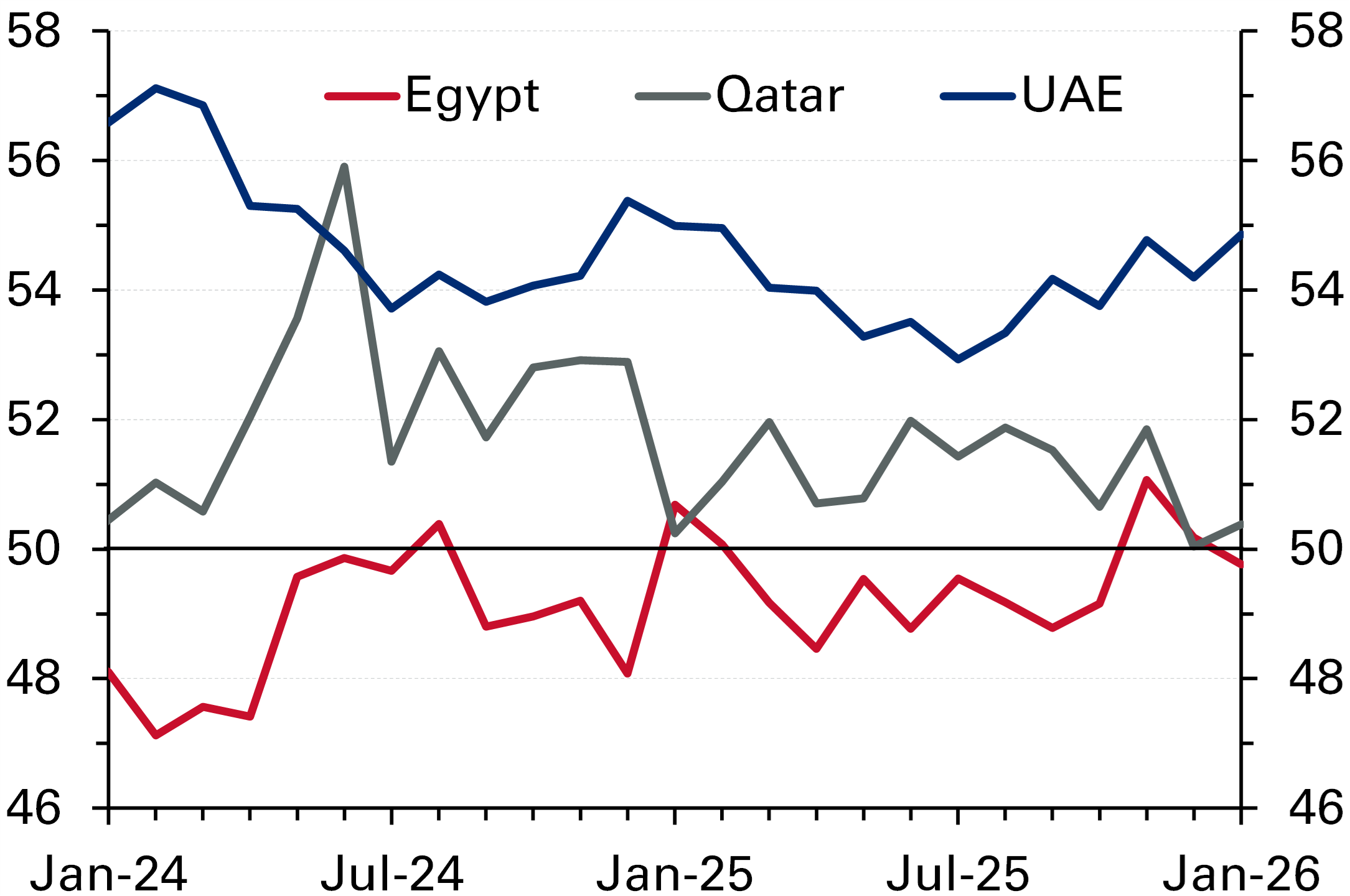
Egypt: PMI slips marginally, but growth momentum remains intact. Egypt’s PMI activity gauge edged back into contractionary territory in January, easing to 49.8 from 50.2 in December, signaling a mild weakening in non-oil private sector operating conditions. Despite this pullback, the reading remains above its long-term average and continues to be consistent with a solid GDP growth pace exceeding 5% y/y in Q1 2026. Notably, business activity and output expanded for the third consecutive month, with many firms reporting their longest stretch of growth since the COVID period. This resilience in production, however, was weighed down by a slowdown in demand, as new orders declined, prompting the sharpest drop in employment in more than two years. Several companies opted to leave vacant positions unfilled until demand conditions show clearer signs of recovery. With fewer new orders coming in, firms focused on clearing existing workloads, leading to the fastest contraction in backlogs in nearly three years. On the pricing front, non-oil firms cut selling prices in January for the first time since July 2020, supported by easing input and labor cost pressures, despite higher prices for metals and fuel. Business sentiment improved modestly after turning neutral in December. Optimism was concentrated in manufacturing and services, while it was subdued in construction, and wholesale and retail, suggesting that the recovery remains uneven across sectors.
UAE: PMI logs an 11-month high in January on strong sales. The non-oil PMI rose to 54.9 in January from 54.2 in December, marking its highest reading in eleven months and signaling a further strengthening in domestic demand and private sector activity. The improvement was mainly driven by a robust rise in new orders, which recorded the fastest growth in nearly two years while export orders saw a more modest increase. Output growth also remained solid though unchanged from December’s readings. However, cost pressures intensified with input prices rising at the fastest pace in eighteen months due to higher raw material prices and elevated operating costs, while selling prices increased only marginally as firms absorbed costs amid strong competition. Employment continued to edge higher, helping to ease capacity pressures, while business confidence improved to a fifteen month high, reflecting expectations of sustained higher demand over the next 12 months. Meanwhile, the Dubai PMI also pointed to robust expansion in January, with sales growth accelerating to a two-year high, though firms similarly faced rising input cost pressures while selling prices rose at a more moderate pace due to limited pricing power and strong competition.
Qatar: Non-oil activity improves slightly, as the slump in new orders and output eases. The non-energy, private sector PMI activity gauge rose to 50.3 in January from 50 in December, indicating a slight improvement in overall business conditions. However, the index remains firmly below its long run average of 52.2. Output recorded its first back-to-back decline since Q1 2025, while new orders fell for the seventh time in the last eight months, although the rate of contraction eased for both from December. Firms still added workers to help expand capacity and provide sales support but at the slowest pace in nine months; staffing costs rose at the fastest rate since September, highlighting wage pressures and pushing firms’ input costs higher. Nevertheless, prices charged by firms fell for the fourth consecutive month in January, reflecting heightened competition, discounting strategies, and efforts to retain customers amid weak demand dynamics. Looking ahead, businesses remained upbeat about the year-ahead, though the degree of optimism moderated, suggesting lingering caution amid still-tentative operating conditions.
US: Partial government shutdown ends after the House passed the funding deal. President Trump signed the spending bill to end the four-day long partial government shutdown after the House of Representatives voted to pass a revised package approved earlier in the Senate. The newly agreed funding deal would fund most government functions through September 30 but the Department of Homeland Security (DHS) only through February 13 under a Continuing Resolution, as Congress works out disputes over DHS funding and Immigration and Customs Enforcement’s (ICE, which falls under DHS) recent brutal crackdowns. Meanwhile, Fed Governor Stephen Miran, who was on leave from his role as Chair of the White House Council of Economic Advisers (CEA) after being appointed at the Fed in September, resigned from the CEA. Miran highlighted that his move was part of a prior commitment he made to the Senate in September that he would resign from his CEA post if he were to stay on the Fed board past January. His term as Fed Governor officially ended on January 31, but he would remain on the Fed Board for now until his replacement, Kevin Warsh, is appointed to the Fed. We note the Senate confirmation for Trump’s Fed Chair nominee, Warsh, will likely be bumpy as a Republican Senator (Thom Tillis) of the Senate Banking committee, whose vote is critical to approve the nomination, has vowed to block it until the criminal investigation case involving Jerome Powell is resolved.