
 +965 2292 4888


Daily Economic Update
08.04.2026
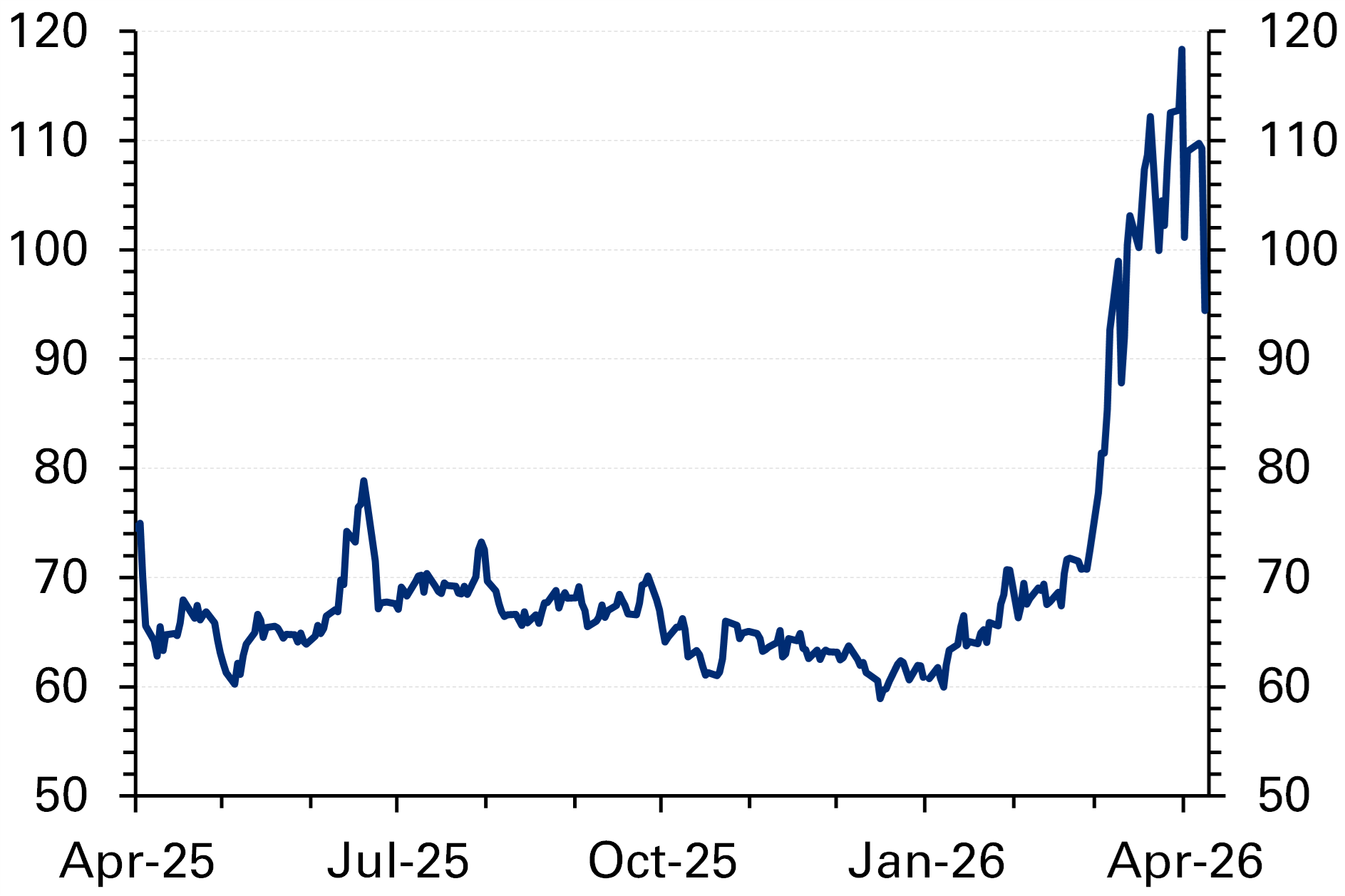
Oil: Prices plunge below $100/bbl as Iran and US agree to two-week ceasefire. Brent shed almost 16% this morning in Asian markets on the news that President Trump had agreed overnight to a temporary truce with Iran based on the 10-point Plan drafted with the assistance of Pakistan. Acceptance of Pakistan’s last ditch mediation effort appears to have forestalled, temporarily at least, the prospect of the US striking Iran’s, mostly civilian, energy infrastructure, for which the Iranian regime promised to retaliate in kind on GCC power, water and energy facilities. The market reaction was seismic after President Trump acknowledged that the plan was a workable basis on which to delay for two weeks the expiry of his ultimatum for Iran to open the Strait of Hormuz. Under the rehashed 10-point plan, concerning the Strait, shipping will be allowed to pass through under the stewardship of Iran, which, with Oman on the other side of the waterway, will be allowed to charge transit fees on vessels. Taken at face value, the agreement represents a significant achievement for the Iranian regime and an obvious strategic defeat for the Israelis and the Americans, with many of Iran’s demands, including the lifting of all sanctions, reparations, guarantees of non-aggression from the US/Israel, right to enrich uranium for peaceful purposes and withdrawal of US combat troops from the region seemingly met. The GCC will also be dismayed at the level of control over the Strait afforded to Iran. The deal should be seen as an opening gambit, however, that President Trump welcomed only in so far that it gave him the opportunity to extricate himself temporarily from his self-imposed deadline. There appears little likelihood that the 10-point plan will remain in its current guise, with Iran likely to have to make more serious concessions once more advanced negotiations take place starting this Friday in Islamabad. Oil prices ended Tuesday largely unchanged, after enduring a choppy trading session that reflected the ebb and flow of the news cycle linked to these ceasefire negotiations, and as the US renewed its attacks on Kharg Island and President Trump ramped up his incendiary rhetoric. At the UN, Russia and China vetoed a draft resolution put forward by Bahrain on behalf of the Gulf states that would have provided international legal cover for regional states in coordination with external actors to use defensive force to reopen the Strait. The two objected that the draft resolution was “one-sided”, earning Iran’s appreciation in the process, while 11 of the 15-member Security Council, including the United States, France and the United Kingdom, voted in favor. There were two abstentions. Brent was last trading around $94.5/bbl.
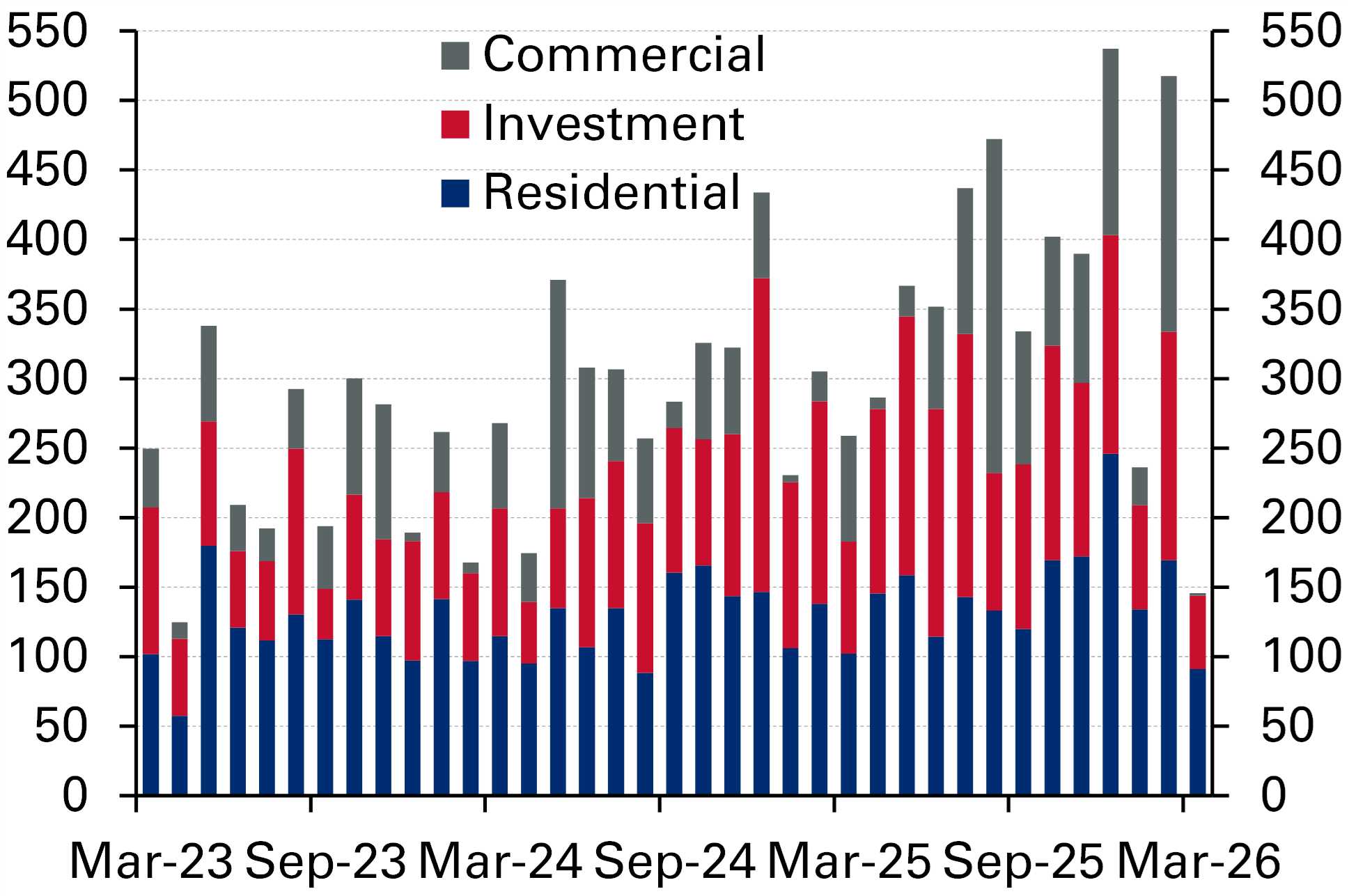
Kuwait: Property sales slump in March amid regional conflict. Real estate sales weakened sharply in March amid heightened geopolitical uncertainty and seasonal factors (including part of the holy month of Ramadan and the subsequent Eid vacation), with monthly sales falling to their lowest levels in three years. According to Ministry of Justice data, total real estate sales dropped to KD146 million in March, down by -44% y/y and -72% m/m, marking the weakest monthly results since April 2023. The pullback was broad based but most acute in the commercial segment, declining to just KD2.0 million (-97% y/y; -99% m/m), the lowest reading since October 2019, and reflecting a near complete pause in large-ticket transactions. In addition, investment sales fell to KD53 million (-35% y/y; -68% m/m), their weakest level since April 2024. On the other hand, residential sales were more resilient with sales of KD91 million (-10.9% y/y; -46% m/m), the lowest since August 2024. Despite the weak March outcome, Q1 2026 figures paint a more nuanced picture with total sales amounting to KD899 million in Q1 2026, up 13.2% y/y but down 32% q/q, indicating that activity earlier in the quarter partially offset March’s sharp slowdown. Residential sales totaled KD394 million (+13.9% y/y; -33% q/q) while investment sales declined to KD292 million (-15.5% y/y; -33% q/q), the lowest quarterly level since Q2 2024. Commercial sales reached KD213 million, more than doubling y/y (+107%) albeit falling 30% q/q and marking their weakest performance since Q2 2025. Overall, the data suggest that the deterioration in investor sentiment linked to the US–Iran conflict has led to a temporary decline in sales rather than a structural shift in fundamentals. Looking ahead, assuming a de-escalation in regional tensions, we expect a rebound in sales supported by pent up demand, particularly in the investment and commercial segments, although near-term market activity will remain closely tied to developments in the geopolitical outlook.
US: Consumer short-term inflation expectations jump on higher energy prices; global financial markets rally after the US-Iran ceasefire. According to the monthly New York Fed survey, consumers’ year-ahead inflation expectations climbed to 3.4% y/y in March from 3% in February, the third joint-highest reading since April 2025, lifted by a surge in gasoline price expectations. Inflation expectations for the three-year-ahead horizon edged up to 3.1% from February’s 3% but remained unchanged at 3% for the five-year-ahead period for the seventh straight month, echoing Fed Chair Powell’s views of longer-term inflation expectations remaining anchored for now. Consumers’ perceptions about the job market worsened as more saw a higher unemployment rate and increasing chances of losing one’s job over the next 12 months. Views about household finances also deteriorated, showing tighter access to credit and a worsening overall financial situation in the year ahead. Separately, durable goods orders fell 1.4% m/m in February after a drop of 0.5% in January (revised downward from the previously reported no change), though core goods orders (non-defense excluding aircraft) rebounded by 0.6% after a decline of 0.4% in January, helped by optimism related to ongoing AI and tech spending. Meanwhile, New York Fed President John Williams (an FOMC voting member) reiterated his previous views, saying “monetary policy today is really well positioned” as he predicted only a slight uptick in underlying inflation (between 0.1-0.2%) despite higher energy costs. Finally, after the announcement of a two-week ceasefire between the US and Iran, global financial markets rallied this morning, Many Asian equity benchmarks are up between 2-5%, while US equity futures were up +2% at the time of writing. Gold and silver prices also surged sharply, and the US dollar retreated along with yields on UST 10Y bonds.
China: Fuel price increases capped as the Middle East war pushes energy costs up. China’s National Development and Reform Commission (NDRC) once again limited the rise in domestic fuel prices to soften the impact of higher global oil costs. The agency, which reviews prices every ten working days, raised retail gasoline and diesel prices by 420 yuan and 400 yuan per metric ton respectively, which are around half of the increases that would have resulted from simply following the scheduled pricing mechanism. The latest increases are also much smaller than those announced at the prior adjustment, on March 23. The decision reflects Beijing’s continued effort to steady domestic energy costs as global crude prices stay elevated given the Middle East war and tensions around the Strait of Hormuz. That said, while the move does support short-term stability somewhat, it also squeezes profit margins for major refiners. Moreover, the controlled price hikes underscore China’s cautious approach—maintaining economic stability now while postponing deeper fuel market reform.
Japan: Employees’ nominal cash earnings accelerate, supporting BoJ’s higher interest rate outlook. Average cash earnings (nominal wages) increased by 3.3% y/y in February (above the consensus forecast of 2.7% growth), accelerating from the rise of 3% in January and the highest growth since July 2025. Rising nominal wages have delivered positive real wage growth for two consecutive months, which should encourage the BoJ to ponder an interest rate hike at this month’s policy meeting.