
 +965 2292 4888


Daily Economic Update
09.04.2026
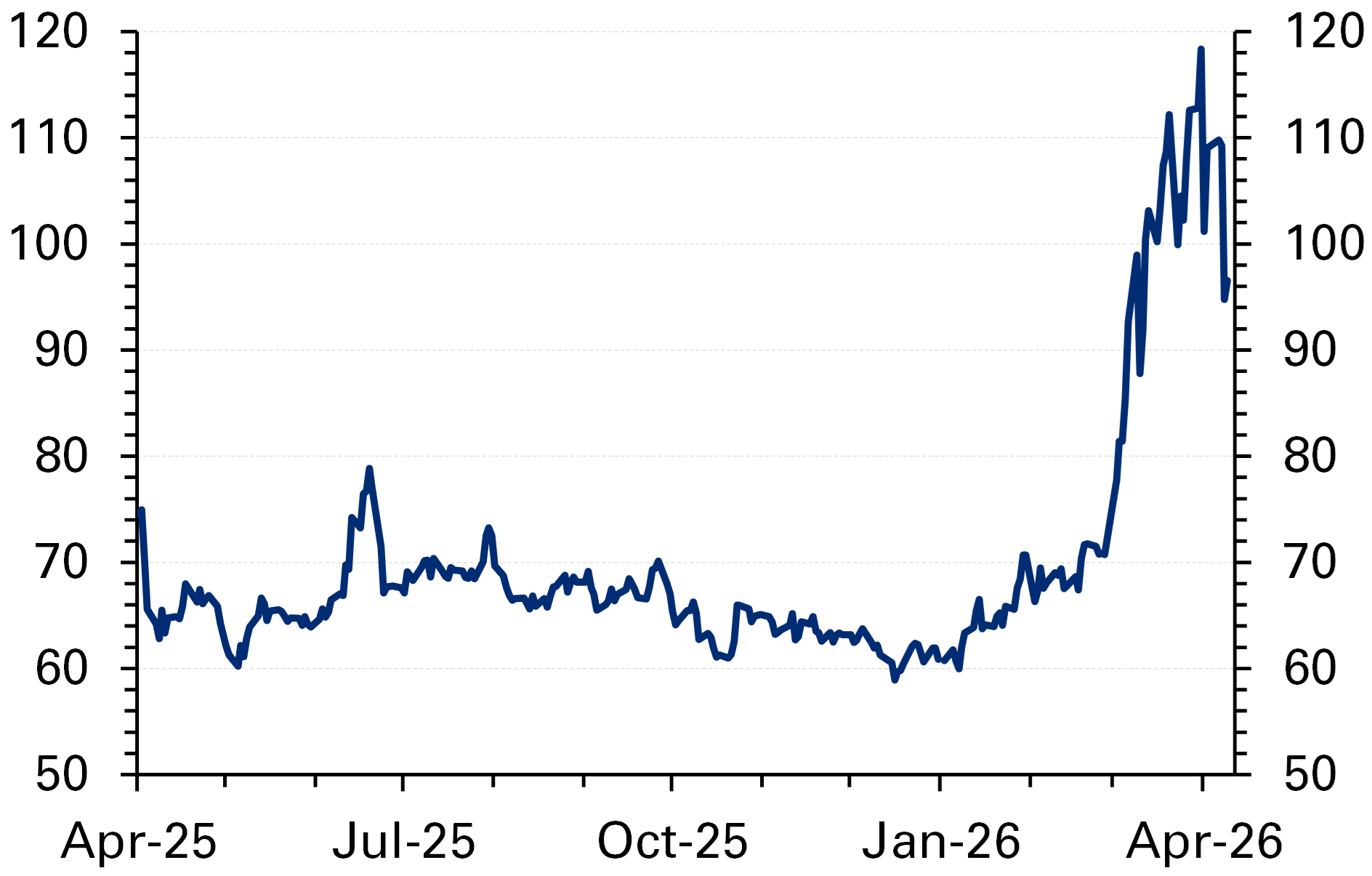
Oil: Prices rise in early trading amid tenuous ceasefire. Brent futures, fresh off the steepest one-day decline in six years on Wednesday (-13%), were rising again this morning in Asian trading to around $96.5/bbl (+1.9% d/d) at the time of writing amid continued Israeli bombardment of Lebanon and still-constricted shipping flows through the Strait of Hormuz. Since yesterday’s two-week truce was agreed by the Americans and the Iranians, Lebanon has emerged as a key diplomatic flashpoint, with Iran insisting that the agreement included a cessation of hostilities in Lebanon as well as in the Gulf and Israel and the US stating otherwise. Iranian parliamentary speaker Ghalibaf, who will reportedly be the Islamic Republic’s lead negotiator at the upcoming peace talks in Islamabad, accused the Israelis especially of violating the truce by continuing to bombard Beirut and southern Lebanon, incurring heavy casualties in the process. The Iranians also disputed the US interpretation that Iran’s right to enrichment was not included in the 10-point plan. Sporadic attacks were reported across the region throughout Wednesday after the ceasefire went into effect. Iran looks to have responded to the situation by maintaining a firm grip on the Strait, although two Chinese oil tankers could be on track to be the first vessels to successfully exit post-ceasefire. Iran has also threatened to pull out of the weekend’s ceasefire talks, which has fueled market anxieties this morning. US Vice President JD Vance and lead negotiators Kushner and Witkoff are expected to attend. Meanwhile, Bloomberg, in its latest survey of OPEC crude production, said that monthly output by the exporters’ group had fallen in March by the most in at least four decades due to the conflict, dropping by 25%, or 7.56 mb/d, to 22 mb/d. Echoing the Reuters’ survey reported last week, Iraq, was the worst affected, suffering a decline of 2.76 mb/d to 1.63 mb/d. Saudi Arabia fared better, but still saw output fall by 2.07 mb/d to 8.36 mb/d, while the UAE’s production dropped by 1.44 mb/d to 2.16 mb/d, the survey reported.
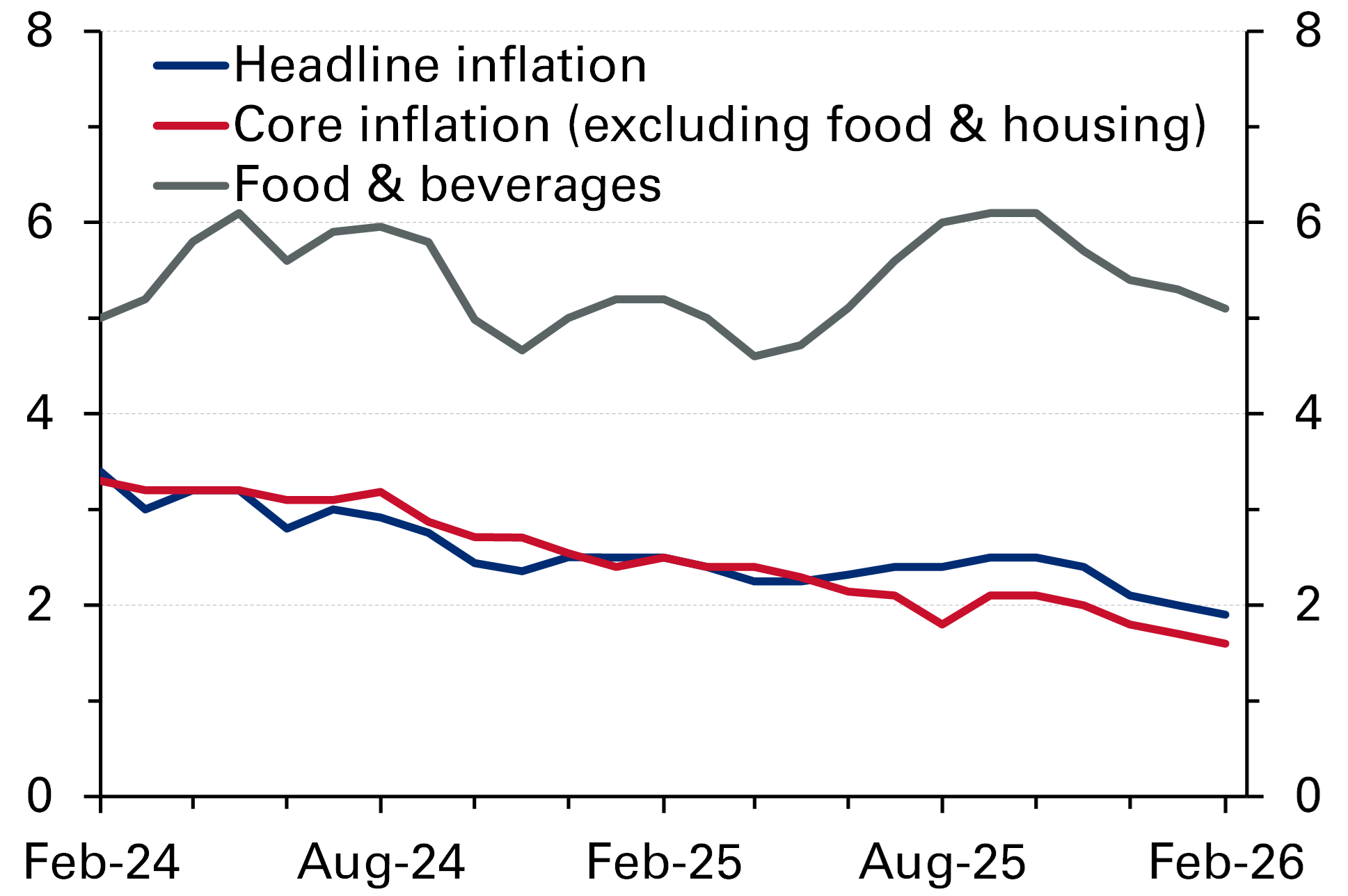
Kuwait: Inflation falls below 2% in February before the regional turbulence. Consumer prices rose 1.9% y/y in February (January 2.0%), extending the softening trend observed over the past four months and marking the lowest reading since July 2020. Prices of food & beverages rose at their slowest pace in eight months, albeit still elevated at 5.1% y/y. Meanwhile, housing services inflation, which primarily reflects rents, remained steady at 0.5% y/y. Excluding food and housing, core inflation slowed to 1.6% y/y (Jan 1.7%), in line with the broader disinflationary trend in the headline rate. This represents the weakest reading since June 2019, driven by sustained moderation in the furnishings & household maintenance and clothing & footwear categories. In the former, annual inflation eased to 1.3% y/y, the slowest pace in a decade, while price growth in the latter fell below 1% for the first time in six years. The transportation component returned to deflation, reflecting a sharp decline in motorcycle prices, while healthcare inflation also moderated. Across other categories, communication was the only segment to record an acceleration in price growth, while inflation remained broadly stable in recreation & culture, education, restaurants & hotels, and other goods and services. The geopolitical conflict in March is likely to weigh on consumer spending, with purchasing preferences shifting towards essentials and away from big-ticket items and recreational activities. Meanwhile, with maritime trade disrupted, Kuwait’s import dependence – especially for food items – remains a significant point of vulnerability. However, prices here are unlikely to spike in March’s inflation readings given government efforts to keep a price cap on basic goods and services including the Ministry of Commerce’s decision to ban the export of food items and a freeze on food prices.
Egypt: CBE moves to renew Kuwaiti deposit, reinforcing external buffers amid volatility. The Central Bank of Egypt is set to renew a $2 billion Kuwaiti deposit maturing this month, with expectations that it will remain under the same terms until a potential agreement is reached to convert part of these funds into equity stakes in state-owned enterprises. With this renewal, total Kuwaiti deposits at the CBE will remain at $4 billion, following the rollover of a previous tranche in September. More broadly, GCC deposits at the CBE stand at around $18.3 billion, providing a key layer of external financial support. Saudi Arabia holds the largest share, with $10.3 billion, including $5.3 billion maturing in October. The decision to maintain these deposits comes at a critical time, as Egypt navigates heightened regional turbulence and a rising energy import bill. Avoiding sudden withdrawals from GCC partners helps preserve external stability and strengthens confidence in Egypt’s FX position. Overall, the continuation of these deposits, alongside concessional and bilateral financing, represents an important financial safety net, supporting the country’s ability to manage short-term external pressures.
UAE: Dubai’s property sales fall in March amid seasonal and geopolitical headwinds. Dubai real estate sales moderated in March to AED43.5 billion (-29% m/m -8.1% y/y), the lowest since December 2024, as heightened geopolitical uncertainties and seasonal factors weighed on activity, according to DXB interact. The correction followed a strong February, when sales surged to AED60.8 billion (+18.5% y/y), underscoring the market’s underlying volatility amid the US-Iranian conflict. Apartment sales, which constitute more than half of total sales, declined by 8.5% y/y to AED22.3 billion, out of which off-plan apartment sales (79% of total apartment sales) rose by 7.5% y/y, signaling continued end user and investor appetite. On the other hand, villa sales declined by -19.7% y/y while plot activity saw the sharpest adjustment -45.8% y/y, reflecting a cautious stance among sellers and buyers during the month. Top performing areas during March were Dubai South, Al Barsha South Fourth, and Wadi Al Safa 3 and 5 underpinned by relatively affordable pricing, infrastructure momentum, and proximity to key employment hubs. The deceleration in March coincided with the outbreak of the US Iran conflict in late February, which dampened sentiment, alongside the seasonal impact of Ramadan.
Oman: Continued effort to develop capital market. The Muscat Stock Exchange (MSX) is advancing a strategy to transform itself into a deeper, more accessible, and internationally appealing capital market in support of Oman Vision 2040, according to CEO Haitham Al Salmi. The exchange is focusing on strengthening liquidity, widening its investor base, improving governance and disclosure standards, and upgrading regulatory and operational infrastructure, while introducing new segments such as the Alternative Investment Market (AIM) to support SMEs and emerging companies. Recent measures include the introduction of market makers to improve trading continuity and price discovery, alongside increased global investor outreach through roadshows and financial forums. MSX sees capital markets as central to Oman’s economic diversification, particularly through privatization and increased private sector participation, with growing global interest in emerging markets representing an opportunity to attract long term capital.
US: FOMC meeting minutes show growing divide among officials, risks seen to both inflation and employment mandates from the Middle East war. Minutes from the FOMC’s March meeting highlighted a further divergence in members’ opinions given the fallout from the Middle East war and higher energy prices with “some participants” (somewhat higher versus the January meeting) emphasizing to mention the possibility of interest rate hikes in case of persistent and above target inflation in the post-meeting statement. Moreover, "many participants pointed to the risk of inflation remaining elevated for longer than expected amid a persistent increase in oil prices," seeing "higher input costs would be more likely to pass through to core inflation." Still, downside risks to employment remained a concern as “most participants” highlighted the risk that “a protracted conflict in the Middle East could lead to a further softening in labor market conditions, which could warrant additional rate cuts.” As a reminder, after keeping the policy rate unchanged in March amid uncertain implications for the US economy from the developments in the Middle East, FOMC’s median dot-plot projections showed a 25-bps interest rate cut by the end of 2026. The futures market currently signals over a 75% probability of no change in the Fed fund rates this year, having fluctuated between one rate cut to one rate hike since the war began. Separately, the announcement of a ceasefire between the US and Iran brought a massive relief rally in US equity markets yesterday as the S&P 500 rose 2.5%, while yields on UST 10Y dropped by around 5 bps to close at near 4.3%.
UK: Halifax house price index drops in March, and the outlook remains generally muted. The Halifax House Price Index fell by 0.5% m/m in March after an increase of 0.3% in February, pushing down the gain on an annual basis to just 0.8% from a downwardly revised 1.2%. These Halifax readings contrast with the previously reported figures from Nationwide, which had shown a 16-month high growth of 0.9% m/m in March; on a monthly basis, data from these two mortgage agencies may diverge, likely due to differences in coverage and the timing of data collection. Looking at the broader trend, as we have noted earlier, the outlook for the UK residential property market over the coming months continues to be broadly muted given an ongoing weak job market, slowing wage growth, high inflation following increased energy prices, and elevated mortgage rates.
Eurozone: Retail sales momentum was subdued in February, even before the energy price shock. Retail trade volumes remained soft in February, with sales declining 0.2% m/m after a flat reading in January, indicating that household spending was already fragile even before the energy price shock. The monthly drop was driven by a 0.5% m/m contraction in food, drinks, and tobacco, while nonfood products (except automotive fuel) were flat after decreasing in the previous two months. In contrast, automotive fuel sales in specialized stores increased by 0.7% m/m, partially offsetting the broader weakness. On an annual basis, retail trade volumes were up 1.7% in February, a five-month low and down from 2.1% in January. The January and February data suggest that consumer demand had been subdued early in the year, and further weakness is expected in March given the energy price shock.