
 +965 2292 4888


Daily Economic Update
29.06.2026
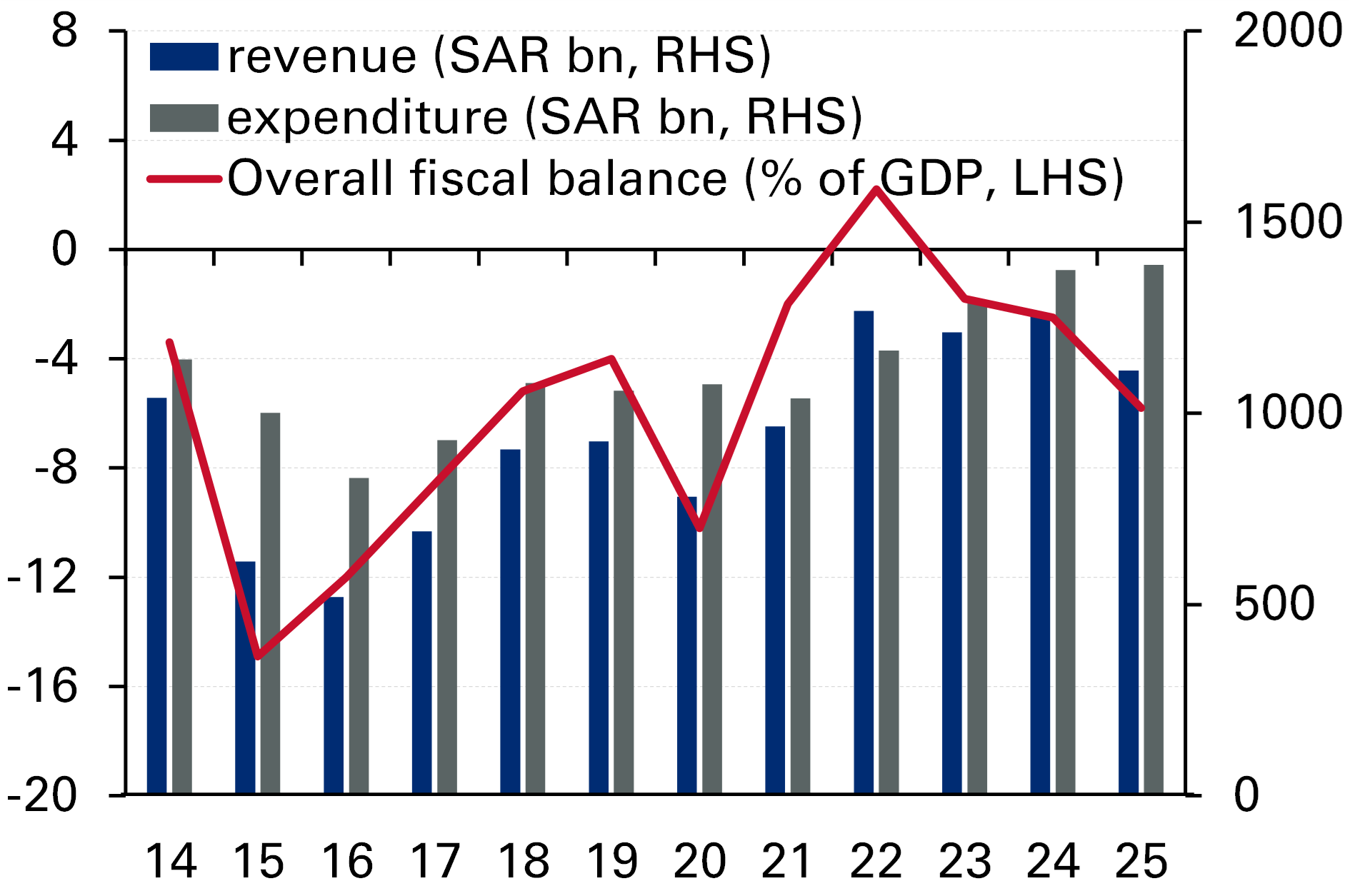
Saudi Arabia: Budget deficit significantly exceeded initial projections in 2025. Saudi Arabia’s budget deficit widened to SAR 277 billion (5.8% of GDP) in 2025, more than double the government’s initial projection of SAR 101 billion (2.3% of GDP), according to the Ministry of Finance’s year-end budget report. The larger deficit reflected a combination of higher-than-planned spending and lower oil revenues. Total expenditure reached SAR 1.39 trillion, around 8% above budget, while revenues came in 6.1% below target at SAR 1.11 trillion. Lower oil prices weighed on government income, but stronger non-oil revenues helped cushion the impact. Non-oil revenue exceeded budget expectations by 5.3%, supported by higher corporate tax collections, stronger VAT receipts, and increased customs revenues as imports expanded. On the spending side, operational expenditure rose 10.8% above budget, driven by higher spending on public services, industrial projects, tourism initiatives, and investments in digital transformation, artificial intelligence, and green energy. In contrast, capital spending came in below budget as several major infrastructure and giga-projects reached key completion milestones and entered their operational phase. To finance the larger deficit, the government raised SAR 402 billion, with around 69% sourced from the domestic market and the remainder from international borrowing. The financing also covered debt repayments and early debt buybacks, allowing the government to preserve its fiscal reserves at SAMA. As a result, Saudi Arabia’s public debt increased to SAR 1.5 trillion, equivalent to 31.8% of GDP compared to the 29.9% originally estimated, while government reserves remained broadly intact, highlighting the Kingdom’s continued financial flexibility despite a more expansionary fiscal stance.
Egypt: First batch of state-owned companies expected to begin trading by year-end. Egypt’s privatization program is entering a new phase, with the first batch of state-owned companies expected to begin trading on the Egyptian Exchange (EGX) during the fourth quarter of this year, according to the head of the State-Owned Companies Unit. Before trading begins, the companies will complete their fair value assessments and appoint Financial Regulatory Authority (FRA) approved advisors to oversee the offering process. The government also plans to temporarily list four additional state-owned companies on the EGX next month, while several petroleum companies are expected to follow once the required procedures are completed. Officials noted that the temporarily listed companies have already attracted strong interest from strategic investors. Listing them on the EGX first is intended to improve transparency and governance by requiring compliance with the exchange’s disclosure and reporting standards before any stake sales take place. The government is also introducing greater flexibility to its privatization strategy. Rather than offering fixed ownership stakes, the size of each offering will be determined by market conditions, company valuations, and investor demand, with the aim of maximizing value while encouraging greater private sector participation.
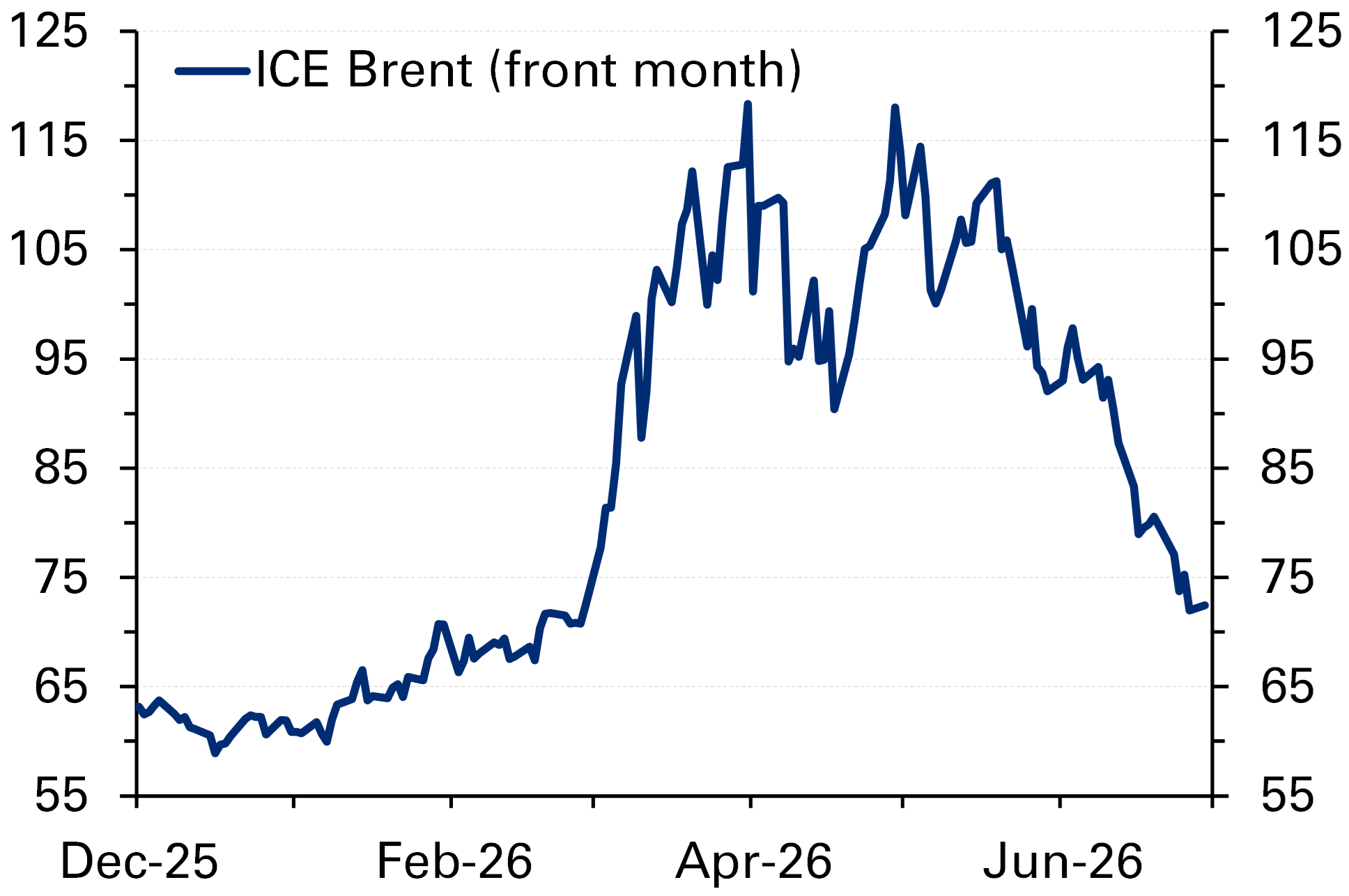
Oil: Market largely shrugs off escalation risk premium after US and Iran exchange strikes. Brent crude futures are marginally higher, trading up around 0.5% at $72.5/bbl, following a weekend marked by tit-for-tat strikes between the US and Iran linked to attacks on vessels transiting the Strait of Hormuz. The developments underscore the fragility of the current ceasefire and the persistence of geopolitical risk in the region. Despite the escalation, however, the market’s reaction has been relatively muted as participants appear to be largely looking through near-term tensions, particularly as both sides have agreed to halt further strikes ahead of another round of negotiations scheduled to take place later this week in Doha. This has helped contain the geopolitical risk premium, suggesting that markets continue to place weight on the diplomatic track rather than immediate conflict dynamics. Price action also reflects the broader bearish backdrop that has been in place over the past week after Brent recorded a near 11% week-on-week decline, falling below $72/bbl to its lowest level since the onset of the conflict. This move was driven by a shift in focus toward improving physical fundamentals, notably the recovery in oil flows through the Strait of Hormuz, alongside continued disappointment around the pace of Chinese demand recovery.
Japan: Retail sales rise again in May; China expands export control list. Retail sales growth improved to 5.3 % y/y in May, comfortably surpassing expectations of a 3.2% rise as government subsidies and strong wage growth continue to support demand. The figure also represents an improvement from the upwardly revised 2.8% increase in the previous month, marking the third consecutive month of improvement in retail sales. Separately, China’s Ministry of Commerce announced that an additional 20 Japanese companies will be placed on its export control list, restricting their access to dual-use items. This expansion builds on the original list issued in February, which was introduced in response to Prime Minister Takaichi’s remarks on Taiwan.
Global: Major central bank heads to appear at the ECB Forum, June US jobs and Eurozone inflation key matters this week. Heads of several global central banks will appear at the Annual ECB Forum in Sintra Portugal this week, with Fed’s Warsh, BoE’s Bailey, and ECB’s Lagarde speaking on Wednesday. In the US, as in his first post-FOMC-meeting conference, Warsh avoided giving any forward guidance on the monetary policy path, and it remains to be seen to what extent he will offer clues on the current US inflation and the economic dynamics at the ECB symposium. The Supreme Court may decide on Trump’s removal of Fed Governor Lisa Cook this week. As a reminder, Trump fired Cook on alleged mortgage-related frauds, but lower courts let her remain a Fed Governor pending rulings by the Supreme Court. In terms of economic data, June’s non-farm payroll report is due on Friday, with the consensus forecast pointing at a solid 114K rise in jobs after a forecast-buster 172K increase in May, with a steady unemployment rate of 4.3%. Job openings in May (JOLTS on Tuesday) are seen easing to 7.3mn from April’s 7.62mn. The ISM manufacturing PMI (Wednesday) is expected to ease to 53.7 in June from May’s 54. In the Eurozone, CPI inflation (Wednesday) is expected to ease to 3.0% y/y in June from 3.2% in May, on the back of lower energy prices following recent declines in oil markets, with the core rate seen remaining flat at 2.6%, its highest level in over a year. In the UK, the Nationwide house price index (Tuesday) is seen staying unchanged in June after dropping 0.6% m/m in May. In China, the forecasts for the official PMI for June (Tuesday) point to a near-stagnant backdrop, with the manufacturing measure at 50.1 versus 50 in May and the non-manufacturing gauge at 49.9, down from 50.1. Finally in Japan, the street estimates for May’s industrial production (Tuesday) signal a 1.1% m/m increase, up from 0.5% in April. Markets are also closely watching the yen, which has remained above the JPY160/$ threshold for over two weeks and recently weakened beyond JPY161.5, raising the likelihood of government intervention.