
 +965 2292 4888


Daily Economic Update
26.04.2026
US: DoJ ends probe into Powell, aiding Warsh’s nomination process; US equity market rally continues. The Department of Justice (DoJ) announced dropping its criminal investigation into Fed Chair Powell related to the cost overruns about a Fed building renovation project. US Attorney for the District of Columbia Jeanine Pirro stated that the case would be investigated by the Fed’s Office of Inspector General, which is already conducting a review of the project. However, Pirro noted that a criminal investigation could be restarted “should the facts warrant doing so.” The approval process of Fed Chair nominee Kevin Warsh by the Senate banking Committee is currently being blocked by Senator Thom Tillis as he had demanded the DoJ to drop this “bogus” investigation into Powell. It is not yet clear if this development is enough for Tillis to remove his block given Pirro’s mentioning that it can be restarted. In all cases, the Senate Banking Committee has now scheduled a vote to advance Warsh’s nomination this Wednesday (April 29). As we had earlier noted, a reversal from the Trump administration on that matter had always seemed likely given Tillis’ unrelenting opposition. Powell’s term as Fed Chair will end on May 15 but he will continue as chair pro tempore until his successor is confirmed. Powell previously stated that he did not intend to step down from his role as a Fed Governor—set to expire in 2028—until the DoJ’s investigation involving him was “well and truly over.” Again, it is not clear if this development would meet Powell’s condition. Powell’s premature exit will give President Trump another nomination for the Fed’s governorship, and hence greater influence on monetary policy. Meanwhile, the S&P Global flash PMIs for April came in stronger than expected. Manufacturing surged to a nearly four-year high to 54 from March’s 52.3, helped by the front-running of activity amid the Middle East war, while services also rebounded into expansion territory, though still-subdued, at 51.3 from 49.8. Finally, supported by fresh optimism about AI and strong corporate earnings, the S&P 500 continued to rally, rising 0.8% on Friday and hitting a new record high, brushing aside worries about current high energy prices and ongoing shipping disruptions given the Middle East war.
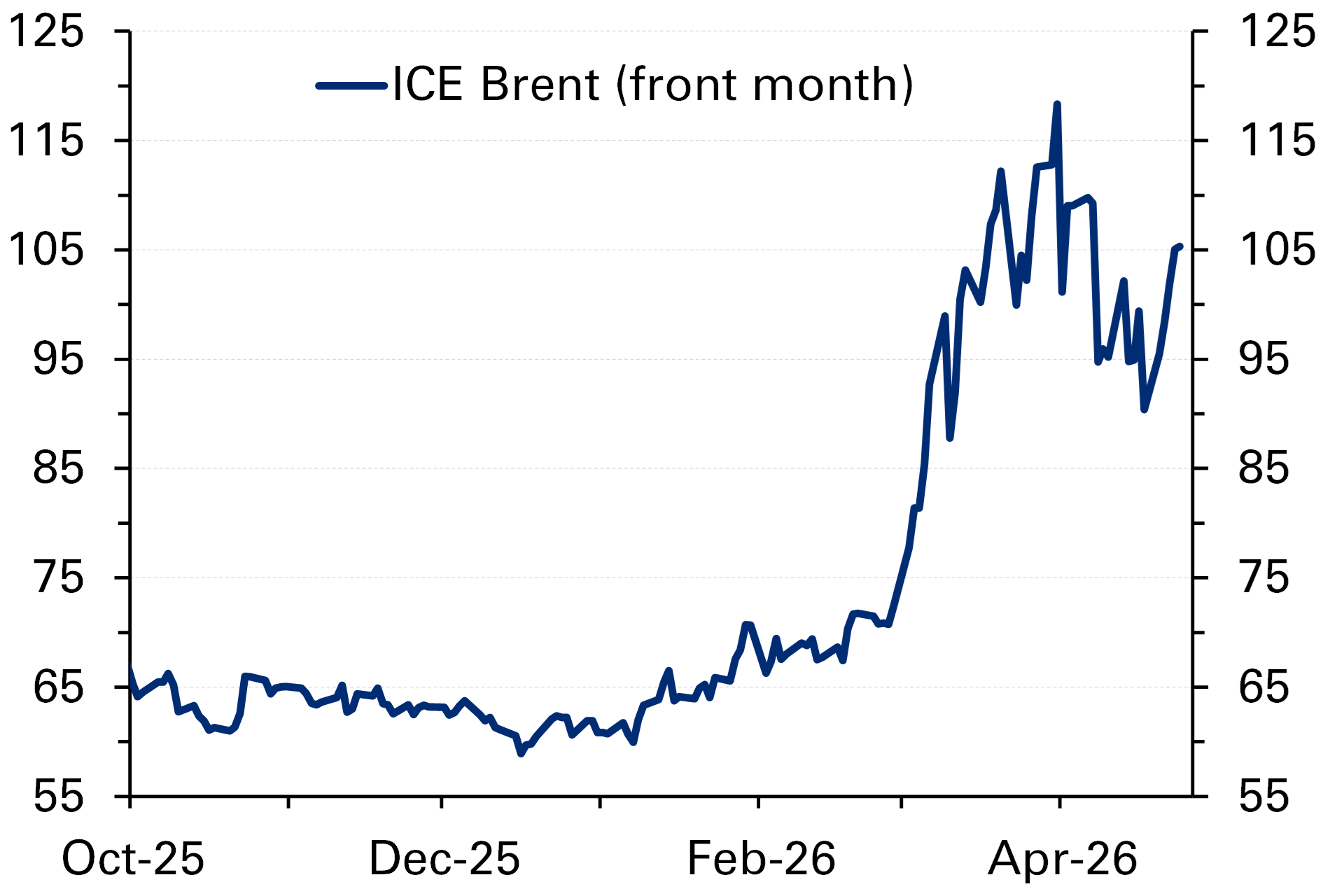
Oil: Prices rebound amid continued US-Iran standoff and as peace talks look uncertain. Brent futures rallied sharply last week, rising 16.5% w/w to settle at $105.3/bbl by Friday’s close, for the first weekly gain in three weeks and more than fully recouping the previous week’s losses linked to Iran’s communique that the Strait of Hormuz had been reopened. The rebound was underpinned by elevated geopolitical risk as prospects for a second round of US–Iran negotiations remain distant and as tensions intensified after IRGC forces attacked and boarded multiple vessels in the Strait, keeping the risk of disruption front and center. Over the weekend, President Trump briefly signaled renewed diplomatic engagement by instructing his envoys Witkoff and Kushner to travel to Islamabad only to announce the subsequent cancellation of their trip, citing the inadequacy of Iran’s proposal and the fact that “nobody knows who is in charge, including them.” Iranian foreign minister Araghchi had been in Islamabad engaged in bilateral talks with the Pakistanis but appeared to have departed for Oman well before the planned arrival of the US delegation. With diplomacy stalled for now, the Strait of Hormuz remains effectively closed, quickly exacerbating oil supply losses which are rapidly approaching a billion barrels of lost crude oil exports.
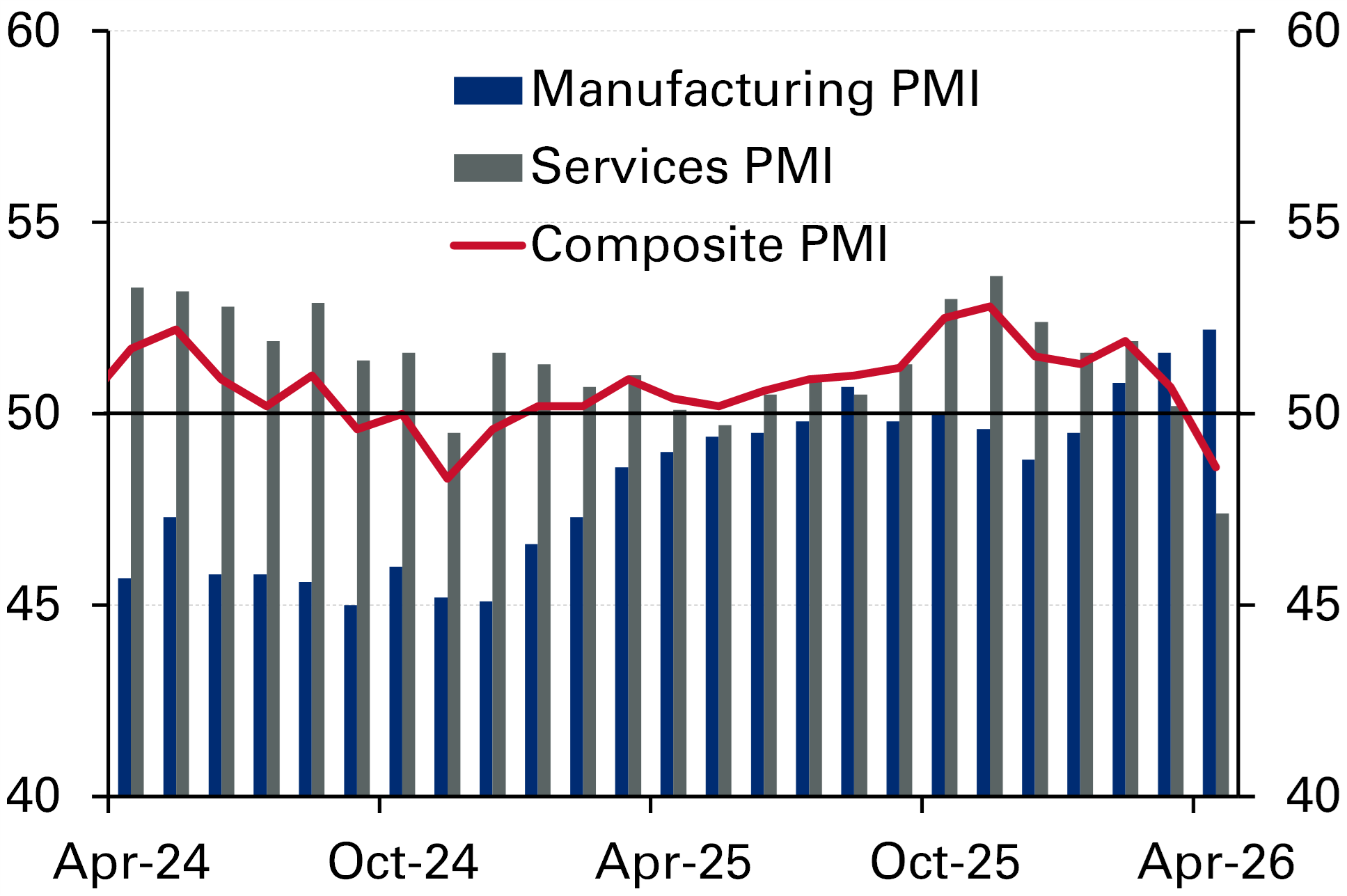
Eurozone: April PMI shows growth slipping amid inflation risks. April’s flash PMI readings suggest the Eurozone economy has moved into contraction, as rising energy costs and renewed supply disruptions linked to the Middle East war weigh on activity. The composite PMI fell sharply to 48.6 in April from 50.7 in March, the first sub-50 reading since late 2024 and undershooting expectations. The deterioration was driven by services, where the PMI dropped to 47.4 in April (50.2 in March), as firms reported falling demand and heightened uncertainty. By contrast, manufacturing proved more resilient, with the PMI rising to 52.2 (51.6 in March), supported in part by inventory building as firms sought to secure inputs amid supply risks. At the same time, inflationary pressures intensified further, with input costs rising at the fastest pace since late 2022 and output prices accelerating to a 37-month high, reflecting higher energy prices and supply bottlenecks. Overall, the April survey points to a stagflation prone backdrop, complicating the ECB’s policy calculus as weakening growth coincides with renewed upside risks to inflation.
UK: Supported by front-loading, the PMI unexpectedly rose in April, but inflation spiked and confidence fell. The S&P Global flash composite PMI rebounded from a six-month low of 50.3 in March to 52 in April, beating expectations. While the manufacturing gauge surged to a nearly four-year high of 53.6 from 51 in March, the services index also increased to 52 from 50.5. However, the survey details were more downbeat as the improvements (especially in manufacturing) mostly reflected the front-loading of buying activity to mitigate the impact of supply chain disruptions and future price hikes, and hence, the acceleration will be difficult to sustain over the coming months. Input cost inflation climbed to the highest level since November 2022, with services costs seeing the biggest jump in the series’ history, and the measure of prices charged also rose to the highest reading since February 2023. Employment shrank for the 19th month in row, but new orders stabilized. Business optimism weakened, hitting the second lowest level since December 2022 on accelerating cost concerns and supply chain pressures. Meanwhile, retail sales volumes in March rebounded by a more-than-expected 0.7% m/m following a drop of 0.6% in February, significantly helped by a 6.1% jump in fuel sales amid concerns about the impact of the Middle East war. Excluding fuel, retail sales volumes rose by 0.2% m/m after a fall of 0.6% in February. Broader signs of faltering economic momentum but rapidly rising inflation would make the Bank of England’s job trickier, and it may adopt a wait-and-watch policy stance for now.
Japan: Inflation edges up in March ahead of the BoJ meeting on Tuesday. Japan's CPI inflation rose to 1.5% y/y in March, up from February’s nearly four-year low of 1.3%, remaining below the BoJ's 2% target for the third consecutive month. Similarly, core inflation (excluding fresh food) rose in March, matching consensus estimates of 1.8% y/y despite government subsidies that drove electricity prices lower. Meanwhile, “super-core” inflation (excluding fresh food and energy) softened for the fifth consecutive month in March, reaching a 15 month low of 2.4% y/y. These data points come after the BoJ released the results of its Q1 economic survey, which showed that more than 83% of respondents expect prices to be higher in one year’s time. The BoJ will take all that into account ahead of its decision on interest rates this Tuesday, with the market currently expecting the central bank to hold rates at 0.75%.
Kuwait: Moody’s affirms sovereign rating at ‘A1’ with stable outlook. Moody’s noted that Kuwait’s sovereign credit strength is anchored by exceptionally large and liquid financial buffers, with sovereign assets estimated at about 475% of GDP, and vast, low cost oil reserves which together shield public finances from regional geopolitical shocks, including recent disruptions to oil exports via the Strait of Hormuz. The agency cites that reduced output is expected to drive a real GDP contraction of around 8% in 2026, before recovery from 2027 as conditions normalize, while a stable, well capitalized banking sector, credible monetary policy, and continued access to markets support resilience. The outlook remains stable, with any upgrade contingent on tangible progress in economic diversification and policy effectiveness. Downside risks arise from prolonged oil revenue weakness, delayed reforms, or severe damage to oil infrastructure, even as major infrastructure projects and regulatory reforms aim to bolster non-oil growth over the medium term.
Saudi Arabia: Non-oil exports strengthen ahead of regional escalation. Saudi Arabia’s non-oil exports recorded strong growth in February, offering a clear snapshot of external sector performance before the onset of recent geopolitical tensions. According to GASTAT, non-oil exports, including re-exports, rose by 15.1% y/y. The expansion was driven by a sharp 29% increase in re-exports, particularly in machinery and electrical equipment, which surged by 60% y/y. Overall, merchandise exports grew by 4.7% y/y, while oil exports saw a more modest increase of 0.6%. As a result, the share of oil exports declined to 68.7%, down from 71.5% a year earlier, reflecting gradual diversification in the export mix. On the import side, merchandise imports rose by 6.6% y/y, while the non-oil exports-to-imports ratio improved to 40.8% from 37.8% in February 2025, indicating a strengthening non-oil trade position. Despite this, the overall trade surplus edged down by 1% y/y. By category, machinery and electrical equipment led non-oil exports, accounting for 26% of the total and growing by 56% y/y, followed by chemical products, which made up 22% and increased by 17.6% y/y. Imports showed a similar pattern, with machinery and electrical equipment representing 31% of total imports, rising by 28% y/y, while transport equipment and parts ranked second at 11.6%, though declining by 10.5% y/y. Overall, the February data highlights solid momentum in the non-oil external sector prior to the conflict, providing a useful baseline to assess the impact of geopolitical developments in the months ahead.
Egypt: Six more state-owned enterprises cleared for EGX listing as privatization strategy evolves. Egypt has approved a new batch of six state-owned companies to initiate the process for listing on the Egyptian Exchange (EGX), as part of its ongoing privatization program aimed at expanding private sector participation. Four companies are set to join the main market, including El Nasr Housing and Development, Sinai Manganese, Spring and Transport Equipment Manufacturing, and the Egyptian Contracting Company (El Abd). Meanwhile, National Asset Management & Investment Company and Al Ahly for Investment and Development (Norco) will be listed on the SME market. This step is part of a broader plan to list around 30 state-owned enterprises on the EGX by the end of the current fiscal year. However, the government has recalibrated its targets, now aiming to raise approximately $4.5 billion over the next three years, compared to earlier plans of generating $6 billion within a single fiscal year. The shift reflects a more pragmatic approach amid ongoing regional tensions and global uncertainty. Rather than focusing solely on maximizing proceeds, the government is prioritizing attracting private sector participation, improving efficiency, and deepening capital markets, even if that comes at a slower pace of divestment.