
 +965 2292 4888


Daily Economic Update
02.02.2026
Kuwait: Amiri decree appoints seven new ministers. A decree was issued yesterday to appoint seven new ministers as part of a limited cabinet reshuffle. The appointments filled several ministerial positions either vacant or shared under a single minister, including those of the finance, information & culture, economic affairs, foreign affairs, and commerce and industry ministers. The government has for some time had to make do with a below-full-strength cabinet, which may have precluded faster reform implementation and development projects rollout. This reshuffle brings the total number of cabinet ministers to 21 and could lead to an expediting of staffing for other executive positions vital for key decision-making, thereby helping to achieve a more promising pace of reform and development project implementation.
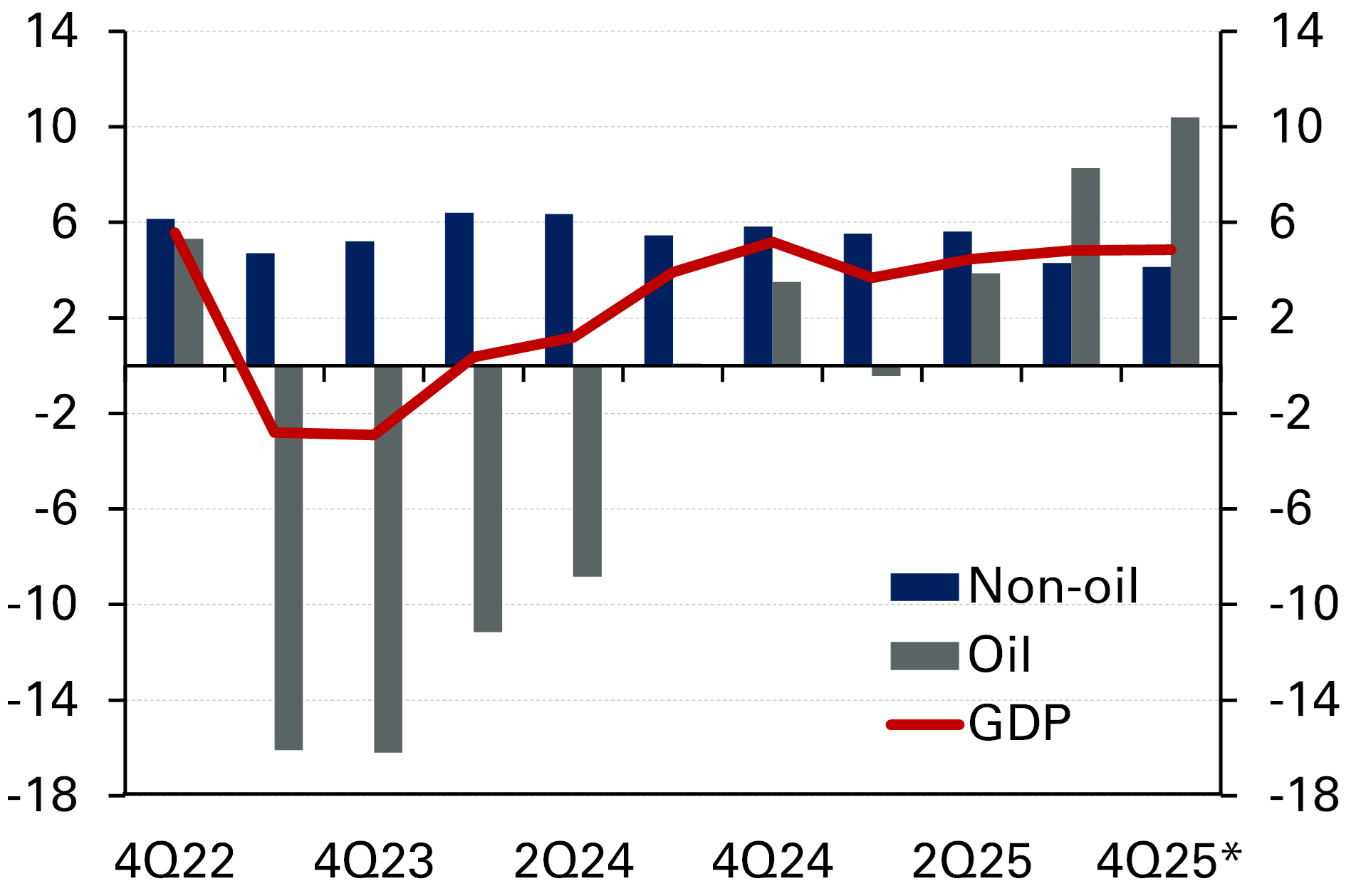
Saudi Arabia: GDP growth at 4.9% in Q4 2025 and 4.5% in 2025, led by oil sector recovery. Official flash estimates show real GDP growth ticking up slightly to 4.9% y/y in Q4 2025 from 4.8% in the previous quarter. Oil sector activity accelerated sharply to 10.4% y/y (8.3% in Q3), the fastest pace in more than three years, supported by the continued unwinding of OPEC-8 voluntary production cuts, while non-oil GDP maintained its solid rate of expansion, coming in at 4.1% y/y from 4.3% in Q3. In contrast, government activities contracted by 1.2% y/y in Q4 (+1.4% in Q3), reflecting some ongoing fiscal consolidation. For the year as a whole, GDP grew by 4.5% y/y, rising sharply from 2.7% in 2024, which reflects relatively broad-based expansion across the economy but anchored firmly by the non-oil sector (4.9% y/y). Oil GDP increased by 5.6% while government activities grew at a more modest 0.9%. Overall, the 2025 preliminary results align with our in-house projections and highlight a growth mix increasingly supported by both recovering oil output and a resilient non-oil sector. Looking ahead to 2026, oil sector growth is expected to remain supportive amid higher production levels, while non-oil growth could moderate slightly in line with a more prudent PIF investment strategy and modest growth in budgeted government spending under the new fiscal framework.
Saudi Arabia: Credit growth eased to 18-month low in December. Bank credit growth eased to an 18-month low of 11.5% y/y in December from 11.9% in November, marking the eighth consecutive month of deceleration since peaking at 16.5% last April. Credit to the private sector eased to a still strong 10.4% (10.8% in November), with personal loans growth slowing to a multi-year low of 5.2% y/y after a period of exceptional growth driven by the rapid expansion of the non-oil economy and higher employment. This implies a strong increase in investment-driven corporate loans (15.6%). Meanwhile, deposit growth rose to 8.7% (from 6.6% in November), lifted by a jump (24% y/y) in government-led time deposits. Despite the improvement in credit/deposit trends, the loan-deposit ratio remained elevated at 112.7%, not far from November’s peak of 113.2%, signaling ongoing liquidity constraints within the domestic banking system. This is reflected in the higher demand for external funding, evident in the increasingly negative net foreign asset position. Central bank reserves however were up 23% y/y to $460 billion (36% of GDP) as of December 2025.
UAE: Dubai GDP growth tops three-year high in Q3 2025. According to figures published by the Government of Dubai Media Office, Dubai’s real GDP growth continued to accelerate in Q3 2025, reaching 5.3% y/y, the fastest since Q1 22 and the fourth consecutive quarter of faster growth. At the sector level, the financial & insurance activities sector recorded the fastest annual growth at 12.9% y/y, followed by the health & social work sector (8.7%), construction (8.5%), real estate (6.0%) and wholesale & retail trade (4.9%) sectors. GDP growth in the first nine months of the year was 4.7% y/y, the best 9M performance since 2021. Remarking on the figures, Dubai’s Crown Prince and Deputy Prime Minister Sheikh Hamdan bin Mohammad bin Rashid Al-Maktoum said that “Dubai’s growth reflects a dynamic economic ecosystem and a development model that puts people first, invests in talent, and builds prosperity on strong, sustainable foundations”. Economic activity in Dubai should remain strong, underpinned by strong financial services, construction, tourism, and technology-driven sectoral performances amid robust population inflows and infrastructure investment especially. Meanwhile, the ministry of finance has successfully completed two AED denominated T-bond and T-Sukuk auctions for January 2026, issuing a combined AED1.1 billion (AED550 million each). The auctions saw strong investor demand with AED5.2 billion in total bids, reflecting a bid-to-cover ratio of 4.7. Yields were set at 3.66% for the 2027 T-Sukuk and 3.9% for the 2031 T-bond tranche. The issuances were listed on Nasdaq Dubai, bringing total outstanding issuances by the federal government to AED28 billion.
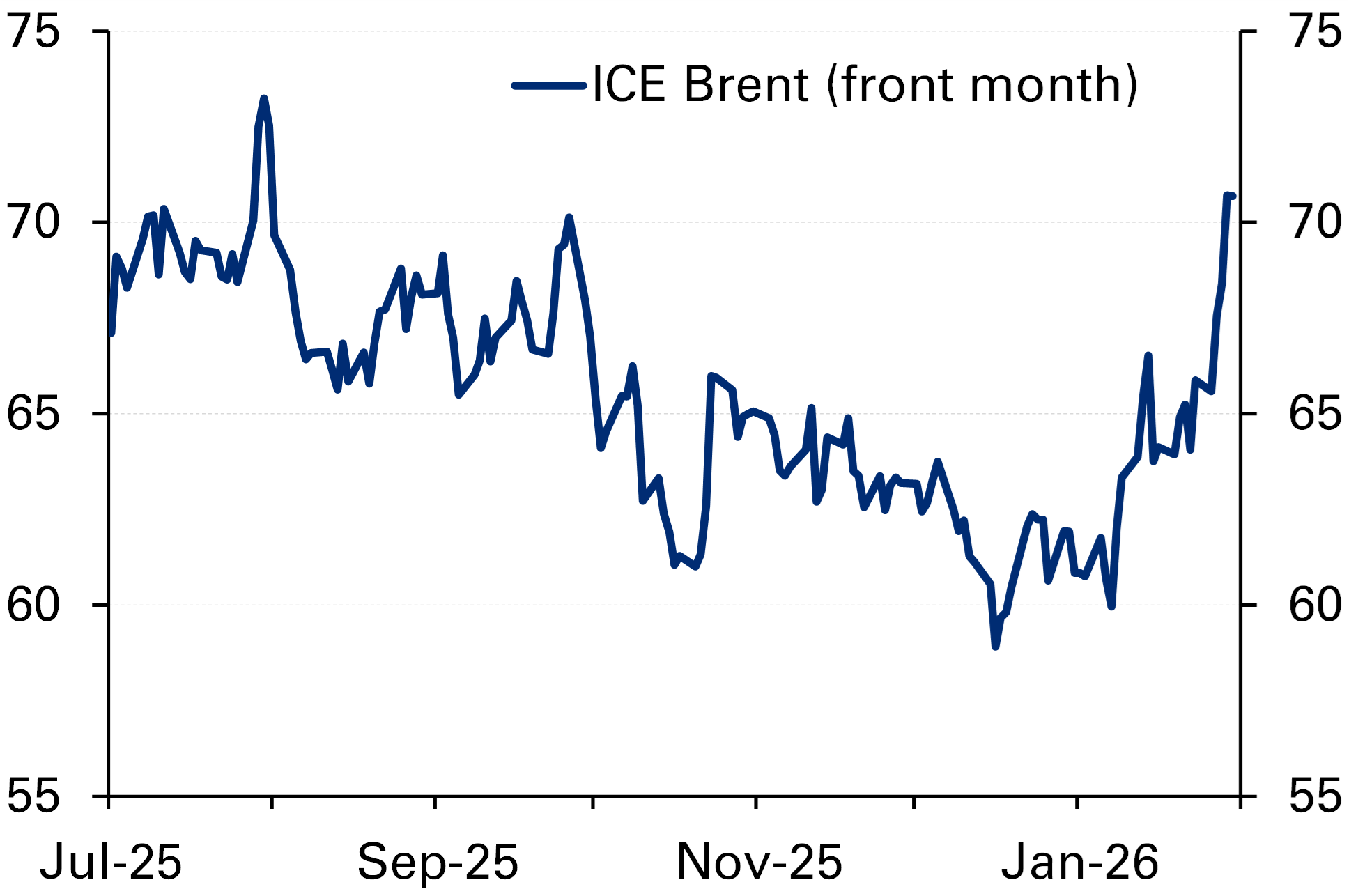
Oil: Geopolitical risk propels Brent in January to its best monthly performance in four years. Brent futures rallied 7.3% w/w last week, closing Friday up at a six-month high of $70.7/bbl and ending January with a gain of 16.2%. This was Brent’s best monthly performance since January 2022, driven primarily by geopolitical upheaval, first in Venezuela with the snatching of President Maduro and second—and more significant—the unrest in Iran and President Trump’s muscular response to the Khamenei regime’s violent crackdown on protestors, sending in an “armada” of naval vessels to the Gulf. Supply side factors also contributed, from the disruption to oil production and exports at Kazakhstan’s giant Tengiz oil field and Black Sea loading terminals, respectively, which tightened the European oil market especially (leading to wider Brent positive spreads over regional oil grades) to the recent winter storm in the US, which temporarily shut in about 2 mb/d of crude production. Oil’s positive performance in January took the markets by surprise, largely coming against the grain of strong bearish sentiment linked to expectations of a significant supply overhang this year. To be sure, oil market fundamentals look loose for 2026, with supply forecast to once again outpace demand, the prospect of which OPEC-8, with its 3-month pause on supply increases, is attempting to mitigate. The oil exporters group agreed yesterday to keep output targets unchanged for March, which would complete the first quarter’s pause on supply gains as scheduled. But the group offered no forward guidance on policy beyond March, after which OPEC-8 is scheduled to resume unwinding the 1.2 mb/d or so of remaining supply cuts from 2023. At $65-70/bbl price levels, we think OPEC-8 will likely proceed with this plan; any supply disruptions arising from the US-Iran stand-off would provide added pretext. In Asian trading this morning, however, Brent had fallen sharply to just over $66/bbl at the time of writing, partly a reflection of the expiry of the March futures contract and partly on the news that the US and the Iranian regime were engaged in negotiations.
Japan: BoJ’s summary of opinions shows inflation risk moderating. The Bank of Japan released the summary of opinions from its January meeting, when it kept rates at 0.75% after raising them in December. The summary states that the BoJ is confident about reining in inflation (2.1% in December) after three years of being above target, with the summary also stating that upside/downside risks are balanced and that the BoJ’s forecast of 1.9% core inflation in FY2026 is expected to be achieved. The summary also highlighted that real interest rates remain at “significantly low levels” and that the BoJ will continue to raise rates if its outlook is realized. Markets are currently projecting 1-2 rate hikes this year, with the earliest coming in around mid-year.
Global: Further market reaction to Warsh’s Fed Chair nomination, US January jobs report, and ECB/BoE meetings key matters this week. In the US, following President Trump’s nomination of Kevin Warsh as Fed Chair, monitoring the market reaction to what lies ahead for the Fed is key. In addition, it is important to monitor the developments on the US partial government shutdown, which is likely to be lifted soon. In terms of data releases, the January jobs report is due on Friday, and the consensus forecast is for net job growth of 70K (up from 50K in December) and a steady unemployment rate of 4.4%. Jop openings for December (JOLTS report on Tuesday) are seen inching down to 7.1 million from 7.15 million in November. The ISM manufacturing PMI (due today) is expected to increase to 48.3 in January from 47.9 in December, but the services measures (Wednesday) is seen easing to 53.8 from 54.4. In the Eurozone, the ECB meets and is widely expected to keep interest rates unchanged on Thursday. Meanwhile, January flash inflation is due on Wednesday, with the CPI seen increasing 1.7% y/y down from 1.9% in December. December retail sales (Thursday) are expected to increase by 0.3% m/m up from 0.2% in November. In the UK, the BoE will announce the results of the MPC meeting on Thursday, where the bank rate is expected to be unchanged at 3.75%. New macroeconomic projections will also be provided. Finally in Japan, the snap parliamentary elections will take place on Sunday, while in terms of data releases, December’s household spending (Friday) is expected to be weak, falling m/m and flat y/y, down from a 2.9% annual increase in November.