
 +965 2292 4888


Daily Economic Update
30.06.2026
Egypt: IMF staff level agreement paves the way for new funding. Egypt has reached a staff-level agreement with the International Monetary Fund (IMF) on the seventh review of its $8 billion Extended Fund Facility (EFF) and the second review of the Resilience and Sustainability Facility (RSF). Once approved by the IMF Executive Board, the agreement is expected to unlock around $1.5 billion under the EFF and an additional $136 million under the RSF, bringing Egypt’s total disbursements under both programs to approximately $7.2 billion. The IMF noted that Egypt has managed the economic impact of the recent regional conflict relatively well, supported by timely policy actions, including fuel and electricity price adjustments, prudent public spending, and a flexible exchange rate that has helped absorb external shocks and portfolio investment outflows. At the same time, the Fund reiterated that further structural reforms remain essential. These include improving the business environment, creating a more level playing field between the public and private sectors, and accelerating the government’s privatization program to support private sector-led growth. The IMF Executive Board is expected to consider the review later this summer. Following its approval, Egypt will move to the eighth and final review under the current EFF program, which is expected to be completed before the end of the year.
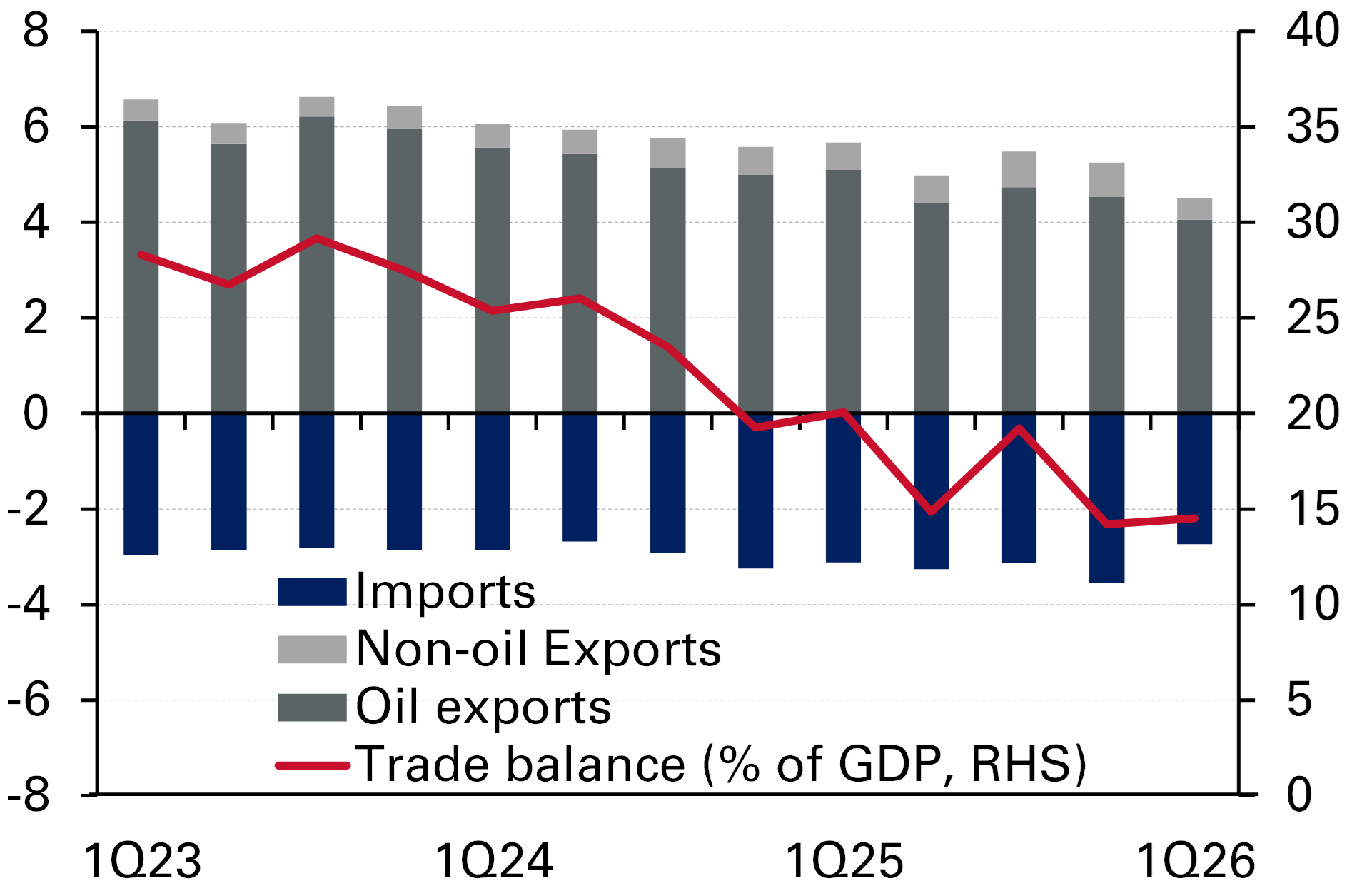
Kuwait: Trade declines in Q1 2026 on regional tensions and closure of the Strait of Hormuz. Total trade in Q1 declined sharply by 17.6% y/y to KD7.2 billion, reflecting broad-based contractions in both imports and exports, amid weaker global demand and supply chain disruptions linked to the US-Iran conflict and the closure of the Strait of Hormuz (SoH) and local airspace to traffic in March. Imports fell by 12.3% y/y, logging their first decline since Q2 2024, driven by significant drops in capital goods (-18.1%), consumer goods (-18.4%) and intermediate goods, which reversed their 16.8% growth in Q4 2025 to post a decline of -1.3%. By commodity, the steepest declines were seen in chemical products (-28.8% y/y), vehicles & transport equipment (-26.1%), machinery & mechanical appliances (-17.7%), and textiles (-12.8%), suggesting softer domestic demand and cautious spending behavior. Exports contracted more sharply, falling by 20.5% y/y, primarily resulting from a comparable decline in oil exports (-20.4%) due to softer oil prices earlier in the quarter and then, after Iran blocked traffic through the SoH, dramatically reduced oil production—down 54% m/m in March (-50.3% y/y), according to OPEC direct communication figures. Non-oil exports (domestic exports & re-exports) also fell by 21.4% y/y, with notable contractions in chemical products (-52.0%), plastics & related articles (-23.8%), base metals (-29.4%), and vehicles (-17.0%). Trade remained concentrated among key partners, with China, the UAE, Saudi Arabia, the US, and India accounting for 55.5% of total trade.
US: The Supreme Court halts Trump’s firing of Fed Governor Lisa Cook for now. The Supreme Court of the United States (SCOTUS), in a 5-4 vote, blocked President Trump’s efforts to fire Federal Reserve Governor Lisa Cook for now, on allegations related to mortgage fraud. Trump had sacked Cook last August, but lower courts allowed her to stay at the Fed Board pending a higher court ruling. The SCOTUS upheld the lower courts’ verdict, with Chief Justice John Roberts, voting in Cook’s favor, writing that “Congress limited the president’s power to remove governors for good reason”. The case about establishing the alleged fraud is still ongoing and Cook will remain a Fed Governor subject to the final verdict on that case. Federal Reserve’s governors can only be removed “for cause” but the court didn’t explicitly define the “cause” in its ruling yesterday. In a separate decision, SCOTUS allowed US presidents to remove top officials at other federal agencies, instituting the executive branch’s authority on firing personnel at other federal offices ‘at will’. Trump, after the court decisions, vowed to take appropriate actions to ensure “that someone who has committed wrongdoing will not be making vital decisions”. For now, the SCOTUS verdict has reaffirmed the Fed’s independence. However, given that this is not the final verdict on whether Cook can be fired or not by the president, the uncertainty remains.
Eurozone: Sentiment stabilizes in June, with improving confidence and easing inflation expectations. Eurozone survey data for June suggests a cautious stabilization in sentiment, with the economic sentiment indicator rising to 95.0 from 93.7 in May. The June reading marks a further recovery from April’s five year low and exceeded expectations of 94.3, though it remains well below the long-term average of 100. This reflects an environment where firms and households continue to assess the economic fallout from the Iran conflict alongside ongoing US–Iran negotiations. Within the same release, consumer confidence (final) improved modestly, rising to -17.7 in June from -19.0 in May, confirming the earlier flash estimate and marking a second consecutive monthly increase, although remaining firmly in negative territory. Meanwhile, on the prices side, consumer inflation expectations declined notably, with the European Commission’s survey measure falling to 34.0 in June from 40.4 in May, indicating a clear easing in perceived price pressures. This suggests that disinflation is gradually feeding through to household perceptions following earlier energy and geopolitics-driven increases. However, the still elevated level of the index points to lingering caution, reflecting ongoing uncertainty and only a partial normalization in the inflation environment.
Japan: Industrial production weak in May; Yen weakens to a multi-decade low as the government hints at intervention. May’s industrial production missed consensus estimates of a 1.1% m/m rise, instead matching the previous month’s increase of only 0.5%. Industrial production decreased by 1.7% on an annual basis, marking the first decline in six months. Meanwhile, the yen weakened beyond JPY162/USD, marking its lowest level since 1986. The move came despite comments from Finance Minister Satsuki Katayama that authorities stand ready to take "decisive action" should excessive currency movements persist. Her remarks echoed earlier statements from the Chief Cabinet Secretary, who reiterated the government's willingness to intervene if necessary while emphasizing longer-term efforts to build an economy less vulnerable to exchange rate fluctuations.
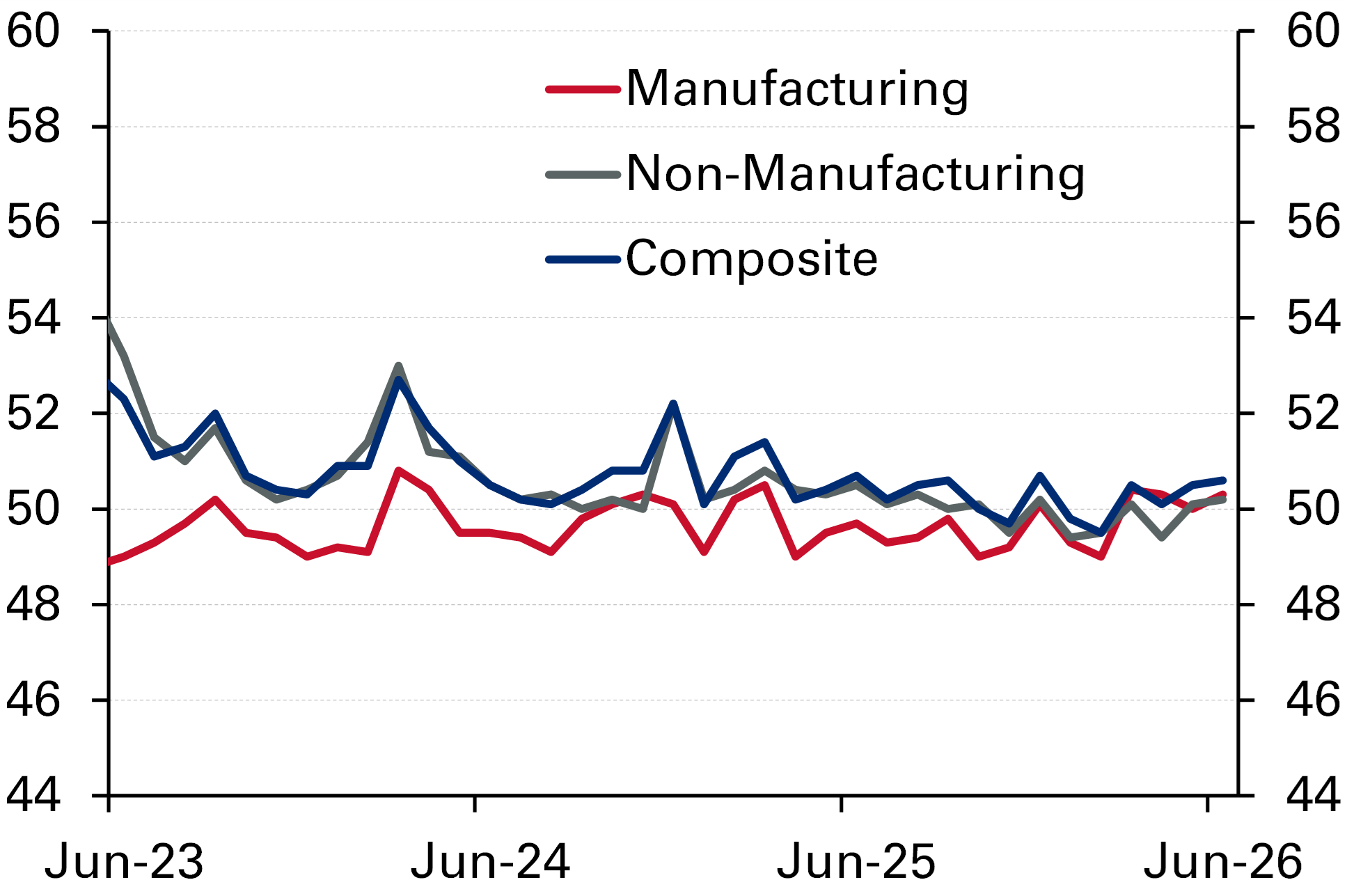
China: The official PMI points to a modest improvement in activity in June. The official PMI data for June signaled a modest improvement in economic activity, with both manufacturing and non-manufacturing activity inching up and remaining in expansionary territory. The manufacturing PMI rose to 50.3 in June from 50.0 in May, coming in above expectations. The resilience in factory activity was supported by strength in high-tech manufacturing and AI-related exports, although weaker shipments across other sectors and soft domestic demand continued to weigh on overall momentum. Meanwhile, the non-manufacturing PMI increased to 50.2 from 50.1, exceeding expectations of 49.9, as stronger services and construction activity helped support the recovery. The composite PMI edged up to 50.6 in June from 50.5 in May, hitting a six-month high. Beneath the headline figures, firmer production and an improvement in new orders helped support manufacturing activity, although employment remained subdued and price indicators continued to reflect soft underlying demand. That said, the June readings point to a somewhat firmer economic backdrop at the end of Q2, though the pace of expansion remains modest and underlying demand conditions remain uneven.