
 +965 2292 4888


Daily Economic Update
13.01.2026
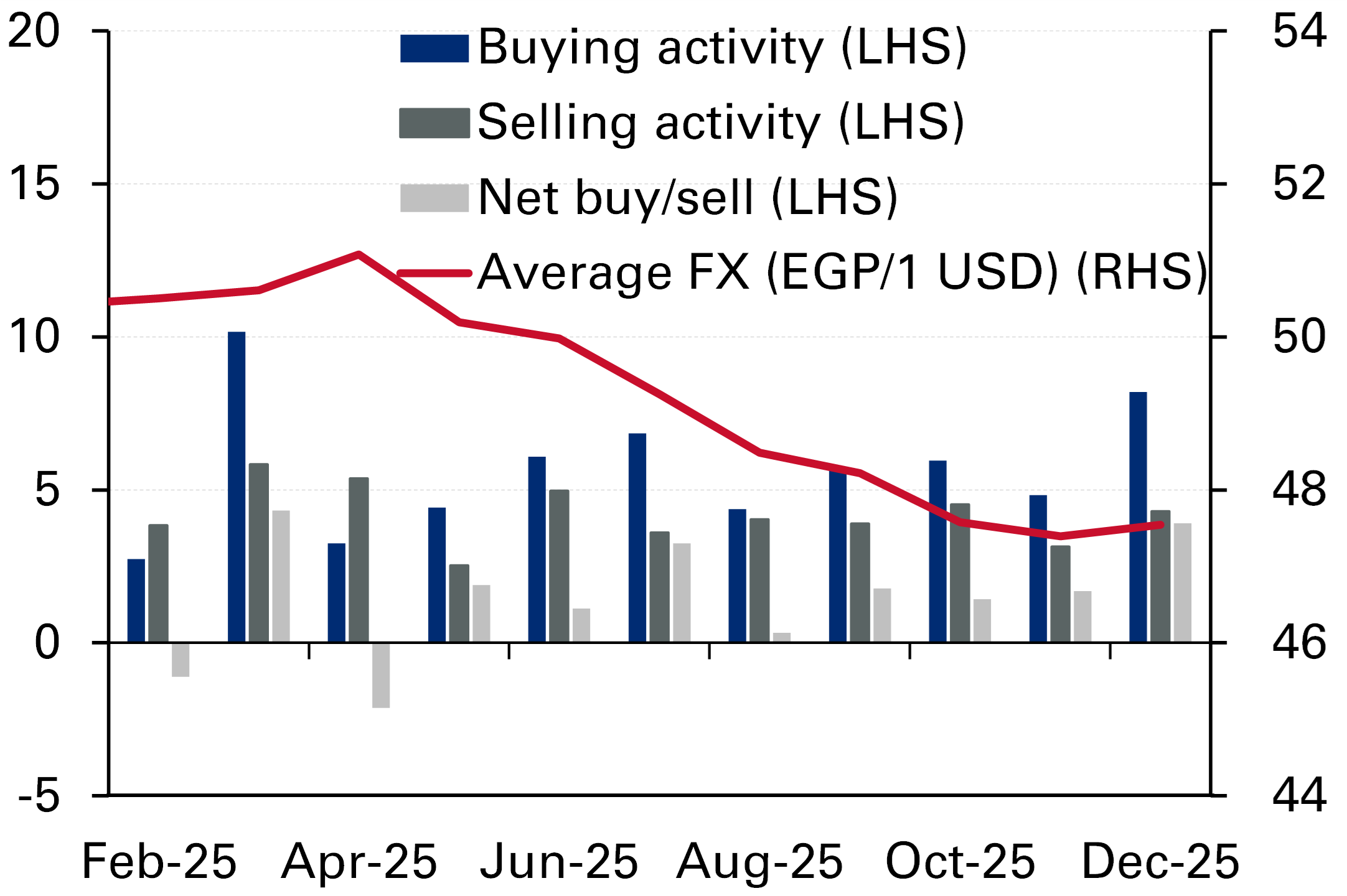
Egypt: Strong capital inflows push the pound to its strongest level since March 2024. The Egyptian pound has started 2026 on a strong footing, supported by sizable foreign inflows into the sovereign debt market. Net inflows into Egyptian government securities in the secondary market surged to a record $3.9 billion in December, before extending into early January with an additional $700 million in foreign purchases. Investor appetite is increasingly shifting toward longer tenor instruments, away from the shorter 3-6 months T-bills. This rotation reflects expectations that the Central Bank of Egypt will proceed with a more decisive easing cycle in 2026, prompting investors to lock in current high yields for longer maturities. The strong demand for local currency debt has translated directly into foreign exchange market gains. The pound has appreciated by around 1% YTD, equivalent to roughly 50 piasters in just ten days, marking its strongest level since the March 2024 devaluation. While the rally highlights renewed confidence in Egypt’s macro trajectory and policy framework, it also underscores the continued sensitivity of the FX market to portfolio flows, reinforcing the importance of maintaining policy credibility as the easing cycle unfolds.
Oil: Venezuela’s output to record modest increases by end-2026. The recent ouster of Nicolas Maduro from Venezuela has shifted the spotlight in the oil market towards Venezuela, where the US foreign policy actions have taken on heightened importance as the situation develops. In the first week of January, US forces captured Maduro and installed a pro-Washington administration in his place, with the US also seizing Venezuela-linked tankers in the Atlantic, effectively freezing most Venezuelan oil flows. At the same time, the Trump administration signaled it would “control Venezuela’s oil sales” indefinitely, while directing proceeds to US accounts in the name of Venezuela. The US also seized 50 million “sanctioned” barrels, which are to be directed to US Gulf Coast refiners, netting a windfall of $2.8 billion. President Trump has also urged US oil majors to invest in Venezuela’s oil infrastructure, hoping to increase production from the current ~950 kb/d. To ease this process, Treasury Secretary Bessent has announced that US sanctions on Venezuela could be lifted as soon as this week. Comment: The recent US actions have opened up speculation regarding the outlook for Venezuela’s crude production prospects and its effect on global oil market balances, since the Latin American country has the world’s largest reserves estimate at 303 billion barrels. However, while the figure is indeed the biggest (17% of the world total), most of it is comprised of extra-heavy crude (Orinoco Belt petroleum), which requires large volumes of light diluents, carries a steep cost to produce (breakeven quoted around $80/bbl), and trades at a heavy discount to US benchmarks due to its density and embedded impurities. Moreover, the decaying infrastructure amid chronic underinvestment and sanctions have driven output to near 1 mb/d, down from 3.7 mb/d Venezuela once produced in the 1970s, implying significant need for new investment, which could total $100 billion over the next decade to bring production back to peak levels. Thus, the response from US oil majors has been mixed to Trump’s call to pour investments into Venezuela’s oil industry. Nevertheless, there is potential for Venezuela’s output to increase to 1.4 mb/d by end-2026, helped by expanded Chevron operations (currently produces 240 kb/d in the country) and unrestricted diluent imports to help oil flows.
US: With GOP election setbacks in 2025 and a possible loss of the House majority in November’s mid-term elections, Trump is scrambling to address the affordability problem. Despite previously calling the affordability issue a “hoax” and a “scam,” President Trump, rattled by some GOP election losses last year and plunging approval ratings, has made addressing the affordability crisis a key priority in recent weeks. Despite recent solid GDP growth (4.3% in Q3, 3.8% in Q2), low-income households have lagged amid weak job market conditions, stagnating net job growth over the last several months, and elevated inflation. Trump’s approval rating has plummeted to around 40% now from above 50% at the time of his inauguration last year, and the GOP faced, late last year, several electoral defeats and setbacks such as mayoral seats in Miami (a first Democrat mayor in three decades) and New York City as well as in governor races in New Jersey and Virginia, among others. As the Trump administration faces the affordability-related headwinds, it has postponed, earlier this month, planned tariffs hikes on Italian pasta and certain furniture along with slashing, in November, import duties on coffee, beef, and some fruits to keep prices of these staple foods and other items in check. Last week, Trump asked Freddie Mac and Fannie Mae (government-sponsored mortgage financiers) to buy mortgage bonds worth $200 billion to help drive mortgage rates lower and sought to ban institutional investors from buying single-family homes. He is also attempting to cap credit card interest charges at 10%. Elevated mortgage rates have been one of the main drivers of weak housing activity, and more importantly housing unaffordability. Moreover, as Trump’s tax cuts also take effect, White House Press Secretary Leavitt recently attributed higher than usual expected individual tax refunds (estimated at around a third higher on average) in 2026 as a measure towards improving household finances, saying, “remember that the next time Democrats try to talk about affordability.” Previously, Trump had relaxed environmental regulations to enhance oil-drilling in the US to drive oil prices lower. In fact, addressing the affordability challenge is one of the main reasons behind the unprecedented and repeated attack on the Fed, in an attempt to lower policy interest rates. However, we note that since the Fed’s first rate cut in the current easing cycle in September 2024, yields on long-dated UST bonds have in fact risen, keeping interest rates on most consumer and business loans in addition to mortgages high. This should be a warning for the US administration that forcing policy interest rates lower will not necessarily help address the affordability problem. All these measures underscore that as we approach the mid-term Congressional elections in November (in which, as we stand now, the GOP will likely lose control of the House) the US administration will probably take further steps to mitigate the impact of price rises and avoid implementing new policies that will drive prices higher.