
 +965 2292 4888


Daily Economic Update
29.04.2026
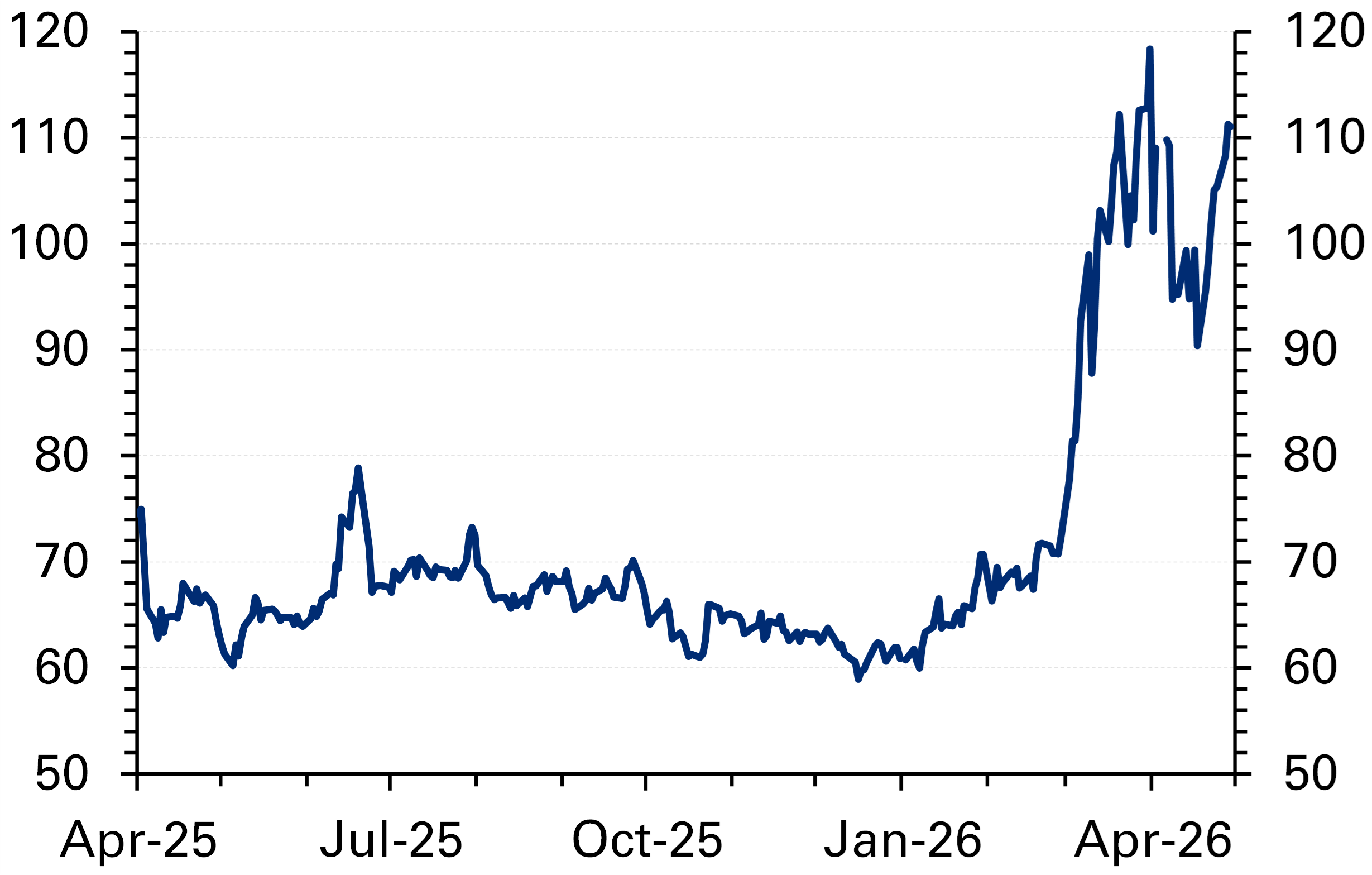
Oil: UAE announces shock OPEC departure; oil prices gain on signs the US is preparing for extended conflict. Brent finished higher for the seventh consecutive trading session on Tuesday, closing up 2.8% d/d to $111.3/bbl after it emerged that President Trump had reportedly told officials to prepare for a lengthier naval blockade of the Strait of Hormuz. Markets took this as a sign that Iran’s latest peace proposal, in which it suggested parking nuclear negotiations until after a deal was struck to resolve the impasse at the Strait, held little weight with the Trump administration. Trump on Tuesday proclaimed that Iran was desperate to reopen the waterway as it was in a “state of collapse”. Oil’s higher move also came despite a shock announcement by the UAE that it intends to leave OPEC at the end of the month, a potentially seismic development for the 12-member oil exporters’ group. The UAE’s exit, the second from the GCC bloc after Qatar’s departure in 2019, heralds a significant shift in the structure of oil producer coordination and global oil market management, with potentially bearish consequences for oil prices in the long term. As well as leaving OPEC with around 3.5 mb/d less of pre-conflict global supply under its management, the UAE’s departure will also see OPEC lose a member with the largest spare capacity in the group after Saudi Arabia, estimated at more than 1 mb/d. The timing of the announcement highlights growing regional divergences as it coincided with an emergency GCC summit in Jeddah, which was attended by the UAE’s foreign minister rather than the UAE’s President, while Oman was also absent. The rationale behind the timing of the exit primarily reflects economic considerations. The UAE is positioning itself to ramp-up production once the Strait reopens, allowing it to recoup revenue losses incurred during the conflict and capitalizing on elevated price levels. Looking ahead, while the immediate market impact is limited by current export constraints, the UAE’s exit introduces a structural shift in future supply dynamics. Once logistical bottlenecks ease, the quick, unconstrained ramp-up of UAE crude output could accelerate the normalization of global inventories, while the market could interpret diminished cohesion within OPEC+ as limiting the group’s ability to effectively manage future oil market cycles.
Qatar: Government rolls out support package for businesses. As the US–Iran conflict continues to weigh on domestic non-hydrocarbon activity, the government has announced a new business support package aimed at bolstering investor confidence amid persistent uncertainty. A central pillar of the initiative is expanded assistance via the Investment Promotion Agency, under which firms can receive support covering up to 40% of eligible local expenses. In parallel, the Qatar Financial Centre (QFC) and the Free Zones Authority will provide rent waivers, payment deferrals, and lease extensions for affected tenants. The QFC has also introduced temporary regulatory flexibility, including extended deadlines for audited financial statements and other compliance requirements. With ceasefire conditions remaining fragile and continuing to weigh on tourism activity, as well as consumer and investor sentiment, additional support measures could be rolled out should pressures on the non-hydrocarbon economy intensify.
Egypt: $1 billion Eurobond issuance signals continued market access despite volatility. Egypt has successfully raised $1 billion from international markets through the reopening of existing US dollar-denominated Eurobonds, under its $40 billion Global Medium-Term Note program, according to a filing with the London Stock Exchange. The issuance took place between March 26 and April 7, highlighting Egypt’s ability to tap global debt markets despite ongoing geopolitical pressures. The largest tranche included an additional $500 million on bonds maturing in 2033, priced at a yield of 9.45%, building on an existing $750 million issuance. Two smaller tranches of $250 million each were also added, one for 2029 maturity at 7.60%, and another for 2030 maturity at 8.63%. Proceeds from the issuance will be directed toward general budget financing, including development spending, refinancing existing obligations, and improving the structure of public debt. Overall, the transaction sends a positive signal on market access and investor appetite, even as borrowing costs remain elevated and external conditions remain challenging.
US: Consumer confidence unexpectedly ticks up in April but remains subdued overall. The Conference Board consumer confidence index ticked up to reach a four-month high of 92.8 in April from an upwardly revised 92.2 in March but remained subdued overall. The improvement was driven by a rise in the Expectations Index while the Present Situation Index inched down. The survey noted that a ceasefire between the US and Iran and a rebound in equity markets likely helped confidence recover somewhat. Consumers’ perception about the job market improved slightly, with less respondents viewing jobs “hard to get” (19.8%, down from 21.3% in March), while the share of consumers saying jobs were “plentiful” was broadly unchanged. However, consumer commentary reflected concerns about higher energy prices and the impact of the Middle East war on household expenditures, underscoring an overall cautious mood. Separately, the rise in house prices (based on the S&P Case-Shiller 20-city index) slowed further on a y/y basis to 0.9% in February from 1.2% in January, the smallest increase since July 2023. On a monthly basis, prices were largely unchanged. Elevated mortgage rates (30Y fixed at around 6.35% currently), gradually slowing wage growth, sustained inflationary pressures, and wider affordability-related concerns have continued to affect homebuyer demand, weighing on housing market activity and prices.