
 +965 2292 4888


Daily Economic Update
06.04.2026
Oil: Price reaction muted in Asian trading after Trump’s threats on Iran’s infrastructure. Brent futures are up 0.7% in early Asian trading, hovering just below $110/bbl, as the market adopts a wait and see stance toward the latest escalation risks tied to President Trump’s threats against Iranian power and transport infrastructure. Yesterday, the US President seemed to extend his deadline by just one day, pushing the ultimatum for Iran to reopen the Strait of Hormuz to Tuesday – by far the shortest reprieve granted and a sharp contrast to the 10-day delay announced on 26 March. The compressed timeline has kept risks elevated, with mediation efforts by Pakistan, Turkey, and Egypt likely intensifying in an attempt to avert a broader regional power crisis. Iran has warned that any US strikes would be met with retaliation targeting power and water infrastructure across the region, including in the GCC, whose economies are highly dependent on energy and desalination capacity. Separately, OPEC 8 agreed on Sunday to raise output targets for May by 206 kb/d for the second consecutive month following a similar hike in April. OPEC also stated that restoring “damaged energy assets to full capacity is both costly and takes a long time”. On paper, OPEC’s latest supply increase would leave the group with 827 kb/d, or about half, of the second tranche of production cuts from 2023 still to unwind, which at this rate could be completed by September. Of course, OPEC’s output announcement is largely symbolic, given that GCC production is significantly shut-in due to the ongoing blockage at the Strait of Hormuz. Moreover, Russia’s production is at near capacity while Ukrainian attacks continue to pose downside risks to its supply and Kazakhstan continues to exceed its quota, limiting the credibility of headline increases translating into physical barrels. The physical market itself is signaling acute tightness, to an extent that is not being captured by the futures market, with Dated Brent (more a gauge of ‘real world’ prices in the near term) on Thursday soaring to its highest level since 2008 at $140/bbl.
Egypt: Targeted electricity tariff hikes amid fiscal strain, as Moody’s reaffirms positive outlook. Egypt has introduced targeted increases in electricity tariffs, focusing on higher consumption household brackets and the commercial sector, as part of efforts to address mounting fiscal pressures in the energy sector. Tariff hikes for the commercial segment range between 20-91%, while increases for the highest residential consumption tiers range from 16-28%. Notably, the first six household brackets remain unchanged, with the Ministry of Electricity and Renewable Energy emphasizing that around 86% of subscribers are shielded from the adjustments, including low-consumption users who account for roughly 40% of total customers. The move comes against the backdrop of a widening energy sector deficit, with the government absorbing an estimated EGP 500 billion annual shortfall from selling electricity below cost. This marks the first tariff adjustment since August 2024, when broad-based increases were implemented across residential, commercial, and industrial users. In parallel, Moody’s has affirmed Egypt’s long-term sovereign rating at Caa1 with a positive outlook, signaling continued confidence in the country’s reform trajectory despite ongoing external pressures. The credit rating agency highlighted that the sustained positive outlook reflects expectations of gradual improvement in fiscal and external metrics, supported by the government’s commitment to economic reforms. It also pointed to Egypt’s ability to generate strong primary surpluses since FY2023/24, alongside efforts by the Central Bank of Egypt to contain inflation and restore external balance. Overall, the combination of targeted fiscal measures, such as energy price adjustments, and ongoing reform momentum appears to be reinforcing investor confidence, even as the economy navigates heightened challenges from the regional geopolitical environment.
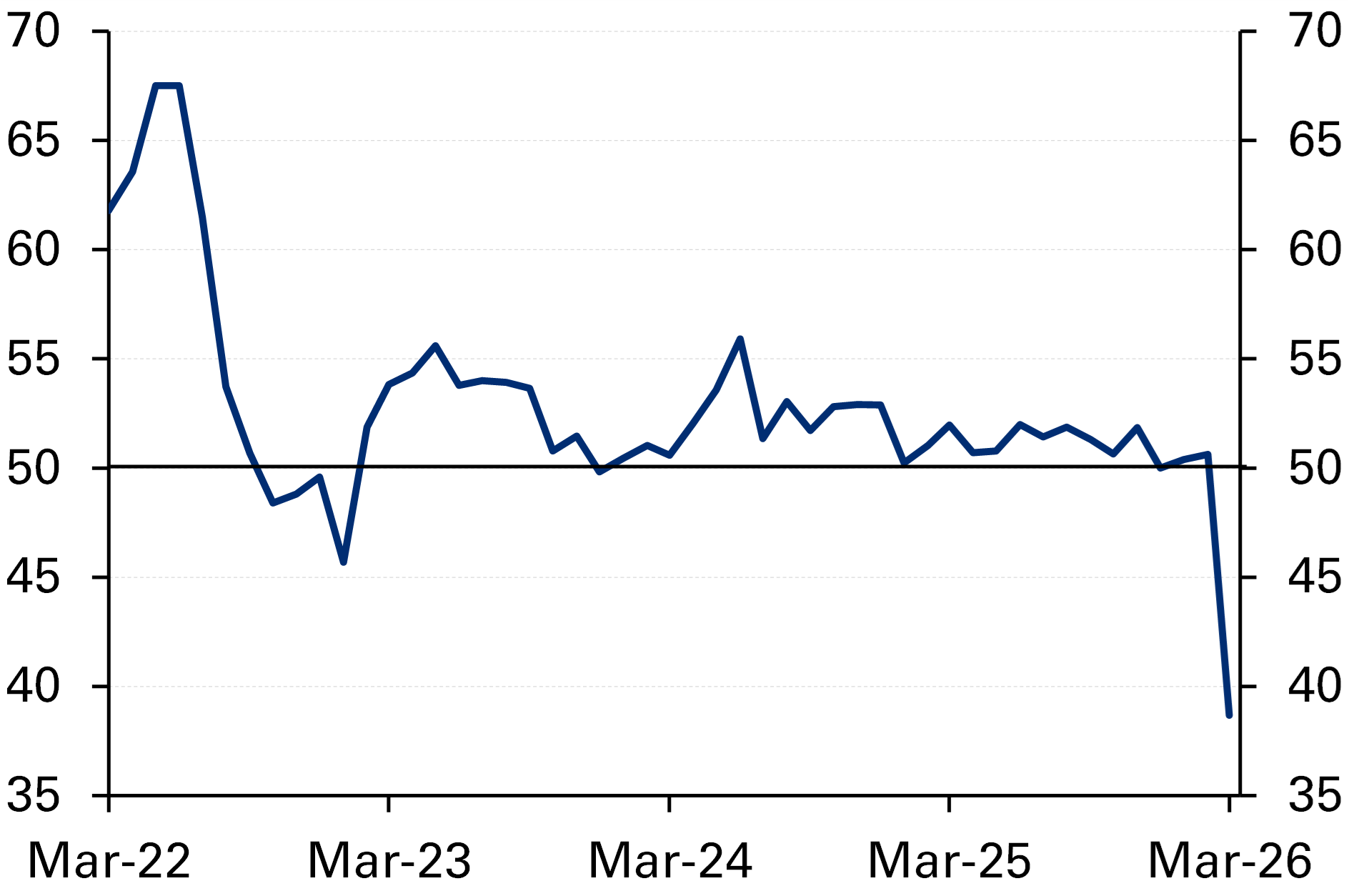
Qatar: PMI at second worst reading on record. The non-energy private sector PMI activity gauge slumped to 38.7 in March from 50.6 in February, marking its lowest level since pandemic-linked 2020, amid a sharp deterioration in business conditions due to the regional conflict. Both output and new orders declined significantly, with the latter falling to a series low, as clients delayed spending decisions and postponed new project implementation amid heightened uncertainty. The conflict has exacerbated already weak demand conditions, with both output and new orders registering a fourth consecutive contraction. Business sentiment points to a further deterioration in conditions should the conflict persist, with firms’ 12-month outlook signaling peak pessimism. Employment – previously the strongest-performing PMI subcomponent – remained in expansion territory, although growth slowed to its weakest since September 2024, broadly in line with moderating wage pressures. Meanwhile, input costs rose to their highest level in 15 months, with purchase prices increasing at their fastest pace since October, reflecting supply chain disruptions linked to reduced trade through the Strait of Hormuz. Nevertheless, weaker demand conditions appear to have prompted firms to offer discounts, with output prices declining compared to February. The sharp deterioration in March brought the Q1 2026 average headline PMI to 46.5, the lowest since Q2 2020, signaling a rapid deceleration in non-hydrocarbon GDP growth. Looking ahead, developments in Q2 2026 will remain highly dependent on the duration of the conflict and the extent of further infrastructure damage in the event of continued conflict.
Saudi Arabia: Banking sector liquidity tightens as credit growth outpaces deposits. Saudi Arabia’s banking sector showed early signs of tightening liquidity conditions in February, even before the impact of the recent regional escalation. Net foreign assets (NFAs) in the banking system edged slightly lower to SAR 1.47 trillion, compared to SAR 1.48 trillion in January, according to the Saudi Central Bank (SAMA). While the central bank’s NFAs remained broadly stable at around SAR 1.7 trillion, commercial banks saw their net foreign liabilities widen, with the NFA deficit increasing to SAR 230.8 billion from SAR 212.9 billion a month earlier. This reflects growing reliance on external funding amid strong domestic lending activity. Total banking sector assets rose to SAR 5.07 trillion, marking an 8.9% y/y increase, while credit growth accelerated to 9.6% y/y, reaching SAR 3.33 trillion. Lending remains heavily concentrated on personal loans, which account for over SAR 1.45 trillion, followed by corporate exposure to real estate, trade, and utilities sectors. On the retail side, residential mortgage activity softened, declining by 13.2% m/m to SAR 5.37 billion, with the number of new contracts falling to 8,350 from around 9,000 in January. Meanwhile, money supply (M3) expanded by 8.4% y/y, supported mainly by demand deposits, which continue to represent the largest share of liquidity in the system. Overall, the data pointed to a familiar dynamic: credit growth outpacing deposit accumulation, keeping liquidity conditions relatively tight and increasing dependence on external funding sources.
Global: All attention on the Middle East war developments; US inflation prints key data points this week. The Middle East war, in its sixth week now, continues to dictate the markets’ moves and drive wider implications for the global economy and inflation. In the US, the first CPI inflation print after the war began will be released on Friday and the consensus forecast indicates a sharp pick up in the headline rate to 3.4% y/y (0.9% m/m) in March from 2.4% in February and a higher core rate of 2.7% y/y from 2.5%. February’s core PCE inflation (Thursday) is seen at 3% y/y following January’s 3.1%. FOMC’s March meeting minutes (Wednesday) will provide insights about members’ views on the Middle East war’s impact on US inflation and the economy. The ISM services PMI for March (later today) is expected at 55, down from 56.1 in February. In the Eurozone, retail sales for February are due on Wednesday and are projected to inch up 0.2% m/m after a 0.1% fall in January. In the UK, the Halifax house price index (Wednesday) is expected to show a slower 0.1% m/m rise in March after 0.3% growth in February. In China, March CPI inflation is due on Friday with the headline rate seen edging down to 1.2% y/y from 1.3% in February, while producer prices are expected to rise 0.4% y/y in March, which would mark the first annual increase since 2022. Finally in Japan, growth in average cash earnings is expected to ease to 2.7% y/y in February from 3% in January, while household spending is seen declining by 0.7% y/y after a drop of 1% in January, both are due on Tuesday.