
 +965 2292 4888


Daily Economic Update
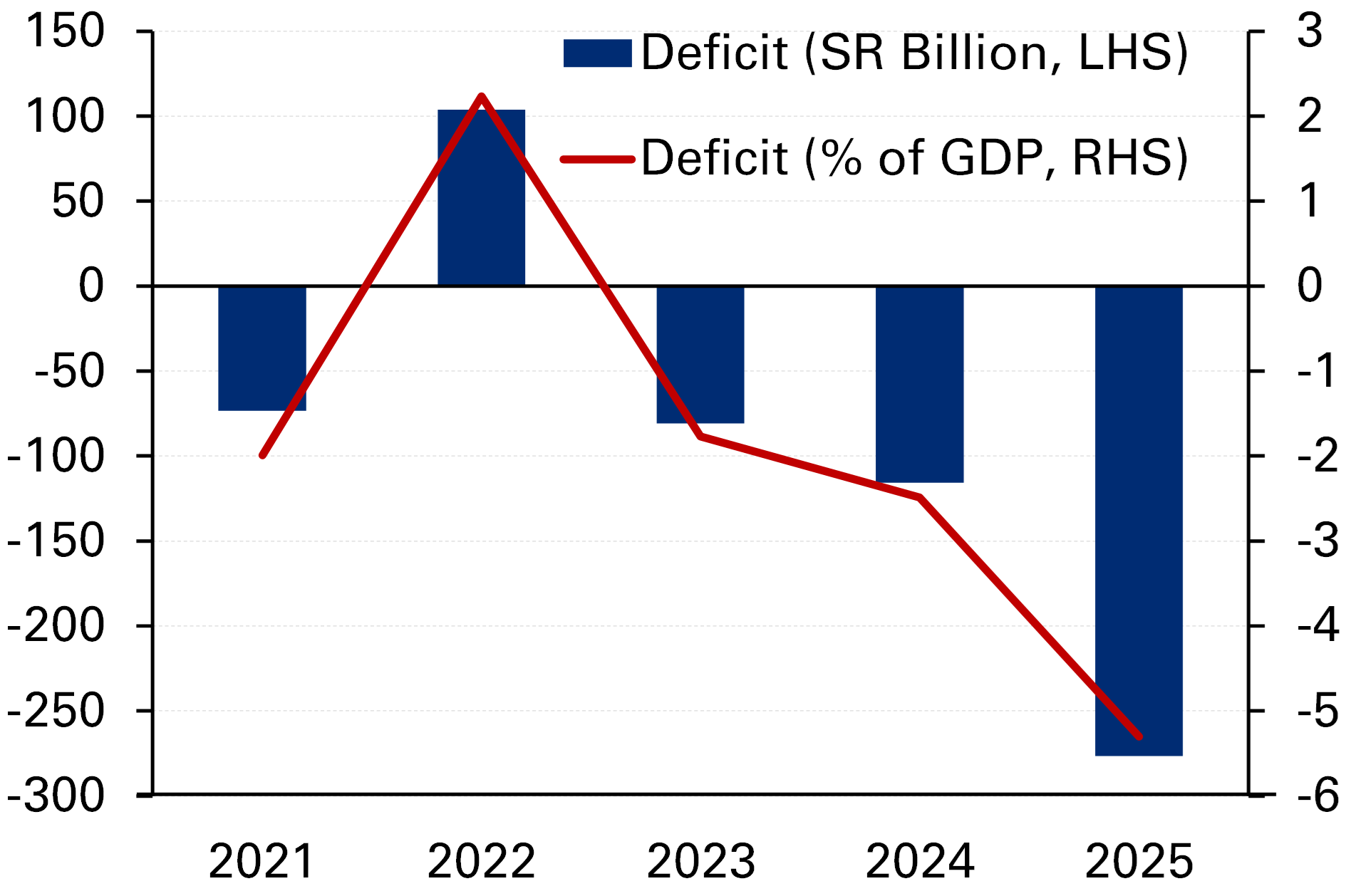
24.02.2026Saudi Arabia: Q4 budget deficit widest in 5 years. According to official data, the budget deficit widened to SR95 billion (1.9% of full year GDP), in Q4 2025, the highest since Q4 2020, from SR 89 billion (1.8% of GDP) the previous quarter. The widening was in large part due to drop in both oil revenues (-10% y/y) and non-oil revenues (-7% y/y), the latter mostly stemming from a decline in taxes on international trade and transactions (customs) linked to lower imports, and other revenues. Higher expenditures also contributed to the deficit, up 3% y/y driven by an increase in several items including capital expenditure (18%) and financing expenses (27% y/y). For 2025 overall, a fiscal deficit of SR 277bn (5.6% of GDP) was recorded, much larger than the SR 101bn (2.7% of GDP) projected in the 2025 budget mostly on lower oil revenues (-20% y/y and 25% below budget) affected by voluntary production cuts and lower oil prices for the majority of the year, outweighing an increase (1% y/y and 33% above budget) in non-oil revenues. Total expenditures rose by 1% y/y (8% above budget, the lowest since 2021), reflecting an ongoing effort to control spending, although mostly from a decline in capex (-12% y/y) partly offsetting a sharp rise in financing expenses (22% y/y). Deficit financing came entirely from debt issuance, pushing public debt to SR1.52tn (31% of GDP) from an opening balance of SR 1.22 trillion at the start of the year. Overall, we see the 2025 budget outcome as confirmation that the authorities are exercising more spending restraint amid lower oil prices and rising debt levels, promoting fiscal sustainability while adopting a more prudent approach to Vision 2030-linked investment spending.
Egypt: Remittances reach a historic record high in 2025. Remittances from Egyptians working abroad surged to an unprecedented level in 2025, rising by 41% to $41.5 billion, up from $29.6 billion in 2024. The momentum remained solid in the first half of FY2025/26 (July-December 2025), during which remittance inflows rose by 30% y/y to $22.1 billion. Monthly data also points to a significant acceleration in December as remittances rose 24% y/y to a record high of $4.0 billion. The strong increase in workers’ remittances along with the broader improvement in FX inflows from investments continued to strengthen the banking system’s net foreign assets (NFA), which jumped $20.3 billion to $25.5 billion by end-2025, its highest since July 2012. This improvement was mainly driven by a steep rise in commercial banks’ NFAs to $12.2 billion from -$6.4 billion a year earlier, a peak not seen since February 2014. Sustained remittance inflows and the continued accumulation of foreign assets at the banking system have strengthened Egypt’s external position, improved confidence, and provide a strong buffer against potential volatility in financial flows in 2026.
US: After the Supreme Court’s blow, Trump’s baseline tariff effective; previous trade deals’ status in limbo as Trump threatens trade partners. After the Supreme Court cancelled IEEPA tariffs, the 10% baseline tariff, as Trump announced on Friday, took effect this morning for a maximum of 150 days. Trump later increased the tariff to 15% but is yet to issue an official order. Creating further confusion over the coming period, the status of several previously-signed trade frameworks appears unclear. The EU, which was moving to ratify the deal in the European Parliament soon, froze the ratification process awaiting further clarity on the matter from the US administration. Similarly, an Indian team, who was to travel to the US this week to finalize additional terms of the recently concluded trade deal, postponed discussions pending more details. The authorities from Japan also asked their US counterparts to not weaken Japan’s position as new duties were being announced, while the two sides agreed to continue working on investment pledges which were part of the signed deal. In addition, other trading partners such as the UK, who previously saw a lower tariff rate of 10% versus the current baseline rate of 15% (whenever the increase from 10% happens), also appeared nervous about the status of the deal and looked for answers from the US. Noting these developments, while heavily criticizing the Supreme Court’s ruling, President Trump said that if any country wanted to “play games” with “the ridiculous supreme court decision,” they would face “a much higher Tariff, and worse, than that which they just recently agreed to." While the tariff drama will continue to unfold in the coming period, given Trump’s strong determination to rebuild the tariff wall, overall tariff rates may settle to be similar to the pre-Supreme Court decision. However, uncertainty is higher in the meantime.
US: Fed Governor Waller bases his March interest rate decision on incoming jobs data and warns against Warsh’s preference for a smaller Fed balance sheet. Fed Governor Christopher Waller, who dissented in favor of an interest rate cut at the January FOMC meeting, said that his March call on interest rates would depend on the incoming job market data, specifically that if February’s data remained consistent with January’s strong figures, indicating “that downside risks to the labor market have diminished, it may be appropriate to hold the FOMC’s policy rate at current levels.” Inversely, he cautioned that any substantial downward revisions to January’s data or a much weaker February report would drive his support for a 25-bps rate cut in March. He emphasized that the recent Supreme Court decision to strike down the IEEPA tariffs wouldn’t change his inflation outlook as he continued to view tariffs’ impact as temporary and underlying inflation without the tariff effect was close to the Fed’s 2% goal. Unlike Fed Chair nominee Warsh’s strong pitch to shrink the Fed’s balance sheet, Waller cautioned that a “scarce” reserve framework is not warranted, saying that looking for emergency funding frequently “is massively inefficient and stupid.” This is a reminder that Warsh would face stiff resistance from the FOMC to carry out his plan to shrink the Fed’s balance sheet, which is a central idea of his thinking. If Warsh insists on his plan to shrink the balance sheet, he may end up being in the minority camp on an FOMC that he is heading.
Europe: The EU puts ratification of the US trade deal on hold following the US Supreme Court’s decision. The EU has frozen approval of its US trade deal while it waits for President Trump to clarify his disrupted tariff agenda. Lawmakers halted the process after the Supreme Court’s decision, adding fresh uncertainty to a pact already languishing since last summer. The setback underscores growing tension in a relationship strained by disputes over tariffs, Ukraine, and Trump’s erratic approach to Europe. Even before the court ruling, the deal’s path to ratification had been bumpy. The EU had accepted a perceived unfair trade deal to avoid a trade war and protect US security ties, with Washington’s later scope-expansion of the 50% metals tariff adding to the frustration while the Greenland issue further added strain. Moving forward, EU officials want a clearer view of Trump’s tariff strategy before proceeding.
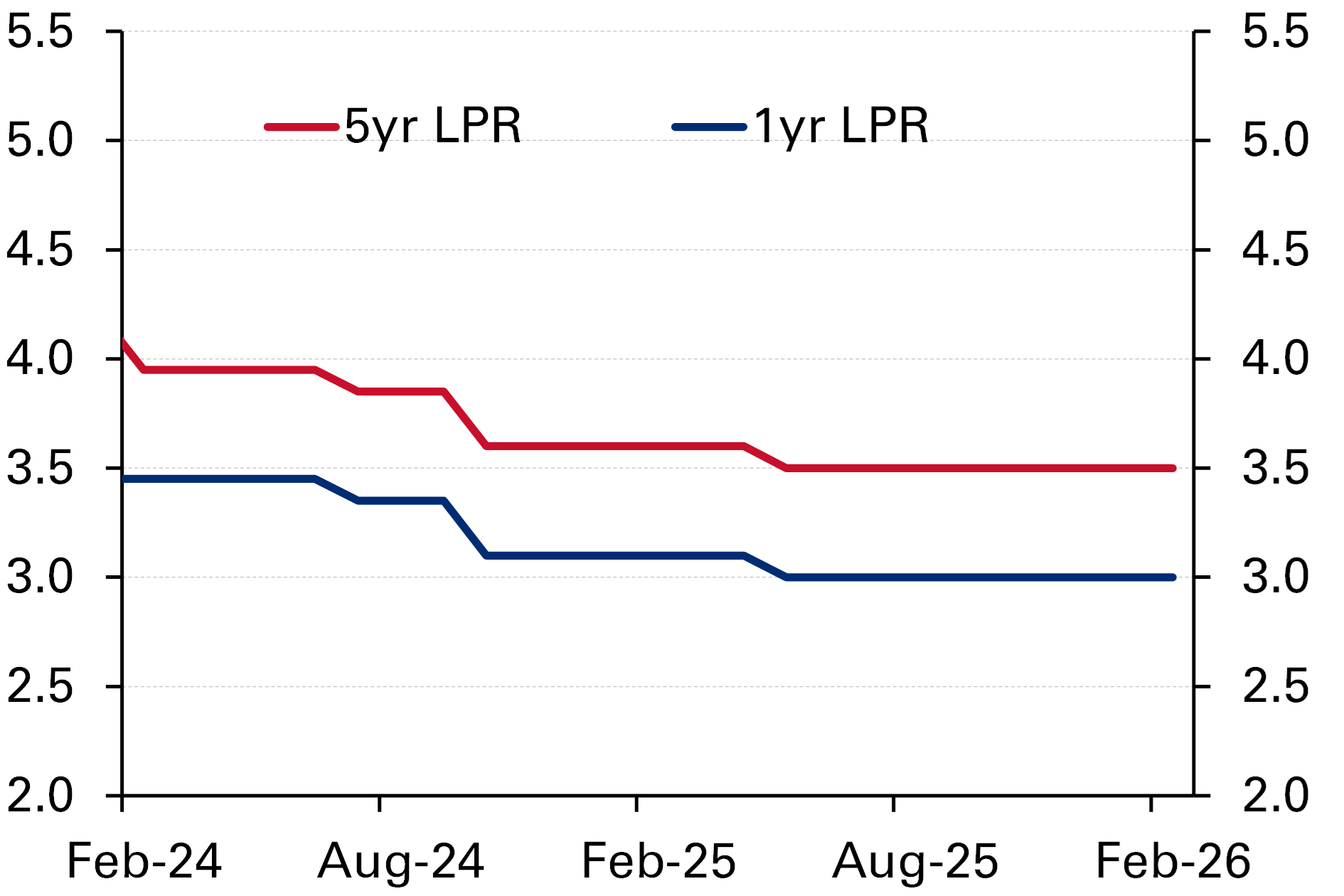
China: PBoC keeps key rates unchanged. The People’s Bank of China (PBoC) kept its loan prime rates unchanged in February, maintaining the one year LPR at 3.0% and the five year rate—its key mortgage benchmark—at 3.5%. The move extends a policy stance that has remained steady since May 2025, reflecting authorities’ balancing act of supporting the economy while preserving currency stability. That said, the yuan has strengthened by around 1% YTD. While the PBoC may be open to a gradual appreciation amid dollar softness, a much stronger yuan will put pressure on export growth amid a still-vulnerable global trade environment.