 +965 2224 8361


Economic Insight
30.04.2026
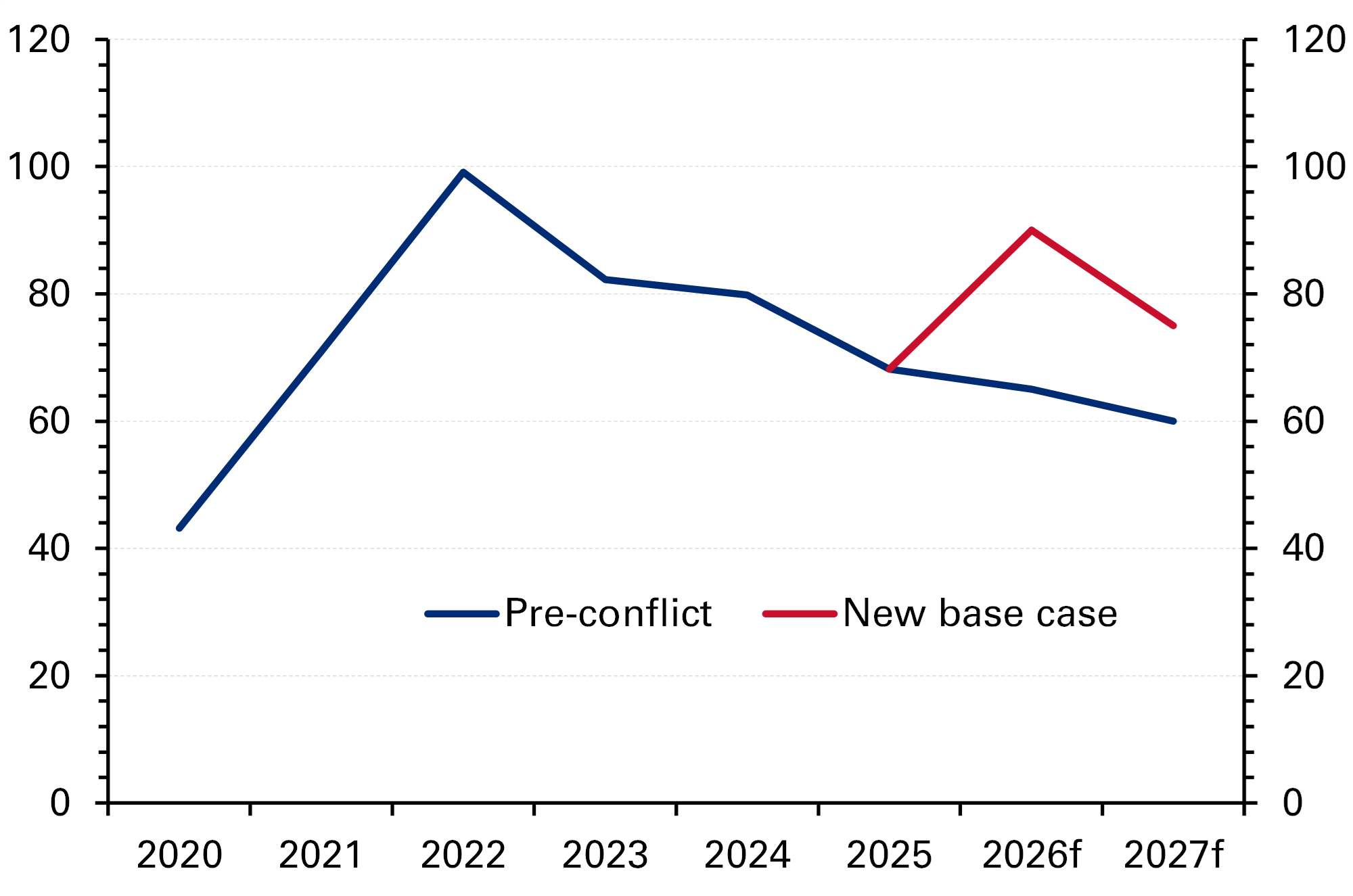
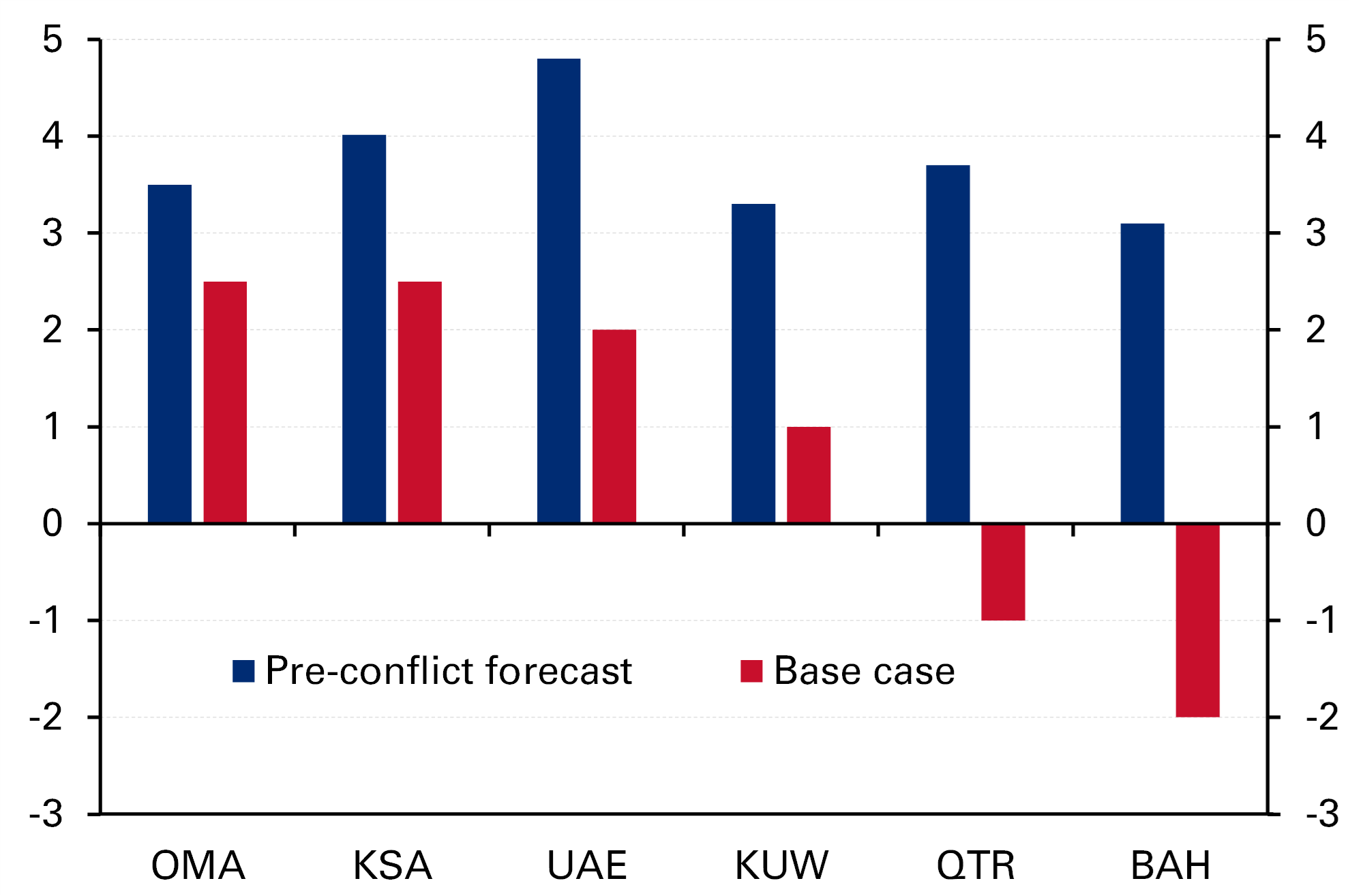
The below sets out some preliminary updated 2026-27 economic projections for GCC countries under our baseline scenario for the US-Iran conflict, in which the war ends promptly, and shipping in the Strait of Hormuz returns broadly to pre-conflict levels in the summer. We judge the non-oil sectors in Saudi and Oman to be least affected, the latter benefitting from its geographical position mostly outside the blocked Strait of Hormuz. Despite suffering the highest number of military strikes, the UAE is helped by its expansive infrastructure and trade flexibility. The Bahraini and Qatari non-oil economies may be the most affected in the short run. Needless to say, an extended conflict would result in more negative outcomes across the board.
Bahrain
The Bahraini economy’s small size, trade openness, reliance upon the Strait for exports and lack of financial buffers compared to GCC peers are points of vulnerability in the current climate. In our base case, GDP contracts by over 5% in 2026, led by a steep reduction in oil sector output due to shut-in of oil fields. Upstream output is assumed to come back online promptly, but the declaration of force majeure by BAPCO due to military strikes implies longer disruption to the Sitra oil refinery (part of the non-oil sector). Other important sectors, such as tourism, trade, manufacturing (especially aluminum) and finance will also be affected. The latter, accounting for 18% of GDP, is likely to face short-term capital outflows and weaker activity. The fiscal deficit will widen to nearly 12% of GDP, with the government facing more difficult trade-offs between sustaining consolidation and containing social strains. Market indicators already point to rising stress, with CDS spreads widening to around 337 in mid-March before easing to 260, still well above the five-year average of 180, underscoring persistent investor concerns over the kingdom’s macro and fiscal outlook.
Kuwait
Kuwait’s economy faces a relatively large GDP hit due to the predominance of the oil sector in the economy and the reliance upon the blocked Strait of Hormuz for external trade. Oil GDP could contract by 9% this year (production averaging just 1 mb/d in March-May) before a sizeable rebound in 2027 as OPEC members hike output to recoup lost oil revenues. Growth in non-oil GDP is forecast to slip to just 1% this year with business supply chains impeded, spending cut due to uncertainty and momentum in project activity disrupted. But a non-oil recession is avoided, with the government’s large role in the economy exerting a stabilizing force. Kuwait also ‘benefits’ here from having an economic model less dependent on tourism and foreign capital than some of its GCC peers. Non-oil growth improves in 2027 as project activity recovers from the delays and reprioritization of government spending this year. On the public finances, higher oil prices are expected to prop up oil revenues once export disruptions abate, but a drop in non-oil revenues, in combination with higher spending on subsidies and reconstruction, could push the deficit to 10% of GDP in FY26/27 (from 6.5% in FY25.26). Next year sees the deficit narrow to under 3% of GDP as oil production recovers and oil prices remain relatively high. The government raised a larger-than-expected KD5.7bn in debt in 2025 offering a substantial boost to liquidity levels pre-conflict; KD1.4bn has been issued so far this year amid increased financing needs but overall debt levels are low.
Oman
Given its location mostly outside the Strait of Hormuz, Oman is the least exposed among GCC peers to supply chain disruptions, including importantly in energy, caused by Iran’s blockage of the strait. Conflict statistics also point to Oman being the least targeted, which also minimizes the risk of damage to vital infrastructure, with the airport, utilities plants and oil facilities all operational. However, non-oil growth may decelerate as spillover risks potentially curb tourism and investment, though Oman could benefit from some GCC members, the UAE and Qatar especially, rerouting trade and energy exports through its ports, such as Duqm. In contrast, oil output is poised to increase, supported by capacity buildups in recent years and the severe ongoing global market shortage, which, coupled with soaring oil and gas prices, should significantly benefit the country’s fiscal position this year and in 2027. The resilience of the Omani economy is also backed by sound fiscal and external positions and the support of government buffers, reflected by S&P’s affirmation recently of Oman’s investment grade credit rating, which it secured in 2025 on the back of strong reform momentum. GDP growth is projected at a region-topping 2.3% in 2026 in our base case forecast. Even in a more prolonged conflict scenario, growth would slow only slightly, but either way we expect faster growth in 2027 as sentiment and business conditions improve.
Qatar
Qatar’s economy could be among the most heavily affected in the GCC in the near term, reflecting its structural inability to bypass the Strait of Hormuz for its hydrocarbon exports, the rapid shutdown of LNG production in March and the impact on gas-related industries. The North Field East gas expansion project will also be delayed, pushing planned LNG capacity gains into 2027. Hydrocarbon GDP will contract sharply in 2026, recovering as flows through the Strait of Hormuz normalize but likely capped at a fifth below capacity due to damage to the Ras Laffan gas complex. The negative spillovers extend downstream, with reduced feedstock weighing on refining and manufacturing. Other non-oil sectors hit will include tourism, which typically accounts for around 10% of GDP, trade and travel, while businesses facing weaker demand and supply chain issues will be pressured to cut wages and reduce staffing, affecting consumption. Offsetting these headwinds to some extent, the government is expected to provide fiscal support through expanded subsidies and reduced fees for public services. Higher defense outlays are also expected. With both hydrocarbon and non-hydrocarbon revenues declining and spending increasing, the fiscal position is set to deteriorate, with a budget deficit forecast at 5% of GDP in 2026 (0% previously). However, this moderate-sized deficit will not inject any big risks. Moreover, we do expect a solid recovery in non-oil growth in 2027, reflecting base effects and the full resumption of gas expansion projects.
Saudi Arabia
Pre-conflict, the Saudi economy was performing strongly, supported by robust growth metrics and an investment-oriented policy focus. Under the base scenario, Saudi GDP growth slows markedly in the near term, to 0.7% in 2026, before rebounding sharply to 6% in 2027. The slowdown (and rebound) is primarily oil-driven, reflecting disruptions to flows through the Strait of Hormuz, supply chain frictions, and the partial rerouting of exports to the Red Sea, which collectively weigh on production, particularly in the first half of 2026. That said, the availability of alternative export routes prevents a more severe contraction. In contrast, helped by the Saudi economy’s size and diversification levels, non-oil growth is likely to remain relatively resilient at 2.5% in 2026, rising to 4.0% in 2027, supported by government spending and still-solid domestic demand. On the fiscal side, unlike some of its Gulf peers, the Kingdom is projected to post a narrower fiscal deficit of 0.3% of GDP in 2026 than forecast pre-conflict thanks to the combined effect of higher oil prices and crude production; the latter is expected to rise sharply post-conflict as OPEC-8 looks to recover lost supply and revenues. The authorities are also expected to err towards a more cautious implementation of Vision 2030 spending, with private sector financing potentially more constrained.
UAE
The UAE’s ‘high value’ status saw it targeted more than other GCC countries by Iran’s military strikes, though its expansive infrastructure, diversification levels and trade flexibility provide some mitigation against economic damage. Under the baseline, GDP growth slows to 1.3% in 2026, reflecting a modest 0.8% contraction in oil activity as export volumes are constrained early in the year. The impact is partially mitigated by the 1.5 mb/d ADCOP (Habshan–Fujairah) pipeline, which allows a portion of crude exports to bypass the Strait of Hormuz blockage. With the reopening of the strait, oil production normalizes and drives an 11% rebound in oil GDP in 2027, lifting headline growth to 5.9%. Non oil growth in 2026 slows sharply versus a strong 4%+ pre-conflict trajectory with tourism, trade, travel and retail sectors hit, but still ekes out positive growth followed by a solid rebound in 2027 as confidence and capex are rebuilt. A decline in real estate activity and prices is likely, but the systemic impact on the banking sector from this is limited and lower valuations could start to entice investors back to the market in 2027-28. Meanwhile, elevated oil prices and a comparatively modest and short-lived drop in oil production sees the government maintain a good-sized fiscal surplus through 2026-2027, underpinning an unchanged credit rating despite the economic dislocation.