
 +965 2292 4888


Daily Economic Update
01.11.2026
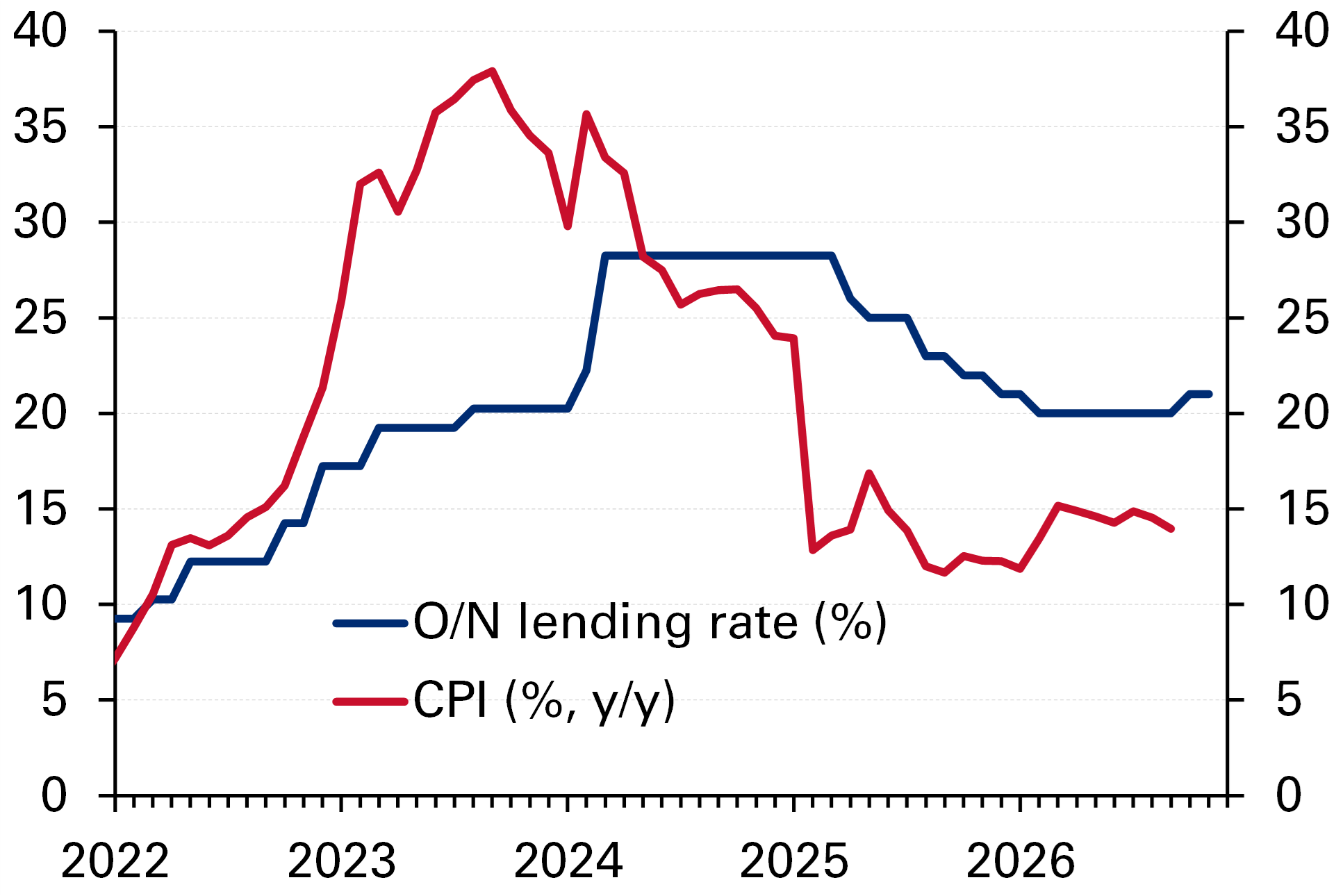
Egypt: CBE surprises markets with 100 bps rate hike, reversing the easing cycle. The Central Bank of Egypt (CBE) raised its key policy rates by 100 bps at Thursday’s Monetary Policy Committee (MPC) meeting, surprising markets that had largely expected another hold. This marks the first rate increase since March 2024 and reverses the easing cycle that began in April 2025, during which the CBE cut rates by a cumulative 825 bps across six moves. The overnight deposit rate was raised to 20.0% from 19.0%, the overnight lending rate to 21.0% from 20.0%, and the main operation and discount rates to 20.5% from 19.5%. The decision came despite a further slowdown in annual inflation, with headline inflation easing to 13.9% in September and core inflation to 14.1%. However, the CBE highlighted a renewed acceleration in monthly price increases. The MPC described the hike as a pre-emptive measure to contain imported inflationary pressures and prevent them from feeding into domestic prices. It also pushed back its inflation convergence timeline, now expecting inflation to reach its 7% target, with a margin of ±2 percentage points, on average in Q4 2027, compared with the previous expectation of the second half of 2027. The change in the CBE’s assessment of risks is particularly notable. In September, it considered the existing degree of monetary tightening sufficient to cushion the economy against external pressures. This time, it said these risks had become more pronounced, warranting a more restrictive policy stance. Foreign portfolio outflows appear to have been an important factor, with investors reportedly selling around $2 billion in local debt instruments in the week preceding the decision, adding pressure on the pound (which finished last week at EGP56.0/$1, -7% m/m). The CBE therefore appears to be prioritizing exchange rate stability and inflation expectations, even as it acknowledges that economic activity remains below potential and demand-driven inflationary pressures are limited. The hike will, however, come with significant costs. The real interest rate has increased to around 6% from 5% before the decision, further tightening financial conditions. It will also add to the government’s debt-servicing burden at a time when interest payments already account for around 46% of total expenditure and 59% of government revenues. Higher borrowing costs could also weigh on private-sector investment and raise financing costs for businesses and suppliers, potentially adding to cost pressures. Overall, while higher interest rates can help limit currency depreciation and prevent imported inflation from becoming entrenched in domestic prices, they cannot directly address the underlying rise in import, shipping and insurance costs. The CBE’s decision therefore reflects a difficult trade-off: tightening monetary policy to contain exchange rate pressures and inflation expectations, at the expense of higher borrowing costs and a heavier fiscal burden.
Saudi Arabia: Public-sector borrowing drives credit growth as private demand cools. Bank lending to public-sector enterprises increased by 22% y/y to SAR285 billion in September, almost three times the 7.3% growth in total bank credit, which reached SAR3.5 trillion, according to SAMA. This indicates that state-linked borrowing is playing an increasingly important role in driving credit growth, while some indicators of private-sector demand have softened. Banks’ holdings of government bonds also increased to SAR678 billion, from SAR643 billion a year earlier, further highlighting the banking sector’s growing exposure to the public sector. Personal loans remained the largest category of bank credit, at SAR1.48 trillion, followed by real estate (SAR435 billion), utilities (SAR264 billion), wholesale and retail trade (SAR224 billion), and manufacturing (SAR213 billion). However, recent indicators point to softer consumer and trade financing activity. New residential mortgage lending fell by 5.7% m/m to SAR5.5 billion. Meanwhile, settled letters of credit (LCs) for private-sector imports declined by 14.4% m/m and 18.2% y/y to SAR12.3 billion, while new LCs fell by 6.2% m/m to SAR14 billion. On the external side, the banking sector’s net foreign assets (NFA) declined to SAR1.45 trillion in September, from SAR1.52 trillion in August. SAMA’s NFA fell to SAR1.66 trillion from SAR1.74 trillion, while commercial banks’ net foreign liabilities narrowed to SAR209 billion, compared with SAR217 billion a month earlier.
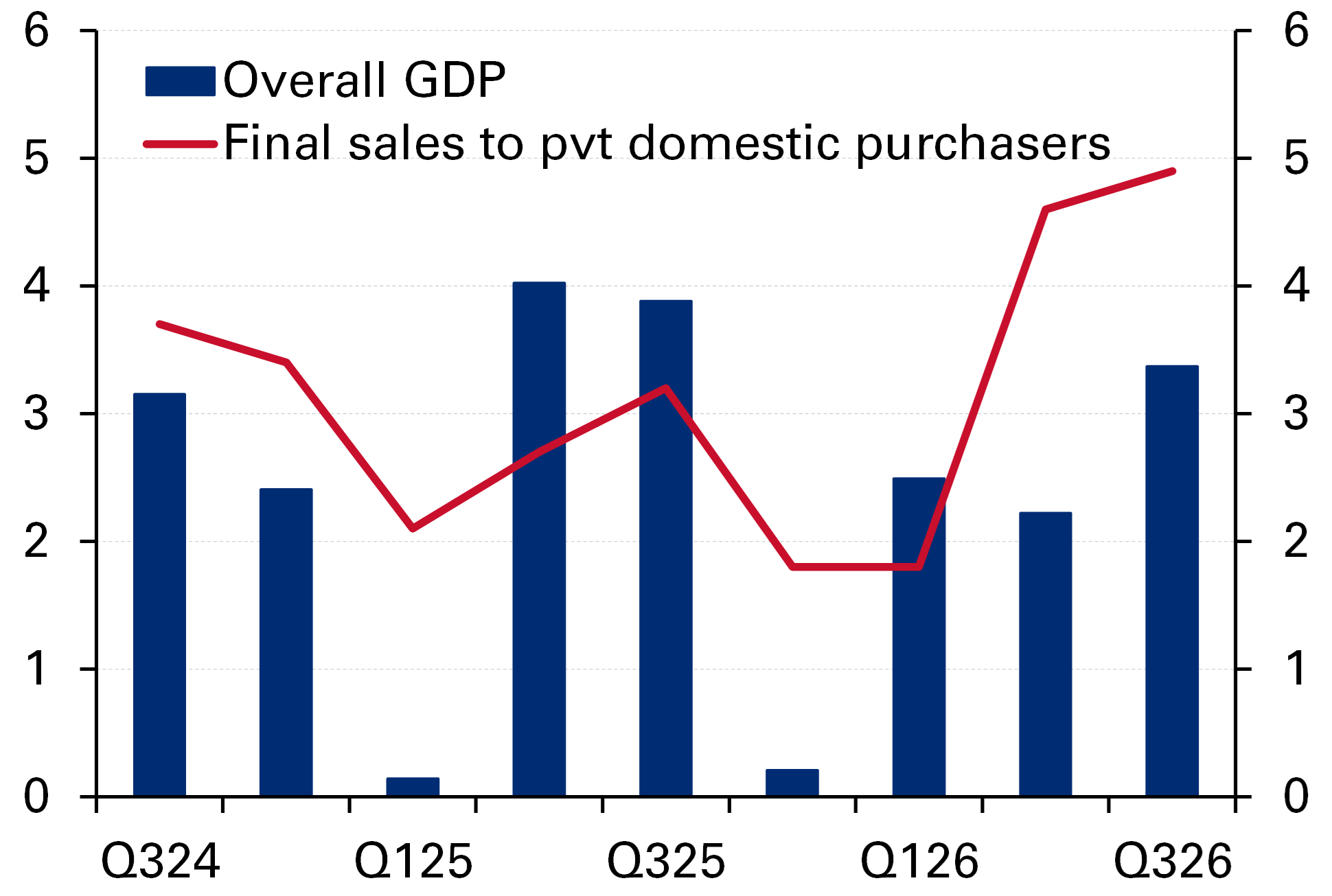
US: Q3 GDP growth accelerates more than forecast while PCE inflation rises in September. The US economy continued to grow strongly at 3.4% in Q3 (annualized), accelerating from Q2’s 2.2% and above the consensus forecast of a 3.2% rise. The AI-driven investment boom and strong consumer spending remained the key drivers of growth, as business equipment investment rose by a solid 21% (up from Q2’s 13.4%), while private consumption increased at a steady rate of 3.8%. Together, this pushed growth in final sales to private domestic purchasers – a key measure of underlying domestic demand – to an over five-year high of 4.9% versus 4.6% in Q2. Surging AI spending and robust household consumption (supported by near record-high equity markets) have helped the US economy withstand the shocks from adverse trade/tariffs and immigration-related policies and the fallout from geopolitical chaos and higher energy prices. Therefore, GDP growth rates over the coming quarters are expected to remain above-trend. However, concerns related to the sustainability of the AI/tech investment boom have also surfaced, raising vulnerability, especially if market expectations about AI’s anticipated economic returns shift. Indeed, the US equity markets on Friday fell sharply on related concerns, with the S&P 500 down by 1.8% and the tech-heavy Nasdaq by 2.9%. Separately, further confirming signs of rising price pressures, PCE inflation in September rose to a four-month high of 3.6% y/y from August’s 3.4%, while the core rate also increased to 3.1% from 3%, matching the consensus forecasts. On a monthly basis, core inflation stood at an elevated 0.3%, in line with an upwardly revised 0.3% in August. The futures market currently signals a 71% probability of a 25bps rate hike in December, dropping from the levels seen last week.
Japan: BOJ holds rates, declares that underlying inflation has hit the 2% goal, and increases the pace of its ETF sales. The Bank of Japan left its policy rate unchanged at 1.25% at its October meeting in an 8-1 vote, in line with market expectations, while maintaining a gradual normalization bias. The BoJ stated that the economy is likely to continue growing moderately despite the drag from higher energy and raw material prices, supported by accommodative financial conditions, government support measures, and strong AI-related investment demand. Importantly, Governor Ueda declared that underlying inflation had hit the goal of 2%. The BoJ mentioned that risks to the inflation outlook are still skewed to the upside, reflecting higher crude oil prices, continued pass-through of wage increases into consumer prices, and the impact of yen depreciation. The BoJ also raised its assessment of inflation pressures, noting that CPI excluding fresh food is likely to remain clearly above 2% in the near term before gradually easing toward target later in the projection period, leaving the door open for a further rate increase in December, which remains the market’s expectation. The BoJ’s updated macroeconomic projections see core CPI inflation at 2.5% in fiscal 2026 (ending March 2027), unchanged from the previous forecast, inching up to 2.6% in fiscal 2027 versus the prior forecast of 2.4% while economic growth is forecast at 0.7% in both years, broadly unchanged from the prior forecast. Separately, the BoJ decided that it would nearly triple the pace of sales of its holdings of ETFs starting this January to about ¥860 billion (in terms of book value) per year, a process that will now take around 43 years to complete, compared with around 112 years initially. Recent economic data suggest that the growth momentum generally continued. Retail sales increased 2.3% y/y in September, down from 2.9% in August, marking the slowest pace of growth in three months but extending the current expansion streak to seven consecutive months, supported in part by government measures aimed at easing cost-of-living pressures. Industrial production rose 2.2% m/m in September, rebounding from a 2.4% decline in the previous month. Meanwhile, inflation in Tokyo remained comfortably above the Bank of Japan's target, with core CPI easing only marginally to 2.6% y/y in October from 2.7% previously, while headline inflation edged up to 2.8% from 2.7%.
Eurozone: ECB holds rates steady as expected; Q3 GDP comes in better than expected. The European Central Bank left all three key interest rates unchanged at its October meeting, keeping the deposit rate at 2.50%, amid heightened uncertainty surrounding energy prices and growth. The meeting was also overshadowed by Christine Lagarde's announcement that she will step down as ECB President on 7 February 2027, several months before the end of her term, triggering speculation over the future leadership of the central bank. That resignation does not come as a surprise though. In her press conference, Christine Lagarde acknowledged that rising energy prices continue to pose upside risks to inflation and downside risks to economic activity, although underlying inflation has remained broadly stable and wages have yet to show second-round effects. She also noted that financing conditions have tightened since the September meeting, which should weigh on both growth and inflation. Importantly, Lagarde stressed that policymakers are not pre-committing to a particular rate path, but indicated that the upcoming inter-meeting period would be “information-rich,” with underlying inflation likely to play a central role in December’s decision. During the Q&A session, Lagarde revealed that the Governing Council debated whether a further rate hike was warranted before ultimately deciding unanimously to hold rates steady, a message interpreted by markets as a relatively hawkish pause. She highlighted the rise in long-term financing costs, the need for countries with high debt burdens to adapt to a higher-rate environment, and emphasized that the ECB remains prepared to use its tools if market developments threaten monetary policy transmission. She also remarked that while energy prices have increased beyond the ECB’s baseline assumptions and some indirect effects are emerging, longer-term inflation expectations remain broadly anchored around 2%. Meanwhile, newly released GDP figures showed the euro area economy remained more resilient than expected in Q3. Flash estimates indicated that GDP expanded by 0.4% q/q, above expectations of 0.2%, though slower than the 0.6% growth recorded in Q2. Finally, Fitch Ratings, in an unscheduled move, downgraded France's credit rating outlook to negative, although kept the rating unchanged at A+.
UK: House prices steady in October, but the trend remains weak according to Nationwide. UK house prices were unchanged in October after falling by a revised 0.3% m/m in September. On an annual basis, price growth further slowed to 0.5% from 0.8% in September, the softest pace since January 2024. The Nationwide survey continued to highlight that heightened geopolitical uncertainty, higher inflation, and mounting expectations of policy interest rate hikes are contributing to weak housing market activity and prices, noting that the near-term outlook remains soft. Moreover, the latest budget proposed to increase the tax rates on savings and property income by an additional 2% points, on top of the 2% increase that was due to take effect in next April as previously announced. Still, the agency is pinning its hopes on improving sentiment once the energy shocks fade amid resilient economic conditions.
China: Official PMI data points to renewed weakness in activity. China’s official PMI surveys weakened more than expected in October, suggesting that momentum softened at the start of Q4 after a brief improvement in September. The official manufacturing PMI fell to 49.3 in October from 50.1 in September, slipping back into contraction territory and missing expectations. Meanwhile, the non-manufacturing PMI declined to 49.7 in October from 50.2 previously, indicating a slowdown across the services and construction sectors, while the composite PMI fell to 49.7 from 50.7. The deterioration was driven by weaker production and demand conditions, with the production and new orders sub-indices both falling below the 50-point threshold, pointing to reduced activity on both the supply and demand sides. That said, and despite the softer headline readings, pockets of strength remained evident in high-tech industries.