
 +965 2292 4888


Daily Economic Update
01.09.2026
Kuwait: Government moves ahead with housing PPP projects after attracting 22 consortia. The Public Authority for Housing Welfare (PAHW) has prequalified 22 consortia that successfully met the technical and financial qualification criteria, comprising 41 Kuwaiti and international companies, to participate in the tendering process for three housing projects under the real estate developer program. The prequalification results included six consortia for the Al-Mutlaa City project (M-3), eight for the East Saad Al-Abdullah City project (ESA-1), and eight consortia for the West Saad Al-Abdullah City and Jaber Al-Ahmad Service Hub projects. The qualified groups include 27 Kuwaiti and 14 international companies, highlighting the solid interest and confidence of local and foreign developers in Kuwait's economic fundamentals and housing development agenda, despite heightened regional uncertainty and geopolitical tensions. The projects form part of a broader real estate development program covering sites in Al-Mutlaa City, East Saad Al-Abdullah, West Saad Al-Abdullah, and Jaber Al-Ahmad, with a combined area of about 4.15 million square meters. They will be implemented under a Design, Finance, Build, Operate, Maintain, and Transfer (DFBOMT) model. Housing units will be sold to eligible beneficiaries of public housing programs with each project awarded under a 30-year contract, comprising a four-year construction period followed by 26 years of operation and investment. Beyond increasing housing supply, the program could help stimulate private investment, support construction sector activity, and contribute to Kuwait's broader economic diversification objectives. Its success, however, will depend on effective implementation, affordability outcomes, and the ability to address the technical, bureaucratic, and administrative challenges that have historically affected residential development projects.
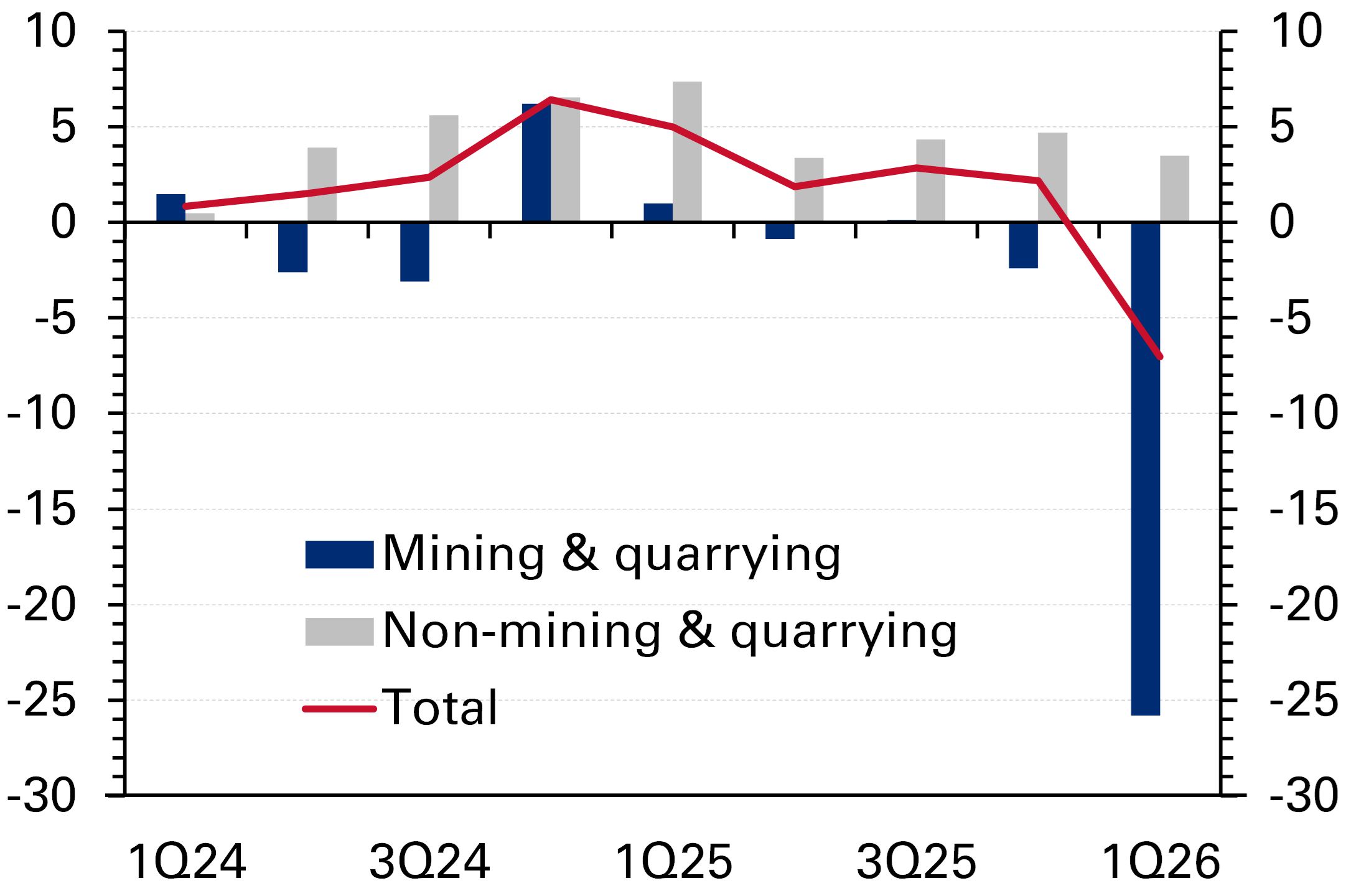
Qatar: Economy contracts in Q1 on oil and gas sector disruptions caused by the US-Iran conflict. Qatar’s economic output fell sharply in Q1 2026 as the outbreak of hostilities in the Gulf and the closure of the Strait of Hormuz led to drastic cuts in the country’s energy exports and production, just-released official data showed. Real GDP declined by 7% y/y (-7.9% q/q), with output in the oil and gas sector, which accounts for about a third of the total economy, falling by a dramatic 26% y/y (-22% q/q). Among GCC countries, the severity of the contraction in hydrocarbon activity is second only to the steep 37% y/y decline recorded in Bahrain’s oil sector (Kuwait’s oil GDP fell by 12.5% y/y in Q1). Qatar’s energy facilities were targeted by Iran early in the conflict, with force majeure declared at the key Ras Laffan gas processing facility in March, which affected about 17% of the country’s entire LNG export capacity, QatarEnergy’s CEO had said at the time. Non-mining and quarrying activities, in contrast, held up well, expanding by 3.5% y/y (-0.9% q/q)—among the most rapid in the GCC—on the back of growth in the key financial services (+4.8% y/y), trade (+9% y/y) and construction (+6.2% y/y) sectors, though manufacturing, with its key hydrocarbon inputs, unsurprisingly declined (-8.1% y/y).
Saudi Arabia: Government seeks $8 billion in borrowings amid the Iran war fallout. Saudi Arabia is in preliminary talks to borrow at least $8 billion as the Kingdom looks to strengthen its funding sources amid the economic fallout from the Iran war. Saudi Aramco is also holding separate talks with major banks over potential financing. Both deals remain at an early stage and may not ultimately be completed. The potential borrowing comes as the Kingdom and other Gulf economies face growing pressures from the conflict, including disruptions to trade through the Strait of Hormuz, higher import and shipping costs, and ongoing supply-chain challenges. Iran has also targeted Saudi energy infrastructure, while the Iran-backed Houthis have threatened shipping in the Red Sea. The disruptions are complicating Saudi Arabia’s efforts to reduce its reliance on the Strait of Hormuz by routing more oil exports through its western coast and the Red Sea. The potential financing therefore comes as the Kingdom seeks to maintain sufficient liquidity and flexibility to navigate a more challenging external environment.
Oman: OQ announces the near-completion of three major gas infrastructure projects. OQ Gas Networks (OQGN) announced that three major gas infrastructure projects, the 193-km Fahud-Sohar Loop Line, the 31-km Budoor-Tayseer pipeline, and the 13-km Duqm Growth pipeline, are scheduled for completion by the end of 2027 as part of an OMR 294 million investment program. The projects will increase gas transmission capacity, support growing industrial demand in Sohar, Ibri, and Duqm, and expand OQGN’s network from 4,368 km in 2025 to 4,717 km by 2027, while raising total network capacity from 76.3 billion to 80.3 billion standard cubic meters. The company also reported strong operational performance, with gas transportation volumes rising 9% y/y in the first half of 2026. OQGN noted that while green hydrogen developments have slowed and are being recalibrated, it continues to prepare for future hydrogen transport infrastructure. The projects will strengthen Oman’s energy infrastructure, improve the reliability and capacity of gas supplies for industrial users, and support the expansion of key economic hubs such as Sohar and Duqm.