
 +965 2292 4888


Daily Economic Update
31.08.2026
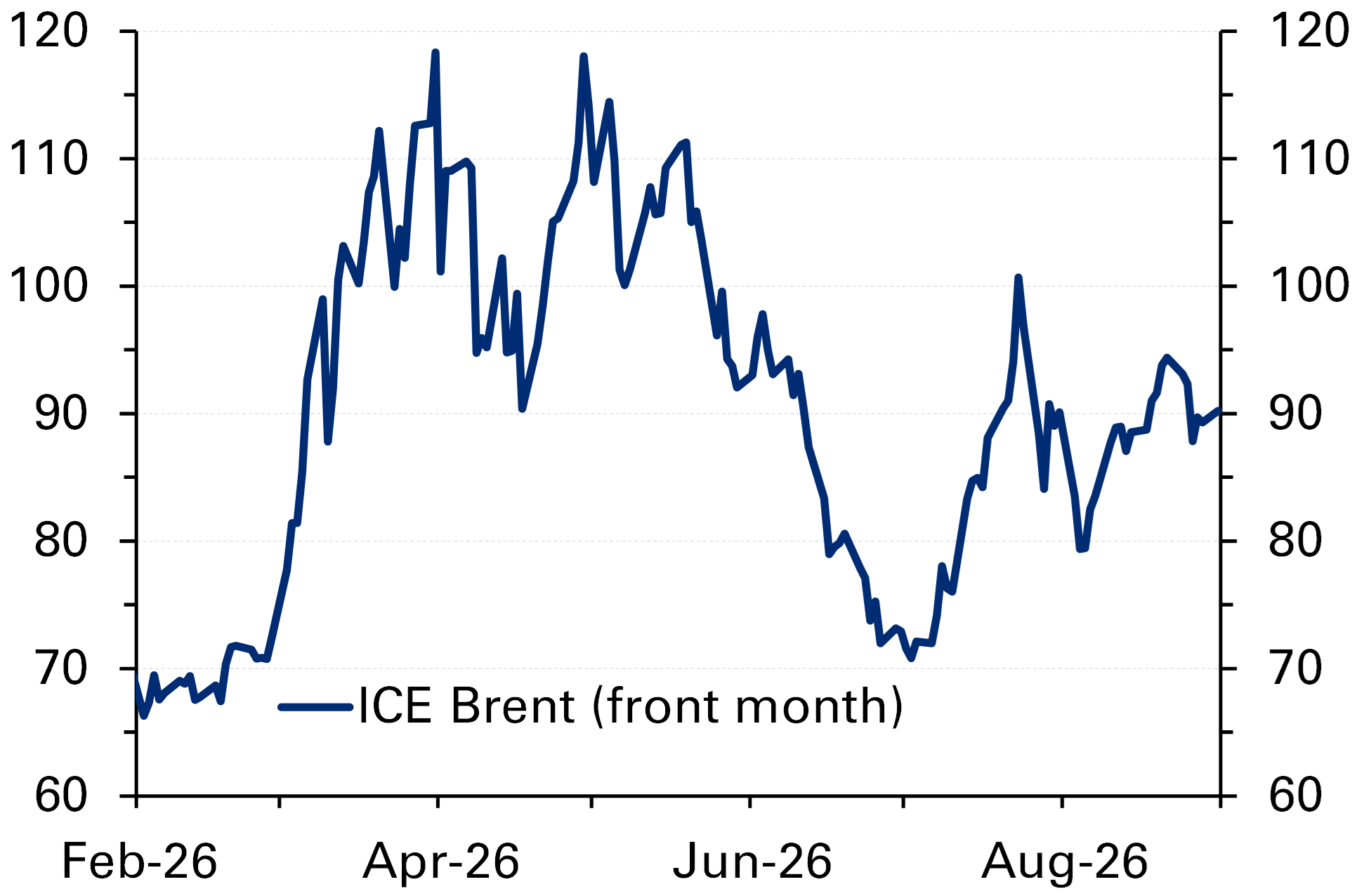
Oil: Prices rally amid fresh US strikes on Iran. Brent crude futures rallied 2.4% in early Asian trading to $90.2/bbl after the US and Iran exchanged military strikes for the first time in roughly a month, reigniting concerns over supply security in the Gulf and prompting markets to rebuild part of the geopolitical risk premium that had faded in recent weeks. Washington targeted missile launchers on Iran's Larak Island in an effort to safeguard vessels transiting the Strait of Hormuz. Tehran subsequently retaliated with a strike on a US military base in Jordan, highlighting the fragility of the current standoff and the risk of a renewed escalation cycle. Today's gains partially reverse last week's 5.4% decline, which had been driven by reports that Iran and Oman had agreed on a temporary maritime transit arrangement for the Strait, although Iranian officials continue to maintain that normal shipping cannot resume until the US fulfills its commitments. Meanwhile, over the weekend, US President Trump announced an agreement giving the US control over 65 billion barrels of Venezuelan oil reserves, equivalent to roughly one-fifth of the country's total reserves. According to Venezuela’s President, the arrangement will remain in effect for 25 years, targets an increase in crude production to 1.5 mb/d, and should generate around $19/bbl in state revenues. While Venezuelan output has already recovered to around 1.1 mb/d according to OPEC secondary-source data, reaching the new target is likely to take time given years of underinvestment and deteriorating infrastructure, limiting the potential for meaningful relief to global oil balances this year. Longer term, however, the agreement could support a more substantial recovery in Venezuelan production, although achieving levels close to the country's late-1990s peak would require significant capital investment of roughly $183 billion, according to Rystad Energy.
Global: US August jobs report and Eurozone’s August inflation key data releases this week. In the US, attention will be on August’s non-farm payroll report (Friday) where consensus forecast is for a rebound in job growth to 45K m/m following an unexpected drop of 23K in July, with the unemployment rate edging up to 4.2% from 4.1% previously. Job openings (JOLTS on Tuesday) are expected to rise slightly to 7.39 million in July from 7.36 million in June. The ISM manufacturing PMI (Tuesday) is seen ticking down to a still-solid 55.3 in August from July’s 55.6, while the services measure (Thursday) is forecast at an unchanged 54.1. The Fed’s Beige Book is due on Wednesday, providing anecdotal observations of the state of the US economy. Few Fed officials will also speak this week, possibly shedding light about the FOMC’s bias ahead of the policy meeting on September 15-16. In the Eurozone, attention will be on August’s flash inflation reading (Tuesday), with the headline rate expected to accelerate to 3.2% y/y from 2.9% in July, but the core rate steady at 2.5%. Retail sales (Friday) are expected to rebound by 0.3% m/m in July after falling by 0.3% in June. In the UK, August’s Nationwide House Price Index (Tuesday) is seen rising by 2% y/y in August (+1.8% in July). Finally in Japan, household spending (Friday) is seen falling by 1.6% y/y in July, though narrower than the 3.3% drop recorded in June.
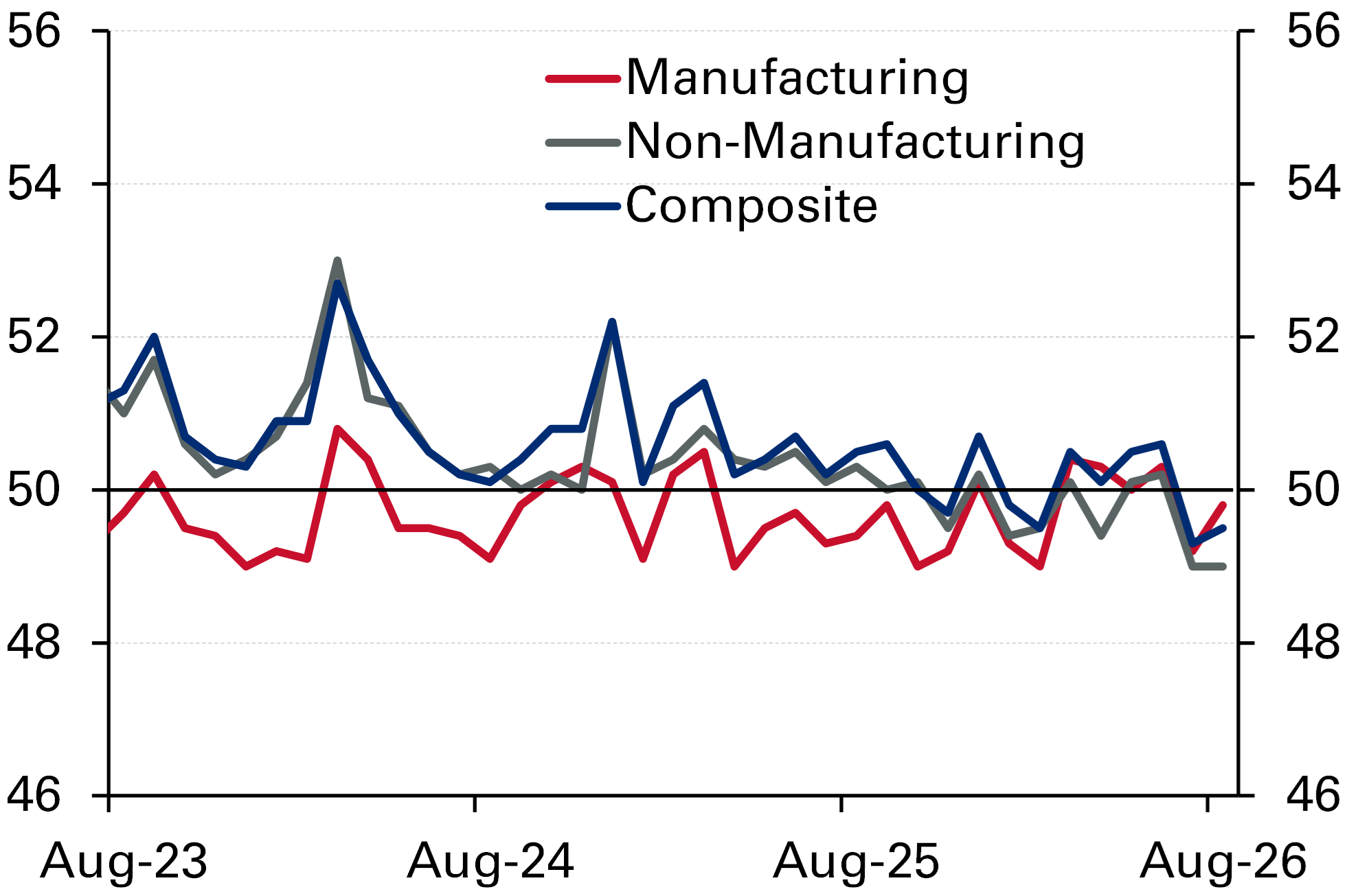
China: PMIs show tentative stabilization in August, but activity remains subdued. China’s official PMI data for August suggested that the pace of deterioration eased somewhat, although overall economic activity remained weak. The manufacturing PMI rose to 49.8 in August from 49.2 in July, beating market expectations but remaining below the 50-point threshold for a second consecutive month, indicating that factory activity continued to contract despite some improvement in production and demand conditions. Meanwhile, the non-manufacturing PMI was unchanged at 49.0 in August, signaling that services and construction activity remained in contraction territory. As a result, the composite PMI edged up to 49.5 in August from 49.3 previously, pointing to a modest stabilization in overall activity but still suggesting a lack of broad-based economic momentum. That said, the improvement in manufacturing offers some reassurance that policy support and resilient exports are helping to cushion the slowdown, but the persistence of sub-50 readings across all headline indicators underscores ongoing weakness in domestic demand and reinforces expectations that policymakers may need to deliver further targeted measures to support growth in the coming months.
Japan: Industrial output and retail sales solid and above expectations in July. Japan's July data pointed to continued resilience in both industrial production and retail sales. Preliminary figures showed industrial production increasing by a higher-than-expected 4.1% y/y in July, marking a second consecutive month of solid growth, though moderating from 4.9% in June. Meanwhile, retail sales growth accelerated to 4.0% y/y in July from 0.6% in June, supported by stronger sales across several categories, particularly motor vehicles (+16.2%). Taken together, the data suggest that activity was solid at the start of Q3, following a weaker-than-expected GDP print in Q2 (+0.3% q/q).
UAE: US escalates sanctions with pressure on Banque Misr’s UAE operations. The US has intensified its economic pressure campaign against Iran by revoking correspondent banking access for the UAE branches of Egypt's state-owned Banque Misr. Treasury Secretary Scott Bessent described the measure as part of "Operation Economic Outcast", alleging that Banque Misr UAE processed $1.8 billion in transactions for more than 100 companies linked to Iranian shadow-banking networks. The action, which is subject to a 30-day public comment period, would restrict the bank’s branches from access to the US financial system and dollar-clearing services while leaving Banque Misr's operations in Egypt unaffected. The Central Bank of the UAE has reportedly begun reviewing the affected branches, while Banque Misr stated that it is assessing the Treasury's notice. The move came as part of a broader US effort to tighten economic pressure on Iran, with the UAE recently suspending trade, commercial exchanges, and financial transactions with Iran. However, the effectiveness of the campaign may prove limited as meaningful economic isolation of Iran would likely require targeting major Chinese entities that purchase Iranian crude oil, a step the US may be reluctant to take given the potential repercussions for global financial stability and broader US-China relations.
Saudi Arabia: Construction costs are rising more slowly, but underlying pressures remain. Saudi Arabia’s Construction Cost Index (CCI) remained at 104 points in July, the same level as in June, but was still 2.3% higher y/y, according to GASTAT. The annual increase slowed to its weakest pace in four months, suggesting some moderation in overall construction cost pressures. However, the headline slowdown masks continued increases in some key inputs. Equipment rental costs and construction materials, which are among the inputs most exposed to the regional conflict, remain under pressure as logistics disruptions and Houthi-related shipping risks continue to affect supply chains. Despite the recent moderation in annual growth, construction costs remain elevated by historical standards. The index averaged 101.1 points between 2023 and 2026, reaching a record high of 104 points in June 2026, compared with a record low of 99.1 points in October 2023. The elevated input and logistics costs remain a challenge for contractors as Saudi Arabia continues to advance its large-scale Vision 2030 project pipeline.