
 +965 2292 4888


Daily Economic Update
21.09.2026
Kuwait: New sukuk law approved, widening government’s funding options. New legislation (Law no. 90 of 2026) was passed establishing a comprehensive framework for the issuance, management, and trading of sovereign sukuk, enabling the government to raise funds through Sharia-compliant instruments alongside conventional debt. The law comes as part of a broader evolution of Kuwait's sovereign financing framework, following both the Financing and Liquidity Law (Law no. 60 of 2025), which restored the government's ability to issue debt under a long-term borrowing framework, and the recent amendment to the Future Generations Fund (FGF) law that permits the government, subject to specific conditions and approvals, to borrow from the fund to support the general reserve. Together, these measures significantly expand the state's financing flexibility by providing multiple funding channels, while reducing reliance on any single source of liquidity. The sukuk law also diversifies Kuwait's debt portfolio by introducing a sovereign Sharia-compliant funding instrument, broadening the investor base to include Islamic financial institutions and dedicated sukuk investors, and supporting the continued development and depth of the domestic capital market. The law allows sukuk issuance in both Kuwaiti dinars and foreign currencies through public or private offerings and links issuance to identifiable state-owned assets, bringing Kuwait in line with international sovereign sukuk practices. We expect the government will lean more towards sukuk issuance in the near term, given the need to develop the local sukuk market and diversify the debt portfolio. Moreover, deficit financing needs remain important, as debt issuance over the last and current fiscal years is still well below the cumulative projected deficits of these periods – although we expect part of the financing to come from the FGF.
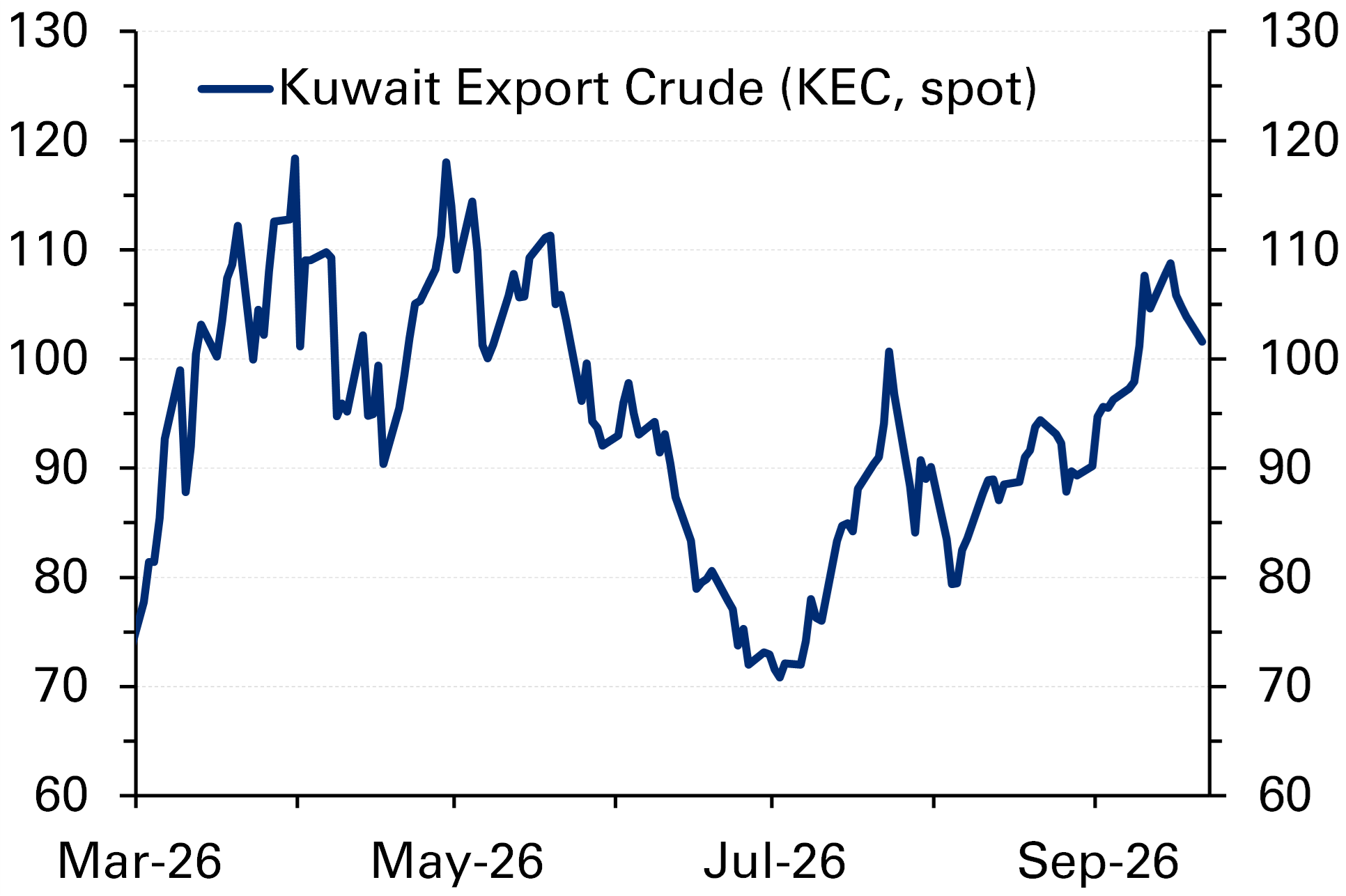
Oil: Prices end the week lower as Saudis look to mitigate pipeline closure and as diplomatic efforts to end the conflict restart. Brent futures closed last week 0.7% w/w lower at $104.8/bbl, dropping over three consecutive trading sessions as Saudi Arabia looked to mitigate the closure of the East-West pipeline by pivoting back to Arabian Gulf exports and as reports emerged that China had urged Iran, on behalf of Saudi Arabia, to limit attacks by Houthi forces on Saudi energy infrastructure. Prices were again retreating this morning in Asian trading, dipping below $102/bbl at the time of writing with markets taking some comfort from Saudi efforts to partially restart its pipeline, find workarounds and from US CENTCOM’s statement that oil and LNG flows through the Strait of Hormuz were running at a six-month high. Admiral Brad Cooper said that 1 billion barrels of crude had been shipped through the Strait “in the last couple of months”. If accurate, that would equate to over 16 mb/d, a massive volume that would bring flows to at least 80% of pre-conflict levels. Nevertheless, recent attacks on Saudi assets have exacerbated existing supply shortages, with Saudi Aramco reportedly notifying at least two European refineries that they will not receive crude cargoes next month. This has added to ongoing tightness in middle distillates markets, pushing European benchmark diesel prices above $200/bbl last week. Sustained supply disruptions and elevated oil prices have also intensified calls, the latest from France’s President Emmanuel Macron, for further releases from strategic reserves. Of the 400 mb agreed for release earlier this year in March, around 320 mb had reportedly entered the market by August, although the pace of drawdowns has begun to slow as the initial tranche nears completion. Weekend developments underscored the continuing fragility of the regional security backdrop. Further Houthi attacks on Saudi Arabia included a strike near King Khalid Airport, while the US State Department issued a security alert for American citizens in the region. At the same time, diplomatic channels remain active, with Iran reportedly conveying through Qatari intermediaries seven conditions to restart renewed talks with the US. The US response is pending.
Saudi Arabia: Domestic tourism offsets decline in foreign visitors. Saudi Arabia’s tourism sector remained resilient in Q1 2026 as stronger domestic travel more than offset a decline in international arrivals amid the regional conflict. International tourist arrivals fell 13% y/y to 8.3 million, showing a clear initial impact from the conflict on tourism activity. However, domestic trips increased by 16% to 28.9 million, more than compensating for the decline in foreign visitors. As a result, total tourist numbers increased by 8% y/y to 37.2 million. However, tourism spending fell by 2% to SAR 83 billion, as international visitors typically spend significantly more than domestic tourists. Spending by international visitors declined by 7% to SAR 48 billion, according to the Tourism Ministry data. The ministry explicitly linked the weaker tourism performance during the quarter to the regional conflict and its impact on travel activity. The difference in spending between domestic and international tourists is significant. Based on the ministry’s figures, a domestic tourist spent around SAR 1,200 during the quarter, compared with roughly SAR 5,800 for an international visitor. This means that replacing the spending of one foreign tourist requires several additional domestic trips, highlighting the importance of international tourism to the Kingdom’s tourism revenues. In 2025, the Kingdom welcomed a record 123 million tourists, an increase of around 6% y/y, while total tourism spending rose 7% to SAR 304 billion, according to the Tourism Ministry’s annual statistical report.
Egypt: Petroleum import bill set to double as Suez Canal revenues rebound. Egypt’s petroleum import bill is expected to double to around $9 billion in Q4 2026, compared with approximately $4.5 billion in the same period of 2025, according to preliminary estimates. The sharp increase reflects the higher cost of securing energy supplies amid elevated global oil prices and rising domestic demand. Meanwhile, Suez Canal revenues jumped 57% y/y to $567 million in August, supported by an increase in both the number of vessels transiting the canal and their cargo volumes. The contrasting developments highlight two important trends for Egypt’s external position: higher energy imports are increasing foreign-currency requirements, while the recovery in Suez Canal traffic is helping to restore one of the country’s key sources of foreign currency inflows.
Global: Trump-Xi summit, Fed speak, and global flash September PMIs key matters this week. US President Trump and Chinese President Xi will hold a summit in the White House on Thursday-Friday, and trade, tariffs, AI, and geopolitics are some of the topics that will feature in their discussions. In the US, following last week’s FOMC decision to raise interest rates, several Fed officials will speak this week, providing clues about their thinking. In terms of data releases, the S&P Global flash PMIs for September are due on Wednesday, with the consensus forecast indicating slightly softer but still robust manufacturing (53.6 from August’s 53.9) and services (56 from 56.5) readings. In the Eurozone, the September flash PMIs (Wednesday) are expected to show a marginal pickup in business activity, with the manufacturing PMI projected to inch up to 52.9 from 52.7 and the services PMI to 51.7 from 51.6. In the UK, on Wednesday, the manufacturing flash PMI is forecast to rise to 52.7 in September from 51.7 in August, but the services measure is seen moderating to 52.1 from 52.5. Finally in Japan, the September flash PMIs are due on Thursday where the manufacturing PMI is seen edging up slightly to 55.0 from 54.9 in August.
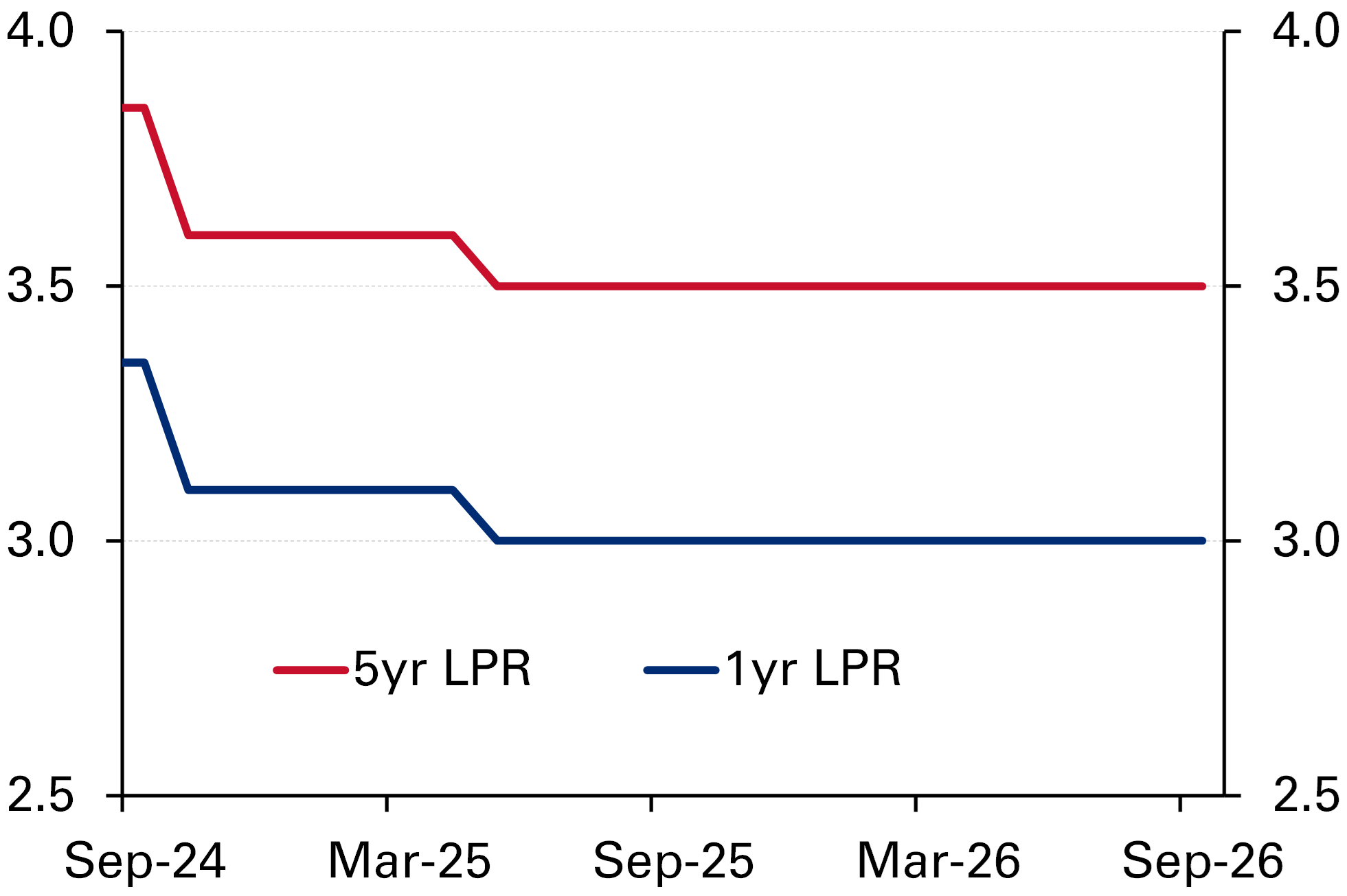
China: Key lending rates left unchanged for the 16th consecutive month in September. The People’s Bank of China kept its benchmark Loan Prime Rates (LPRs) unchanged in September, with the one-year LPR held at 3.0% and the five-year LPR at 3.5%, in line with expectations. The decision extends the current pause in rate adjustments to 16 consecutive months, despite ongoing concerns over weak domestic demand, softening credit growth, and continued stress in the property sector. Policymakers appear comfortable maintaining a steady monetary policy stance for now, supported by signs of resilience in exports and industrial activity, while relying on targeted fiscal measures to support growth. However, with consumer spending and investment remaining soft, markets continue to expect authorities to retain an easing bias and stand ready to deploy additional monetary support should economic momentum weaken more materially in the coming months.