
 +965 2292 4888


Daily Economic Update
16.11.2026
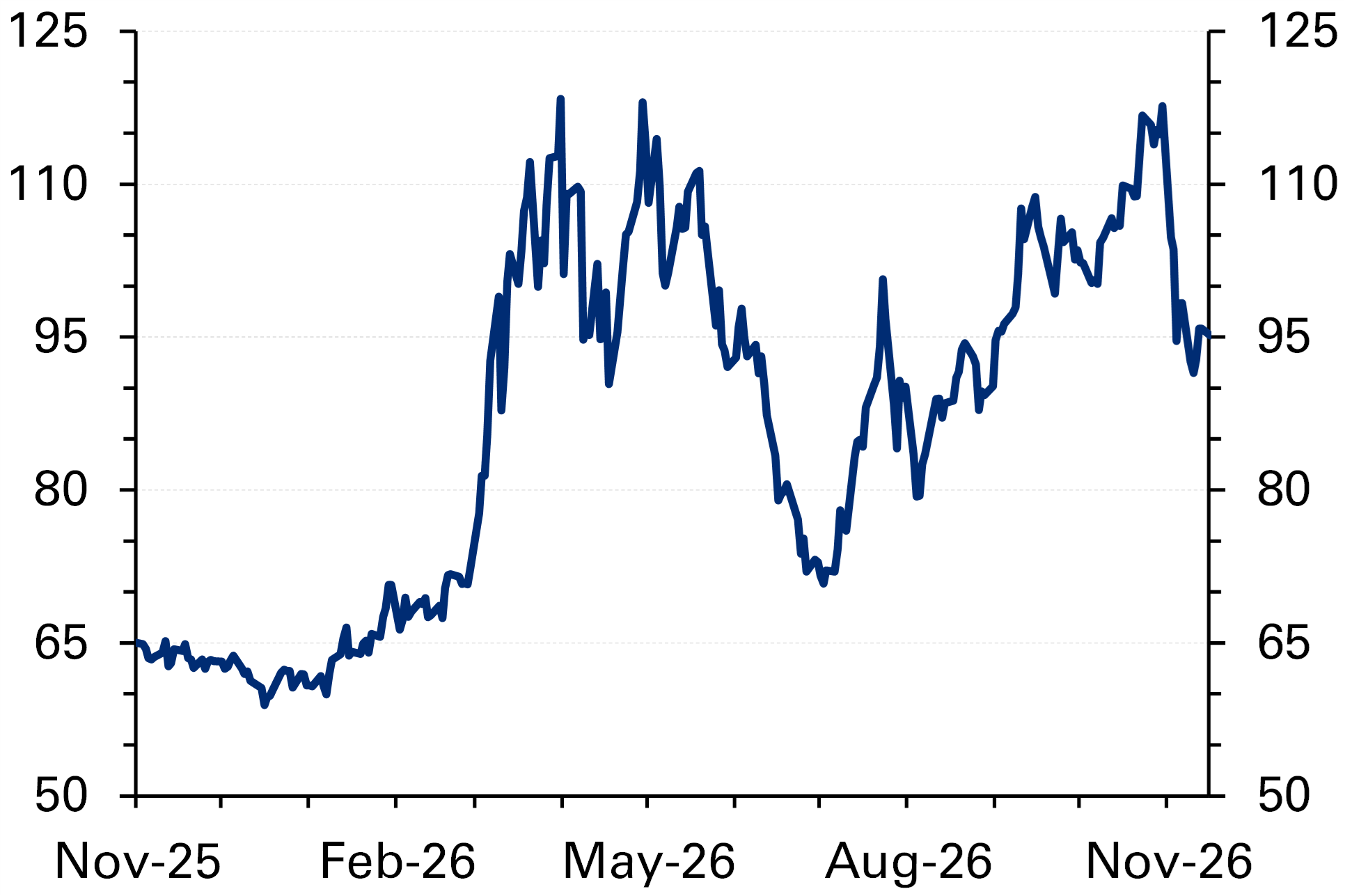
Oil: Prices fall for second consecutive week, physical market signals improving supplies. After a volatile trading week, Brent futures closed Friday at $95.8/bbl, down 2.5% w/w and a second consecutive weekly decline. Pressure on prices stemmed from a continued unwinding of the geopolitical risk premium associated with the US-Iran conflict, alongside growing evidence that crude supply from the Gulf is recovering more quickly than previously anticipated such that exports may have reached between 70-80% of pre-conflict levels, according to oil tanker traffic estimates. One notable indication of this has been the sharper decline in the spot prices of physical crude compared to the price of crude in the futures markets. The international physical benchmark, Dated Brent, had fallen by almost 20% in November (reading taken on 6th November) compared to around 16% for its futures equivalent, while local grade Kuwait Export Crude (KEC) was down almost 26% month-to-date compared to a decline of 18.5% for ICE Brent. Furthermore, physical premiums have switched to discounts, with both Dated Brent and KEC trading lower than ICE Brent (and by around $10 for KEC) – a sign that the physical market is more well-supplied than anticipated. Meanwhile, the IEA, in its latest monthly report for November, reinforced this more bearish market narrative. Higher Gulf exports helped lift global oil supply by 2.3 mb/d in October, prompting the agency to conclude that the market had moved into surplus territory this quarter. At the same time, the IEA revised its demand outlook lower and now expects global oil demand to decline by 2.7 mb/d, a further 100 kb/d downgrade from the previous report. The resulting improvement in market balances was reflected in global inventories, which increased by 52 mb m/m in October, marking the first monthly build since June. Much of the increase came from higher oil-on-water inventories linked to stronger Gulf exports, while onshore inventories fell and have remained near their lowest levels since 2016. More timely US inventory data point in a similar direction. The latest EIA figures showed commercial crude inventories rising in the w/e November 6, accompanied by increases in both gasoline and distillate stocks, suggesting that softer demand and improving supply conditions are beginning to ease some of the tightness that has characterized oil markets since the outbreak of the conflict.
China: Economic data broadly weak in October, missing forecasts and showing signs of lackluster stimulus impact. Economic data for October came in weaker than expected, marking a slowdown across the range of indicators. Retail sales growth slowed to 0.4% y/y in October (versus 0.8% forecast) from September’s 1.1% despite week-long holidays during the month that had been expected to support consumption. Meanwhile, the slump in fixed asset investments deepened to 8.1% y/y in 10M2026 from -7.2% in 9M2026, undershooting estimates by a wide margin. Industrial production growth, which has been the key driver of the Chinese economy recently also faltered, slowing to 4.8% y/y from 5.5% in September, missing the 5.3% consensus forecast. House prices continued to decline, albeit at a more moderate pace, indicating still-dampened homebuyer confidence with new house prices declining by 2.4% y/y (slower than the 2.8% fall seen in September). The economic slowdown underscores the lackluster impact of the recent stimulus, raising pressure on the authorities to introduce further fiscal/monetary policy support. The official statistics agency noted conditions as being overall stable and emphasized that the economy was extending “a trend of renewing growth engines and improving its structure,” but highlighted challenges related to geopolitics and a mismatched demand-supply situation.
Japan: GDP growth weaker than expected in Q3. Preliminary estimates for Q3 GDP growth came in at 0% q/q, missing consensus expectations of 0.1% and a sharp drop from Q2’s growth of 0.4%. Private consumption (more than 50% of GDP) fell by a weaker than expected 0.3% q/q, pressured by high inflation and bad weather. In addition, private consumption in Q2 was revised downward to a drop of 0.3% q/q from flat seen previously. Trade was a drag on growth with exports falling by 0.2% q/q while imports climbed by a strong 2.5%. In contrast, corporate investment was a bright spot, increasing by 1.6% q/q while Q2 was revised upward to a drop of 0.4% as opposed to a drop of 0.9% in the initial estimates. The weakest GDP growth in a year highlights the problems that policymakers have to navigate. Weak consumer spending suggests domestic demand may remain insufficient to sustain inflation in a positive way, although higher costs continue to push inflation higher. Despite this, the market continues to price in a BOJ rate hike in December, with an over 70% probability.
Global: Trilateral Trump-Xi-Putin meeting, Warsh’s comments at the Fed’s productivity taskforce conference, and UK/Japan inflation key matters this week. US President Trump will travel to China this week and is set to hold a trilateral meeting with Chinese President XI and Russian President Putin on the sidelines of the November 18-19 APEC summit in Shenzhen. In the US, the Fed, later today, will hold its first conference on the productivity and jobs taskforce, one of the five taskforces that Chair Warsh had constituted. Warsh will deliver opening remarks and will moderate several of the panel discussions. Minutes from the FOMC’s October meeting will be released on Wednesday, which, along with ongoing Fedspeak this week should continue to shape expectations ahead of the Fed’s December 8-9 meeting. In terms of data, retail sales in October (Tuesday) are seen staying flat after a 0.8% m/m increase in September. In the Eurozone, industrial production in September (later today) is seen rising 0.6% m/m after falling by 0.5% in August. In the UK, CPI inflation for October (Wednesday) is expected to rise further to 3.6% y/y from September’s 3.5%, but with a steady core rate of 2.8%. The unemployment rate for July-September (Tuesday) is seen remaining unchanged from June-August at 4.7%. Attention will also be on monthly job counts, which are showing signs of stabilization after two years of sustained losses. In China, the central bank (Friday) is expected to keep the one-year and five-year loan prime rates steady at 3% and 3.5%, respectively. Finally in Japan, inflation for October will be released on Friday, where the core rate is forecast to increase to 2.3% y/y, up from 2.1% in September. Trade data for October will be released on Wednesday, with export growth seen accelerating to 20% y/y (17% in September) and import growth to 26% y/y from 19% in September.
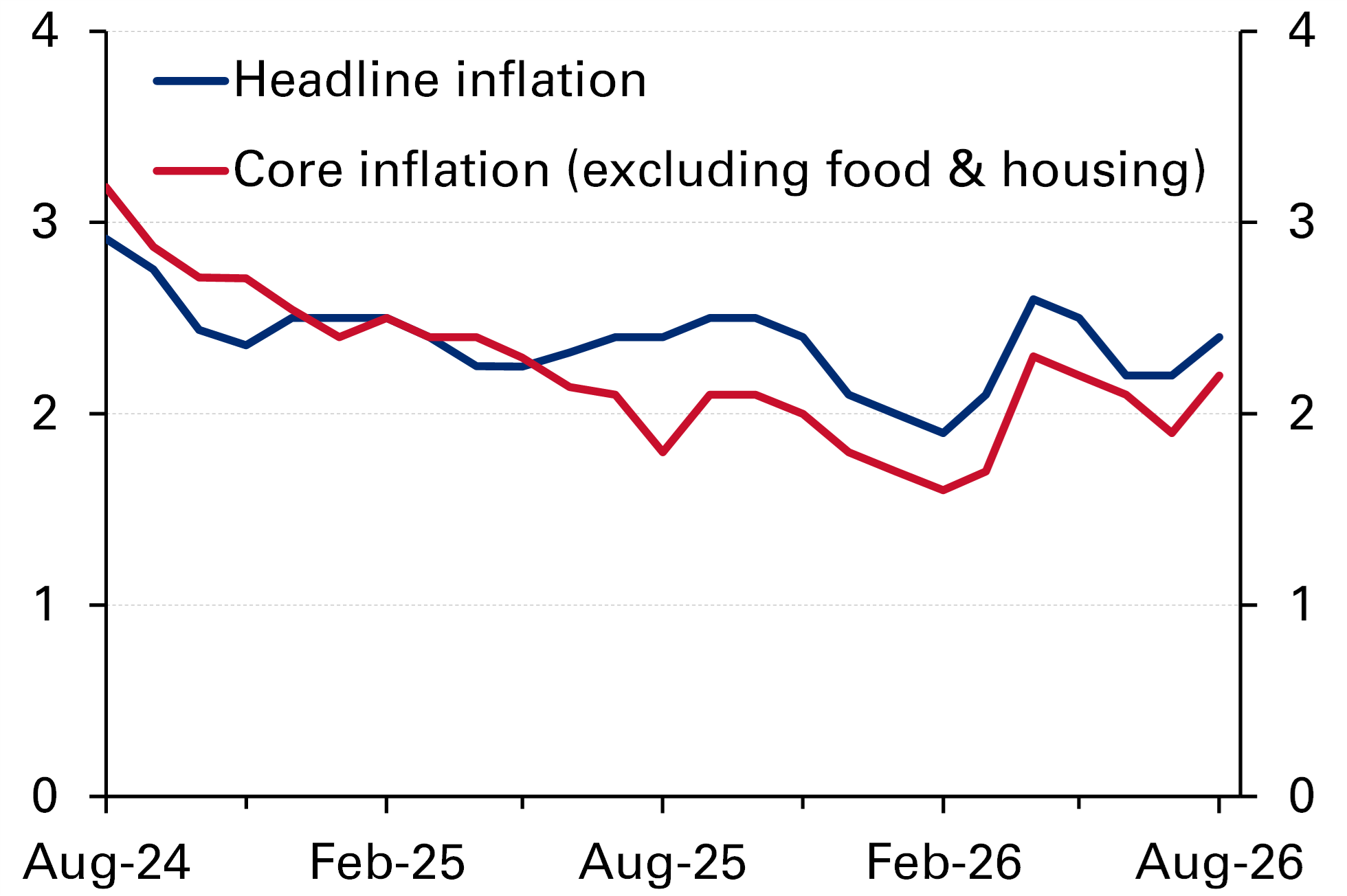
Kuwait: Inflation rises on broad-based price increases. CPI inflation accelerated to a three-month high of 2.4% y/y in August, up from 2.2% in July, driven primarily by stronger food price inflation. Food & beverage prices rose 6.3% y/y, matching the highest reading recorded this year, with higher fish & seafood prices continuing to be the main source of upward pressure. By contrast, housing inflation, which carries the largest weight in the CPI basket, remained subdued at 0.2% y/y, helping contain the headline rate. Excluding food and housing, core inflation picked up to 2.2% y/y from 1.9% in July, reflecting a broad-based increase across most categories. Transport inflation accelerated to 5.7% y/y, supported by higher airfares, while inflation in services & miscellaneous goods rose to 5.4% y/y, largely reflecting elevated precious metals prices. However, this source of pressure is likely to ease from October as favorable base effects begin to emerge. Elsewhere, inflation in communication and education remained unchanged at 1.0% y/y, while tobacco and cigarettes recorded a modest 0.7% y/y increase. Looking ahead, inflationary pressures stemming from the regional conflict appear only partially reflected in current CPI readings. Nevertheless, PMI surveys continue to point to rising input and output prices, suggesting that additional price pressures remain in the pipeline and could affect CPI readings in the coming months.
Saudi Arabia: Inflation eases to 1.7%, but housing remains the main driver. The inflation rate eased to 1.7% y/y in October, down from 1.9% in September, marking its slowest increase since April, while prices rose by 0.1% m/m after being flat in the previous month, according to GASTAT. The slowdown was mainly driven by softer food inflation, which eased to 1.1% y/y from 1.4% in September, and a slight moderation in housing and utilities inflation, which declined to 3.5% from 3.6%. Meanwhile, transport inflation was unchanged at 2.3%. Housing and utilities continued to be the largest contributor to overall inflation, accounting for around 0.7 percentage points of the 1.7% headline rate. Actual rents increased by 3.5% y/y, continuing their gradual slowdown from 5.2% in January. Service prices mostly increased, led by passenger transport services rose at 9.5%, insurance and financial services increased by 3.5% (partly reflecting a 6.5% rise in insurance costs) and recreation, sports and culture (2.7%). Overall, easing food inflation helped bring headline inflation lower, although housing and selected service costs remain the main sources of upward pressure.
Qatar: Fiscal deficit deepens amid continued disruption to hydrocarbon exports. Qatar's fiscal deficit widened to $6.3bn in Q3 2026, equivalent to roughly 13-14% of GDP, up from $5.8bn in Q2 and marking the largest budget shortfall since Q4 2016. Weaker fiscal performance was driven primarily by a sharp decline in revenues, which fell 65% y/y to $4.7bn. Sequentially, revenues also declined from around $7bn in Q2, partly reflecting the absence of one-off investment income booked during the previous quarter. Hydrocarbon revenues remained under severe pressure, declining 75% y/y amid continued restrictions on shipping through the Strait of Hormuz and the resulting disruption to LNG exports. Nevertheless, this represented an improvement from the 97% y/y decline recorded in Q2, helped by a partial recovery in crude shipments as maritime conditions eased somewhat. By contrast, non-hydrocarbon revenues remained resilient, increasing 9% y/y and providing a modest offset to the weakness in energy-related receipts. On the expenditure side, government spending fell 21% y/y, reflecting continued fiscal restraint amid weaker revenues. Much of the reduction came from lower capital expenditure, with both major and minor capex recording sharp declines. Current spending was also reduced, although at a more moderate pace, with salaries, wages, and other current expenditure categories posting smaller contractions. Overall, the data highlight the significant fiscal impact of the disruption to Qatar's LNG exports, while also illustrating the government's willingness to adjust spending in order to contain the deterioration in public finances.
Download Full Report >