
 +965 2292 4888


Daily Economic Update
26.10.2026
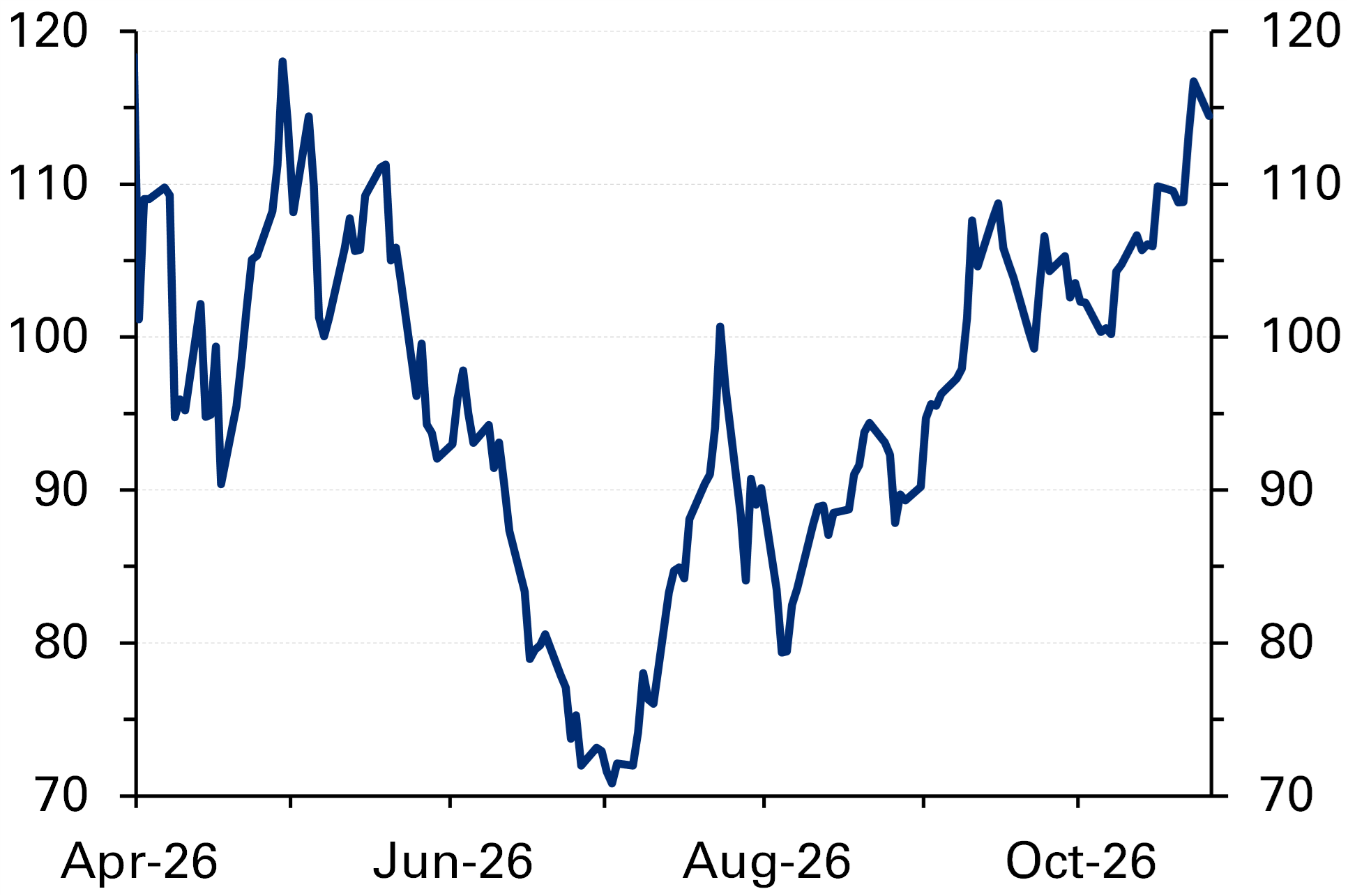
Oil: Prices pull back from near six-month highs in early trading. Oil futures opened lower this morning in Asian trading, with Brent falling around 2% to $114/bbl (+87% ytd) after briefly approaching six-month highs at the end of last week. The pullback appears to reflect some unwinding of the geopolitical risk premium, with Qatari mediators also travelling on Sunday to Tehran to resume peace negotiations, and despite further attacks on Saudi oil facilities, particularly assets linked to the East-West pipeline, by the Houthis. Another attack was also reported this morning. Last week, Brent rose 6.2% w/w to settle at $116.7/bbl, its highest close since late April, amid increasing concerns over Middle East supply security. Continued Saudi-Houthi hostilities were a key driver, alongside growing speculation that the US-Iran confrontation could re-escalate after comments from US President Trump suggesting that military action could resume following the 3rd of November midterm elections. Additional support came from a broader evacuation of US diplomatic personnel across the region, reinforcing perceptions of heightened security risks.. Elsewhere, Iranian attacks on vessels transiting the Strait of Hormuz reportedly intensified last week, with an oil spill detected off the UAE coast, highlighting the growing threat to maritime traffic.
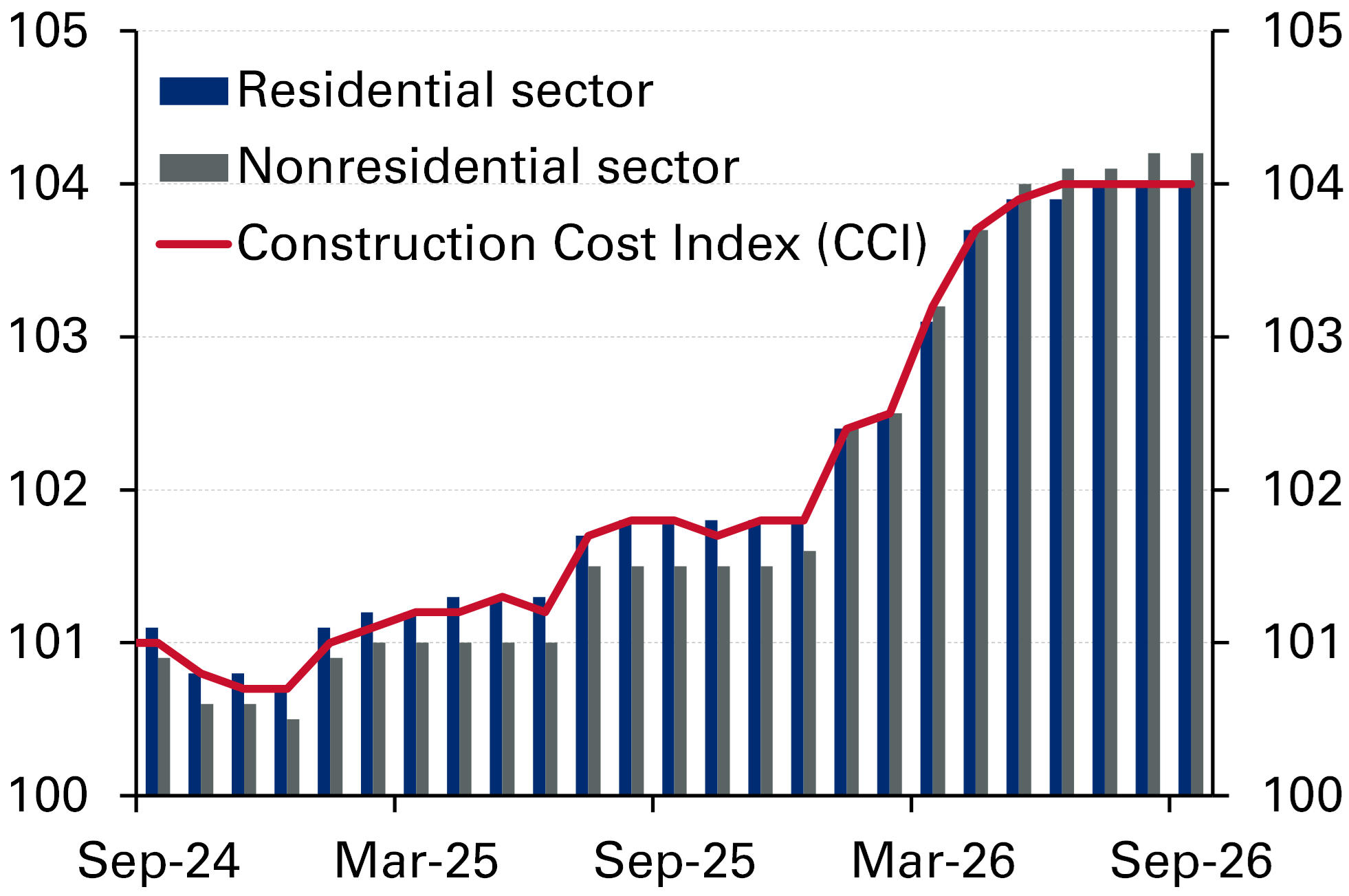
Saudi Arabia: Construction cost inflation eases slightly in September. Construction costs increased by 2.2% y/y in September, according to GASTAT. This marked a slight easing from August’s rate of 2.3%. Residential construction costs, which account for around three-quarters of the index, increased by 2.2%, while non-residential costs rose by 2.7%. Equipment rental remained the main source of cost pressure. Rental costs for machinery and equipment increased by 4.1% in the residential sector and by 5.8% in the non-residential sector. Rental of plants and equipment with an operator rose even faster, by 5.5% and 7.2%, respectively. In comparison, materials and labor costs increased at a more moderate pace of around 1.5% to 2.0%, while energy costs rose by 3.0% in both segments.
Egypt: Final IMF review puts asset sales and energy subsidies under scrutiny. An IMF mission has arrived in Cairo for the eighth and final review of Egypt’s $8 billion Extended Fund Facility (EFF) and the final review under the Resilience and Sustainability Facility (RSF). Successful reviews could unlock around $2.3 billion in funding, including $1.5 billion under the EFF and $800 million under the RSF. Discussions will focus on state asset sales, private-sector participation, exchange-rate flexibility and monetary policy. Asset sales are a key priority, with the IMF seeking around $1.5 billion in proceeds by the end of the program. The government was still around $1 billion short of this target last week and is counting on the Banque du Caire IPO to help close the gap. At the reported price of EGP 5.30 per share, the planned 45% stake sale could raise approximately $680 million. Energy subsidies will also feature prominently in the talks. The government has postponed two fuel price increases agreed under the previous review, keeping prices unchanged through December to limit the burden on households amid higher energy costs. Discussions are expected to address subsidy reforms and the financial health of the oil and electricity sectors. With the program due to expire on 15 December, the government is also preparing its National Economic Transformation program for 2027-2030, which is expected to set clear benchmarks to sustain reform progress beyond the IMF program.
Global: Fed/ECB/BoJ meetings, US/Eurozone Q3 GDP, and UK budget key matters this week. This week is important in terms of economic events, with major central bank policy decisions and key data releases, especially in the US and the Eurozone. In the US, the FOMC meets on Tuesday/Wednesday, with the market pricing indicating around 90% probability for a hold in rates. Attention will be on Chair Warsh’s press conference and the number of dissents, if any. In terms of economic data, GDP growth in Q3 (Thursday) is forecast to accelerate to 3.2% q/q annualized from Q2’s 2.2%. PCE inflation for September is due on Thursday where the core rate is seen rising to 3.1% y/y from 3% in August. In the Eurozone, the ECB’s policy decision is due on Thursday, where rates are expected to remain unchanged. Meanwhile, flash Q3 GDP (Friday), is expected to show growth of 0.2% q/q after a solid 0.6% in Q2. In the UK, Chancellor Healey will present his first Autumn budget on Wednesday and he is already facing challenges given higher market borrowing costs and fiscal deficits that are overshooting original forecasts. In China, attention will be on the Fifth Plenary Session of the Communist Party’s Central Committee, scheduled for Monday through Thursday, for any fresh signals on the country’s economic and policy direction. Meanwhile, the October PMIs are due on Saturday with the manufacturing survey reading seen unchanged at 50.1 and the non-manufacturing reading seen improving to 50.5 from 50.2. Finally in Japan, the BoJ’s policy decision is due on Friday where rates are expected to remain unchanged. Attention will be on Governor Ueda’s press conference and on the release of a new set of economic projections. Several important data releases are also scheduled for Friday; Tokyo’s core CPI inflation is projected to inch down to 2.6% y/y in October (+2.7% in September), retail sales growth is seen accelerating to 3.3% y/y in September (+2.7% in August), and industrial production is forecast to increase by 1.3% m/m in September (-2.4% in August).