
 +965 2292 4888


Daily Economic Update
12.11.2026
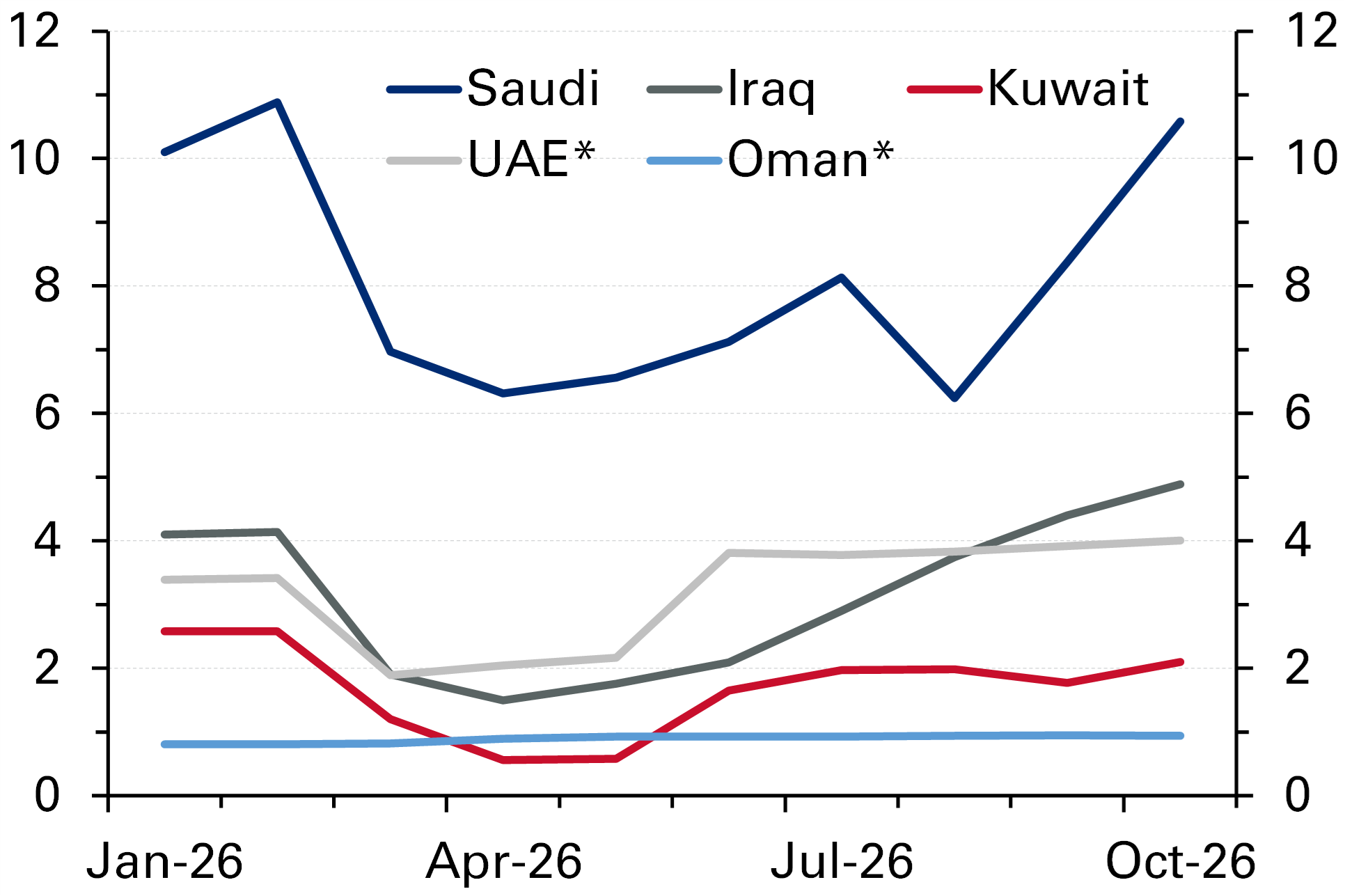
Oil: Prices decline on easing risk premium; Saudi oil production back to pre-war levels. Brent futures have come under pressure this week, touching a two-month low below $90/bbl on Tuesday, as a softer geopolitical risk premium weighed on prices. The decline followed comments from US officials downplaying the likelihood of further military action against Iran, unwinding part of the premium previously built into the market around the possibility of a US strike ahead of the mid-term elections. Nevertheless, the region remains in a state of neither war nor peace, with the absence of a lasting agreement keeping geopolitical uncertainty elevated and Brent inching up towards $91/bbl at the time of writing. Adding to the downward pressure were positive developments in the Russia-Ukraine conflict, as both sides held talks in Abu Dhabi and agreed to a major prisoner exchange, providing some signs of diplomatic progress. Meanwhile, OPEC's latest monthly report showed that the group's crude production in October had almost recovered to pre-conflict levels. According to OPEC's secondary sources data, DoC output (including the UAE) reached 41.2 mb/d in October, broadly matching February 2026 levels. The rebound has been driven primarily by Gulf producers, which have increasingly relied on ship-to-ship transfers to move crude exports through the Strait of Hormuz amid the gradual normalization of shipping routes. Direct communication data showed Saudi production surging by 2.2 mb/d m/m to 10.6 mb/d, although volumes supplied to market were considerably lower at 9.2 mb/d, suggesting that a significant portion of the additional output was directed into storage. Production also increased in Iraq (+489 kb/d m/m to 4.9 mb/d) and Kuwait (+326 kb/d to 2.1 mb/d). On the demand side, OPEC left its growth projections unchanged at 180 kb/d for 2026 and 2.55 mb/d for 2027, following six consecutive downward revisions.
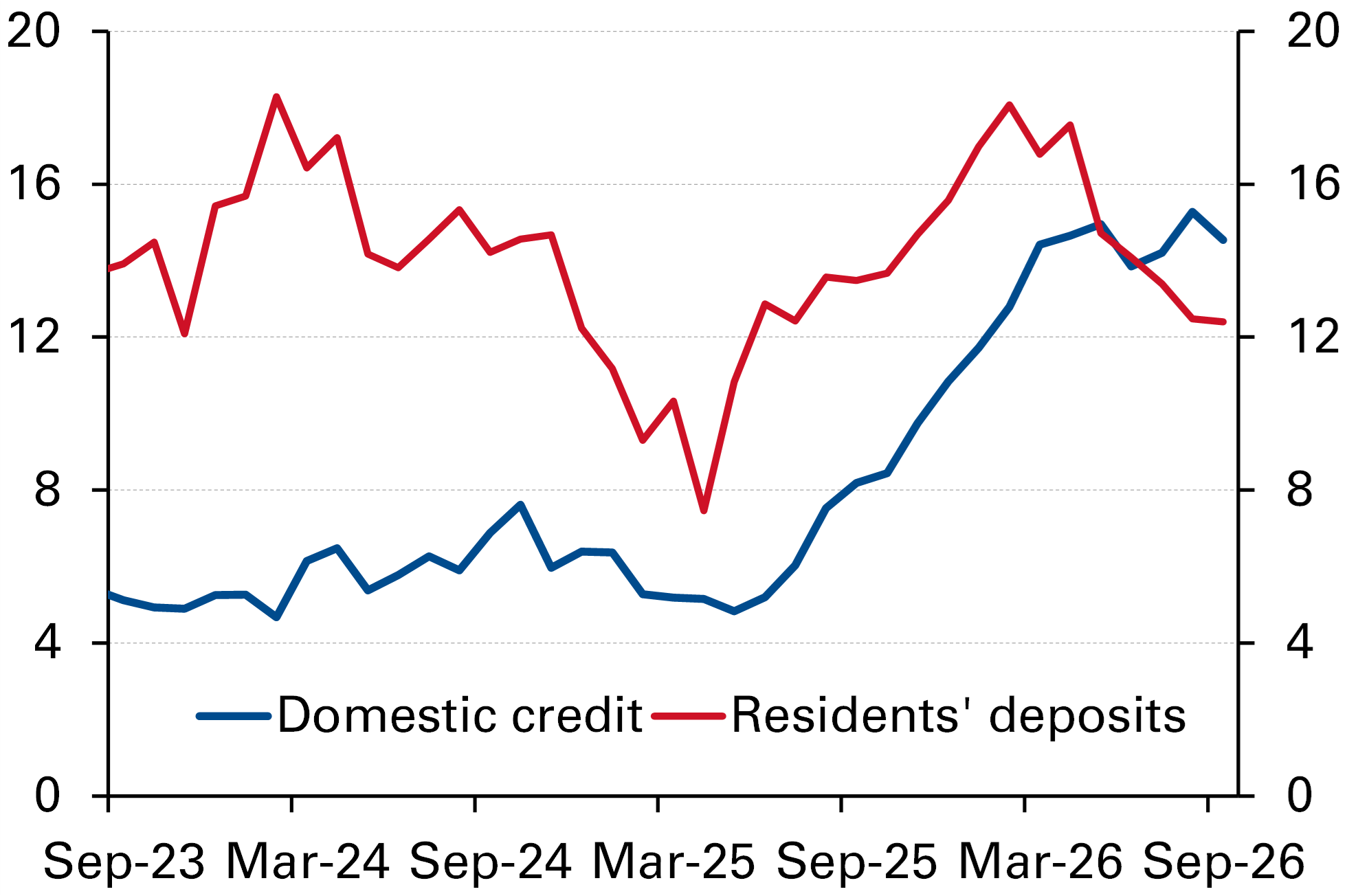
UAE: Domestic credit growth eases in September but remains robust amid resilient economic activity. Domestic credit growth moderated to 14.5% y/y in September from August’s series high of 15.3%. Private-sector credit grew by 12% y/y, slightly down from August’s 12.6%, but still one of the strongest rates in nearly a decade. The moderation came on slower growth in personal credit (+18.9%) and corporate borrowing (+8.0%). Meanwhile, public-sector credit (government plus GREs) continued to post double-digit growth, though slightly slowing to 20% y/y due to the moderation in GREs credit. On the liabilities side, resident deposits growth was broadly stable at 12.4% y/y in September with public-sector deposits rising by 17% supported by a sharp increase in GRE deposits (35%), while private-sector deposit growth stood at 11.3%, driven by continued gains in both corporate (13.1%) and personal (8.3%) deposits. Strong credit growth in September highlights the resilience of the economy despite conflict-related disruptions, and notably that higher living costs (CPI inflation in Dubai for example stood at 5.5% y/y in October) have not yet delivered a sharp slowing in personal lending.
Japan: Dovish BoJ board member Asada cautions against a quick pace of rate hikes. BoJ policymaker Asada, in a speech, cautioned against a quick pace of rate hikes, warning that “recent price increases have not necessarily been driven by demand factors” and “consumption has not necessarily been strong“. Asada is widely known to be a dovish member of the BoJ policy board, and has voted against the recent BoJ rate increases in both June and September. Market pricing, however, is signalling a rate hike with around 70% probability at the upcoming BoJ meeting in December. Meanwhile, in terms of data, and indicating ongoing price pressures, PPI inflation climbed to 7.1% y/y in October (6.8% in September), exceeding expectations (6.5%) by a wide margin.
UK: Housing market outlook worsens as per RICS survey data. According to a Royal Institution of Chartered Surveyors (RICS) survey, the net balance of expected residential property sales over the next 12 months fell to its lowest level since July 2023 at -17 in October from zero in September, with the gauge of new buyer enquiries remaining steady at -24, consistent with a subdued outlook and weak momentum. The RICS house price indicator (over the past three months) turned more negative at -36 from -34, falling for two straight months and reversing the tentative stabilization trend seen over the summer. The price outlook for the next 12 months was also weak, signaling a modest drop of around 1%. We note that housing market indicators from other agencies including Nationwide and Lloyds Bank are also pointing towards a soft landscape amid heightened geopolitical uncertainty, rising inflation, and high interest rates. The Bank of England expects CPI inflation to climb to around 4.9% y/y by Q2 next year from 3.5% in September and it is seen raising interest rates further after hiking the bank rate by 25bps last week, which will continue to weigh on housing market activity.
Download Full Report >