
 +965 2292 4888


Daily Economic Update
09.08.2026
Kuwait: Fitch maintains Kuwait’s sovereign rating despite conflict impact. Fitch maintained Kuwait’s sovereign credit rating at AA- (high investment grade) on Friday, also maintaining a stable outlook. It said that the collapse of the US-Iran MOU in mid-July means the conflict “will remain a source of risk for Kuwait’s creditworthiness”, with Kuwait continuing to be subject to attacks from Iran that have damaged infrastructure and disrupted transit conditions. Even if a new ceasefire is agreed, “there is a high risk that the geopolitical situation will remain unstable”. However, Fitch noted that “the implications for sovereign risk will remain manageable given the sovereign's large [financial] buffers.” It said that it expected some normalization of shipping across Hormuz in the near term, with oil exports having reportedly reached around 2 mb/d in July, but that uncertainty remained high. On the broader economic climate, Fitch expects non-oil growth to weaken but remain positive, “supported by public infrastructure spending, public sector employment and the central bank's support for the banking sector.” It forecasts a budget deficit of 19% of GDP in FY26/27, with the majority of that deficit financed by borrowing. Fitch’s decision to leave the rating unchanged mirrors the announcements by both S&P and Moody’s, which have both maintained Kuwait’s rating at AA- and A1, respectively, since the conflict began in February.
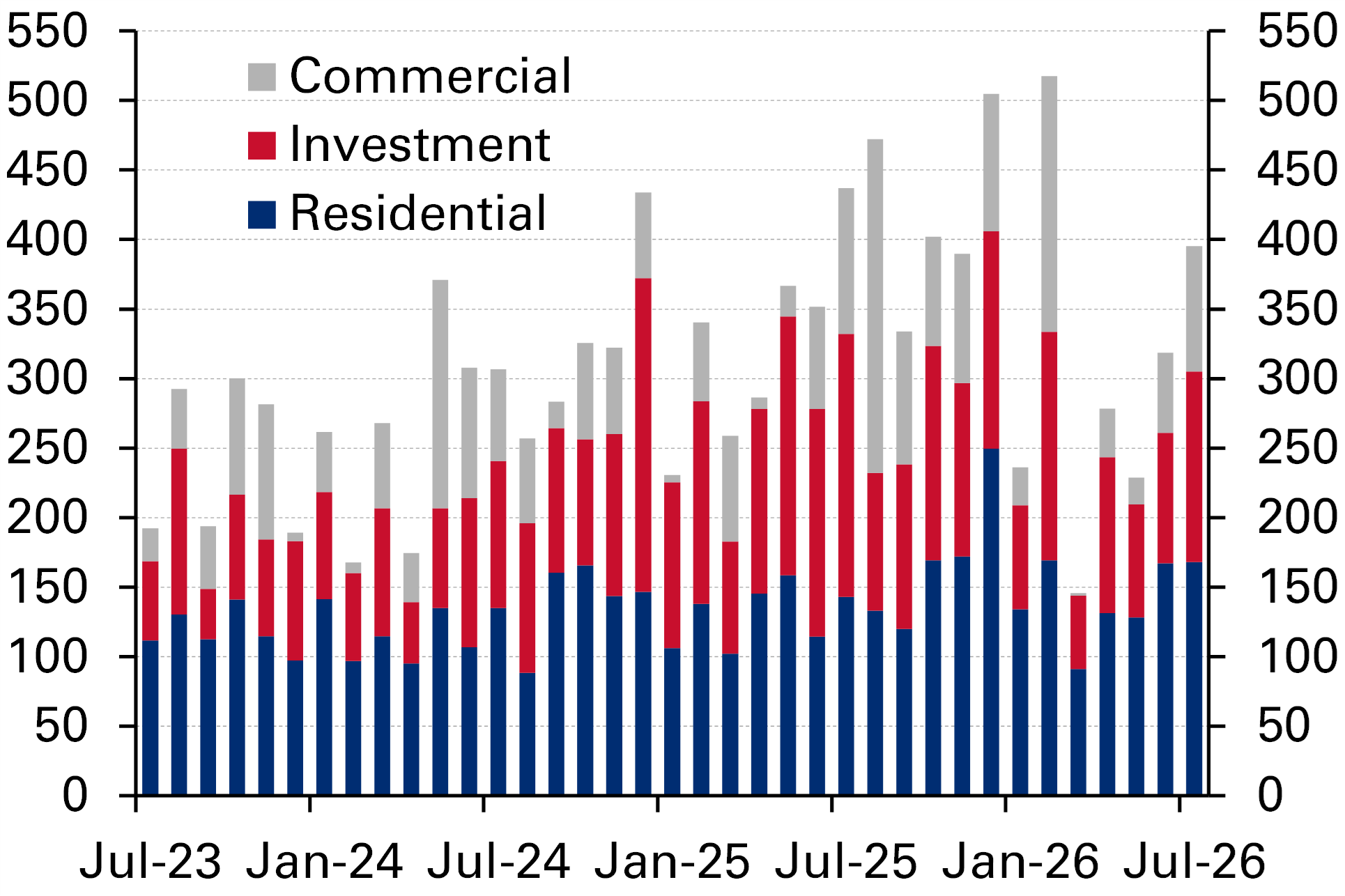
Kuwait: Real estate sales extend recovery in July as market stabilization continued. Property sales rose for the second consecutive month in July, climbing to KD 395 million (+24% m/m), the highest level in three months, though still 9.6% below the level recorded a year earlier. The increase builds on the recovery that began in May and suggests that the market is continuing to stabilize following earlier weakness, helped by easing regional geopolitical tensions. July’s gain was driven primarily by a rebound in the investment and commercial segments, while residential activity remained resilient. Residential sales stood at KD 168 million (+17.6% y/y; +0.5% m/m), broadly unchanged from June but maintaining the improvement seen in that month. Activity in the segment was supported by transaction volumes, which rose 10.9% y/y, pointing to firm underlying demand despite a m/m decline of 8.7%. Meanwhile, investment sales rebounded sharply to KD 137 million (+46 % m/m), recovering part of the weakness that has characterized this segment since the start of the year, though sales declined by 28% y/y. Commercial sales, the market’s most volatile component, also rose significantly to KD 90 million (+57% m/m; -14.1% y/y). Overall, July’s performance adds to evidence that real estate activity is gradually recovering from the softness seen in Q1 and Q2, though uneven annual trends across segments suggest that investors’ confidence remains restrained.
UAE: Growth sharply moderates in Q1 amid contraction in hydrocarbon production. Real GDP expanded by 3.0% y/y in Q1 2026, marking the slowest Q1 growth rate since 2021 and a sharp deceleration from 8.5% y/y in Q4 2025. The slowdown was driven primarily by the decline in oil GDP (-3.4% y/y), following a 9.9% y/y increase in Q4 as oil production fell to 2.88 mb/d in Q1 2026, down 1.0% y/y and 14.5% q/q with much of the decline concentrated in March following the outbreak of the US-Iran conflict in late February, which weighed on regional energy activity. On the other side, the non-oil sector remained the main driver of growth, though slowing to 4.8% y/y, also the weakest pace since Q1 2021 and down from 8.1% y/y in Q4. Sectoral growth trends were mixed with the construction (8.1% y/y versus 13.4% in Q4 2025) and the “professional, scientific and technical activities” sectors (4.9% y/y versus 8.0%) moderating. In contrast, several service sectors gained momentum, such as financial and insurance activities (17.3% versus 11.2%), health and social services (7.7% versus 6.0%), and information and communication (5.9% versus 5.4%). Despite the moderation in non-oil growth, its share of total real GDP rose to 79.4%, highlighting continued progress of the UAE's economic diversification strategy. Looking ahead, oil sector growth is likely to improve in Q2 as multiple media outlets reported that ADNOC restored crude exports to near pre-war levels in June and July. The recovery in exports and production suggests that the March disruption linked to the US-Iran conflict was in some part temporary, supporting a meaningful rebound in oil GDP growth in Q2 and potentially a return to positive y/y growth.
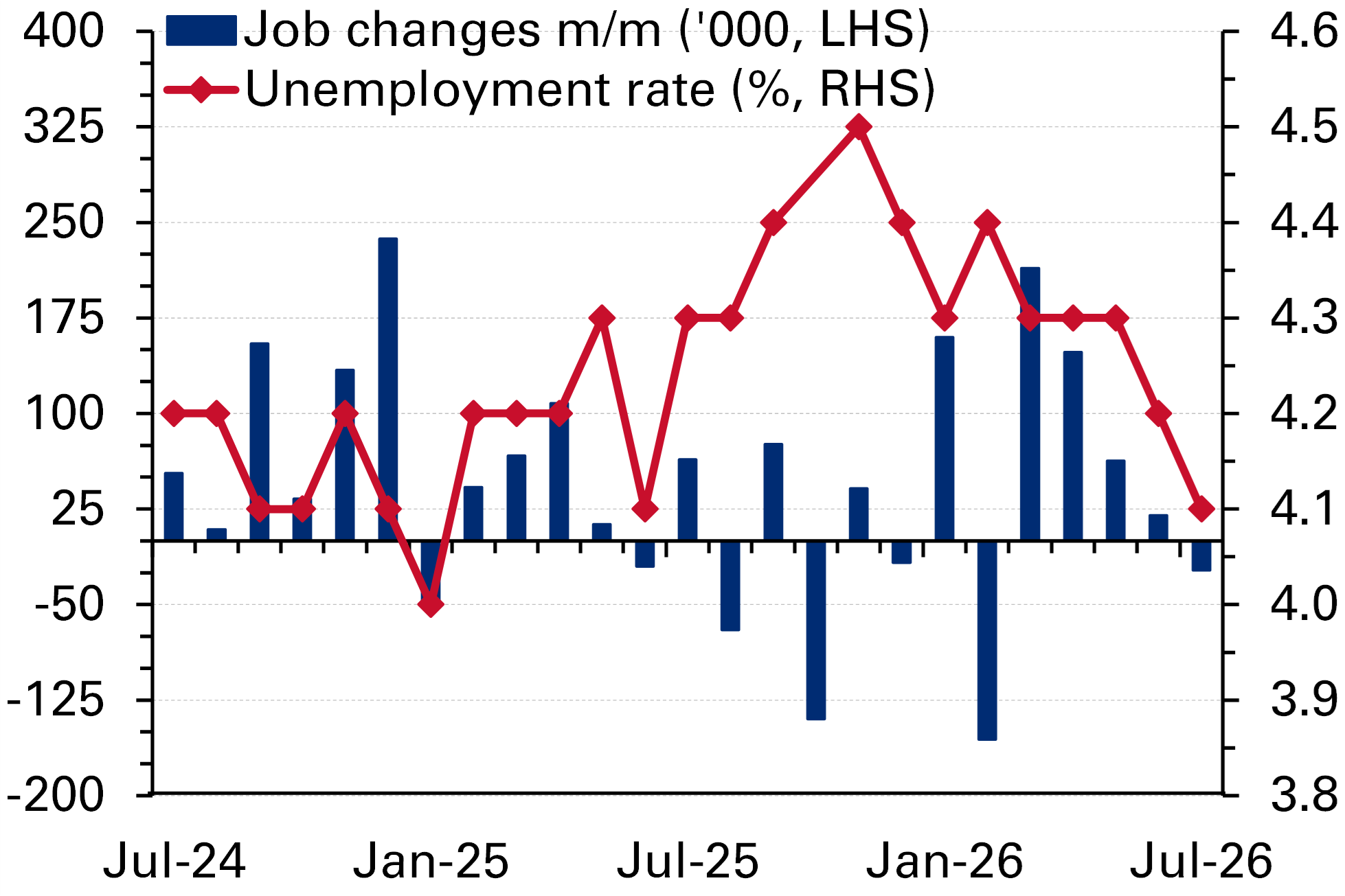
US: Job data in July abruptly weakens, pushes down Fed rate hike expectations. Non-farm payrolls in July surprisingly fell 23K from a downwardly revised increased of 20K in June, much weaker than the consensus forecast of a rise of 80K jobs. Moreover, employment figures for May and June were revised down by a combined 103K, indicating that the recovery seen earlier in 2026 may be losing momentum; the 3M average job growth now stands at just 20K, sharply down from 142K in May. Even though July’s data was weak, the fall was mainly contributed by a 50K drop in government education roles, likely distorted by seasonal factors around the summer school closings. Private sector employment growth was flat at 30K, matching the lowest reading in five months. The unemployment rate, however, dropped for the second consecutive month to 4.1% from 4.2% in June, an over one-year low, but the fall was once again driven by a decline in the labor participation rate to 61.4% from 61.5% in June. In fact, the participation rate declined to the lowest level since the 1970s, outside the pandemic. Wage growth also moderated to the slowest rate in five years at 3.2% y/y from 3.4% in June, underscoring continued easing in wage-linked pressures on inflation. July’s weak labor market prints have again put the Fed’s dual mandate at clash. While inflation continues to be stubbornly elevated versus the Fed’s 2% goal, the renewed weakness in the job market, especially if additional incoming data enforce that trend, should likely widen the divide among Fed policymakers about the near-term monetary policy path. For now, the fact that the unemployment rate remains at 4.1%, and has been dropping, even for the wrong reasons, may keep the focus more on the inflation mandate. The futures market, which was pricing in an almost 70% probability of an interest rate hike at the FOMC’s September meeting few days ago, pared down those expectations to around 45% after the release of the latest job report. Meanwhile, unsurprisingly, the Trump administration reinitiated its efforts to sack Fed Governor Lisa Cook by serving her a formal notice, stating that the president is considering removing her from the post on mortgage frauds. Previously, the US Supreme Court in June had upheld lower courts’ verdict of reinstating Cook after Trump fired her last year while the case to establish the alleged fraud is still ongoing.
Eurozone: Retail sales below expectations in June, with annual growth the weakest in two years. Retail sales fell by 0.3% m/m in June, following an upwardly-revised 0.4% increase in May, coming in weaker than expected. Performance remained mixed across categories with food, drinks and tobacco sales declining by 0.5% m/m and non-food sales falling by 0.4%, while automotive fuel sales increased by 1.5% after sharp decreases in April and May. On an annual basis, retail sales growth slowed to 0.7% in June (1.9% in May), the softest growth in two years, pressured by a 6.6% drop in automotive fuel sales.
China: Inflation eases in July, while export growth remains in double digits beating expectations. China’s CPI inflation remained subdued in July, easing to 0.5% y/y from 1.0% in June, falling short of market forecasts of 0.8% and suggesting that domestic demand remains soft. Meanwhile, core CPI, which excludes food and energy prices, rose 0.9% y/y (1% in June), indicating that underlying price pressures remain very moderate. Separately, China’s trade data remained robust at the start of Q3, with exports rising 24% y/y in July, surpassing forecasts of 22%, although growth slowed from the exceptionally strong 27% recorded in June. The solid export growth was supported by continued strength in high-tech shipments, alongside higher growth in exports to the US, helped by base effects. Meanwhile, imports rose by around 28% in July (+36% in June), helped by firm demand for industrial inputs and components. Despite moderating from June’s USD 126 billion, the trade surplus remained elevated at around USD 113 billion, underlining the economy’s continued reliance on external demand as domestic demand remains comparatively weak.