
 +965 2292 4888


Daily Economic Update
15.09.2026
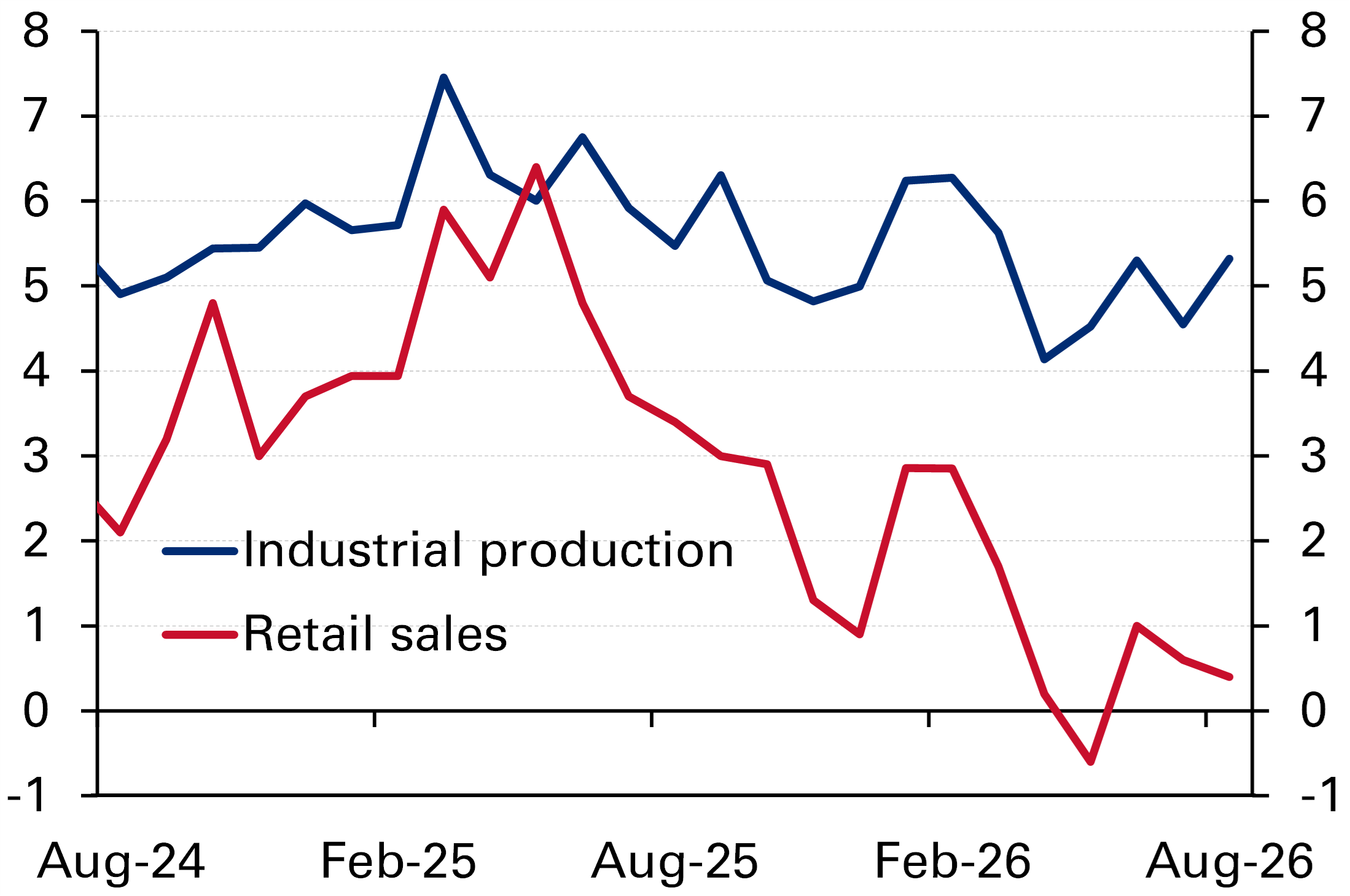
China: August data point to ongoing domestic demand weakness. Economic indicators released today underscored the two-speed nature of China’s economy, as robust manufacturing activity continued to support growth amid ongoing weakness in consumer demand and investment. Retail sales growth slowed further to a lower-than-expected 0.4% y/y in August from 0.6% in July, underscoring weakness in household spending. In addition, fixed-asset investment contracted 7.2% y/y in 8M2026, worsening from a 6.7% y/y decline in 7M2026 and marking the steepest drop since April 2020. Within that, property investment remained a major drag, falling 20% y/y in the same period, while AI-fueled growth helped lift high-tech investment by 5.2%. The urban unemployment rate edged up to 5.3% from 5.2%, indicating some deterioration in labor market conditions. Meanwhile, housing prices continued their downtrend in August with new house prices falling 3.0% y/y in August, though less steep than July's 3.2% decline. In contrast to the negative news above, industrial production accelerated to a higher-than-expected 5.2% y/y in August from 4.5%, with manufacturing activity reportedly supported by demand for hi-tech goods linked to the AI boom. Overall, the latest data reinforce the trend of weak consumer spending and investment weighing on growth while parts of the industrial sector remain relatively robust. The ongoing muted domestic demand will increase pressure on Beijing to implement additional support measures in order not to miss the government’s growth target of 4.5% to 5% in 2026.
Egypt: Government eyes $3 billion international bond issuance in Q4. The Ministry of Finance is considering a return to international debt markets between October and December, as it seeks to secure foreign funding and narrow the financing gap. The government has approved the move, which will incorporate a mix of conventional and innovative instruments, including credit-guaranteed Panda bonds. The ministry plans to time the issuances based on market conditions and investor demand, while diversifying funding sources and seeking longer-term financing at lower costs. Development-bank guarantees could help improve borrowing terms and make some of the planned instruments more attractive to investors. Egypt faces around $7.5 billion in external debt obligations and maturities during FY26/27, including approximately $4.5 billion in concessional development loans and $3 billion in maturities on conventional bonds, sukuk and Panda bonds.
UAE: Abu Dhabi introduces new mortgage rules to support off-plan property market. Abu Dhabi has introduced a new framework that allows buyers of off-plan properties to secure mortgage financing during the construction phase once they have paid at least 50% of a property’s value. The framework also permits mortgage registration before project completion, providing buyers with greater certainty over future payments and reducing financing risks as projects progress. The reform comes amid strong demand for off-plan real estate, which accounted for 89% of Abu Dhabi’s residential sales value in H1 2026, according to ADREC. While the emirate’s property market recorded AED117 billion in total transactions in H1 2026, mortgage-backed transactions amounted to only AED26.7 billion, highlighting the market’s continued reliance on cash purchases. Against this backdrop, the new framework could broaden access to financing, enhance market liquidity, and strengthen investor confidence. Developers are also likely to benefit from improved visibility over future payments and a reduced risk of buyer defaults during the later stages of construction. Aldar and other developers have already started offering off-plan financing solutions under the framework in partnership with local banks, marking a step toward deepening mortgage penetration and supporting the sustainable growth of Abu Dhabi’s residential market.
Saudi Arabia: Major rare earth and uranium resources identified. Saudi Arabia has announced the discovery of an estimated 110 million tons of mineral resources at the Jabal Sayid project in Madinah, containing high concentrations of rare earth minerals, particularly heavy rare earth elements, as well as promising concentrations of uranium. The discovery comes as the Kingdom moves forward with plans to include nuclear energy in a more diversified and sustainable national energy mix. Saudi Arabia is also developing a national program to explore its uranium resources and identify opportunities to use them domestically. The initiative forms part of a broader strategy to develop domestic industries around critical and rare earth minerals. The Kingdom aims to leverage its natural resources, competitive energy costs, infrastructure and investment capabilities to attract technology and investment into these sectors. The Minister of Energy, Industry and Mineral Resources said the discovery places Jabal Sayid among the most significant rare earth mineral resource sites currently under development globally, highlighting its potential importance to Saudi Arabia’s ambitions to develop a domestic critical minerals industry.