
 +965 2292 4888


Daily Economic Update
19.11.2026
US: FOMC October meeting minutes show Fed’s inclination for further action; Governor Waller reiterates his call for a bigger 50bps hike in December. Minutes from the FOMC’s October meeting, at which it left interest rates unchanged in a 10-2 vote (two members voting for a hike) following September’s 25bps hike, showed that almost all participants judged that further action to raise the interest rate would be appropriate to bring inflation back to the 2% target. Moreover, it said that “a couple of participants noted that an increase of more than 25bps could warrant consideration at the next meeting if incoming inflation data were unfavorable.” Importantly, contrasting with Chair Warsh’s strong preference for not providing any forward guidance, the minutes showed that “a few participants who favored an increase in the target range indicated that they could have supported no change in the federal funds rate provided that it was clearly understood by market participants that further tightening was likely.” As we noted previously, other Fed officials are filling the void left by Chair Warsh’s limited communication as the recent commentary from several Fed officials indicates a growing preference for further rises in interest rates given high inflation, with the debate open on the pace of tightening. For now, a 25bps rate hike in December is certain based on the market pricing. Meanwhile, Fed Governor Waller reiterated his call for a bigger 50bps increase at the upcoming meeting, saying a 25bps increase in December would only work if the FOMC sends “credible signal” for another hike in January. However, his call for an outsized rate hike in December remains a minority view with the influential New York Fed President Williams mentioning that he doesn’t see the need for “dramatic action”. The futures market currently indicates a 73% probability of at least two 25bps interest rate increases by January and a 27% probability for only one hike by then.
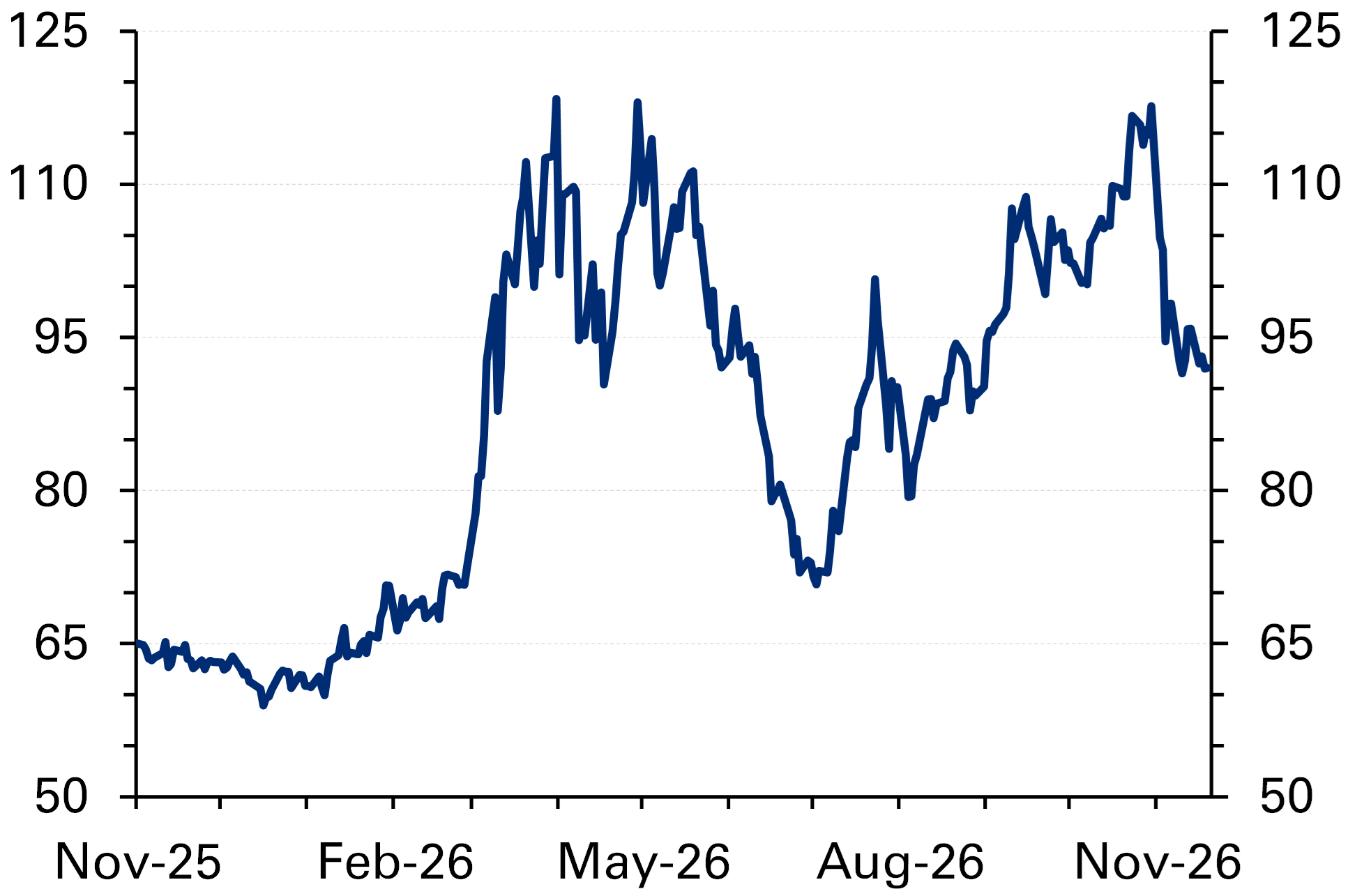
Oil: Prices decline on improving supply picture. Oil prices have continued to trend lower this week, with Brent futures trading near $92/bbl, around $4/bbl below last Friday's close, as markets increasingly focus on improving supply conditions despite continued exchanges of strikes between the US and Iran. Evidence of recovering physical supply has become more apparent, with OPEC data showing Gulf production in October at its highest level since the start of the conflict. Similarly, the IEA recently indicated that the oil market is entering surplus territory in Q4, supported by Gulf oil exports rising to 18.4 mb/d in October, only 26% below pre-war levels. Higher output from both OPEC and non-OPEC producers is also easing pressure on inventories. Latest EIA weekly data showed a 3.4 mb w/w increase in US commercial crude stocks, while gasoline and distillate inventories rose by 5.2 mb and 1.6 mb, respectively, pointing to a gradual easing in refined product markets as US gasoline and diesel prices hit multi-month lows. Although SPR stocks declined by a further 3 mb as part of coordinated releases with the IEA, overall inventory data suggest supply conditions are becoming more comfortable. US crude production also reached a fresh record of 14.032 mb/d.
UK: CPI inflation rises but stays below the BoE forecast; markets still assign 80% probability of a bank rate hike in December. CPI inflation in October rose to a 12-month high of 3.6% y/y from 3.5% in September, slightly below the BoE’s forecast of 3.7%. The rise was mainly driven by a 33% y/y surge in motor fuel prices during the month along with higher regulatory utility costs, while tobacco prices also rose steeply after the increase in duty that took effect in October. Core inflation, however, was unchanged from September at 2.8%, again lower than the BoE forecast of 2.9%. While goods inflation increased to 3.5% from 3.2%, key services inflation was steady at 3.7%. The BoE expects CPI inflation to continue rising over the coming months mainly due to higher energy costs, reaching a peak of 4.9% by Q2 2027. Accordingly, futures market pricing still signals an around 80% probability of another 25bps rate hike in December following the similar move in early November.
Japan: BOJ’s Ueda brushes off weak private consumption, keeping December hike in play. In a parliamentary session, BOJ Governor Ueda argued that the recent decline in private consumption is unlikely to sustain, as he expects consumer spending to return to a rising trend, stating that “the positive cycle from income to spending will be maintained and personal consumption will return to a moderate growth trend”. This follows earlier rhetoric in the BOJ’s quarterly outlook, where the BOJ stated that private consumption is expected to improve in the second half of FY2027. Private consumption, a key component that accounts for roughly 50% of GDP was weak in Q3 (-0.3% q/q). Ueda also stated that he expects the pace of inflation to gradually slow from here. Ueda’s expectation about improving private consumption and less inflationary pressures appear to act as a signal to markets about the ongoing probability of a hike in the BOJ’s meeting in December. Markets have already priced over a 70% chance of a hike in December.
Egypt: IMF staff and the government reached agreement on the final review. The International Monetary Fund and the Egyptian government have reached a staff-level agreement on the eighth and final review of the $8 billion Extended Fund Facility (EFF) and the third review of the Resilience and Sustainability Facility (RSF). Subject to approval by the IMF Executive Board, Egypt could receive around $1.5 billion under the EFF and up to $800 million under the RSF, bringing total disbursements under the two programs to approximately $9.6 billion. The IMF noted that downside risks remain significant, particularly from regional conflicts that could disrupt trade and investment, trigger capital outflows and increase borrowing costs amid tighter global financial conditions. However, inflation has been more favorable than expected, despite remaining elevated. The Fund welcomed the CBE’s 100 bps rate hike in October and stressed that exchange-rate flexibility should remain Egypt’s first line of defense against external shocks, with intervention limited to containing excessive volatility. On structural reforms, the IMF welcomed the successful Banque du Caire IPO and the government’s plans to accelerate the sale of state-owned assets. Divestment proceeds had reached around $526 million by July and increased to approximately $1.2 billion following Banque du Caire’s $658 million offering, bringing the government closer to the IMF’s $1.5 billion target. The planned 15% stake sale in Misr Life Insurance next month could help close the remaining gap. The IMF also stressed the importance of implementing the Egyptian General Petroleum Corporation’s financial viability plan to reduce debt, improve the collection of outstanding public sector receivables and ensure timely fuel price adjustments to recover costs. In addition, state-owned entities, including the Future of Egypt, are expected to operate under the principles of competitive neutrality, proper oversight and transparency. With the current program approaching completion, the government does not appear to be seeking another IMF arrangement for now. Instead, it plans to continue its reform agenda through the National Economic Transformation Program for 2027-2030, while relying on the Fund’s technical assistance to support implementation.
UAE: IMF sees economic activity weaker in 2026 on regional disruptions, but fundamentals point to a sharp rebound in 2027. The IMF has concluded its article VI consultations noting that the UAE economy remained resilient despite the impact of the regional conflict, supported by solid fiscal and external buffers, a well-capitalized banking sector, and strong policy support. The IMF projects real GDP growth to slow to 0.2% in 2026 before sharply accelerating to 7.3% in 2027 as disruptions ease with non-hydrocarbon growth recovering from -0.5% to 5.4% and hydrocarbon growth rising from 2.3% to 13.3%. Inflation is expected to average around 5% in 2026 before moderating to 3% in 2027. Fiscal and external surpluses are expected to narrow temporarily, though central bank international reserves remain ample at about seven months of imports of goods and services. The IMF staff also noted that real estate activity has moderated from earlier peaks, with conditions varying across emirates and market segments, warranting continued monitoring of real estate and construction exposures. The fund highlighted that the outlook is subject to significant uncertainty as escalation of regional tensions and disruptions to trade, tourism, and supply chains could delay recovery and add to inflationary pressures.
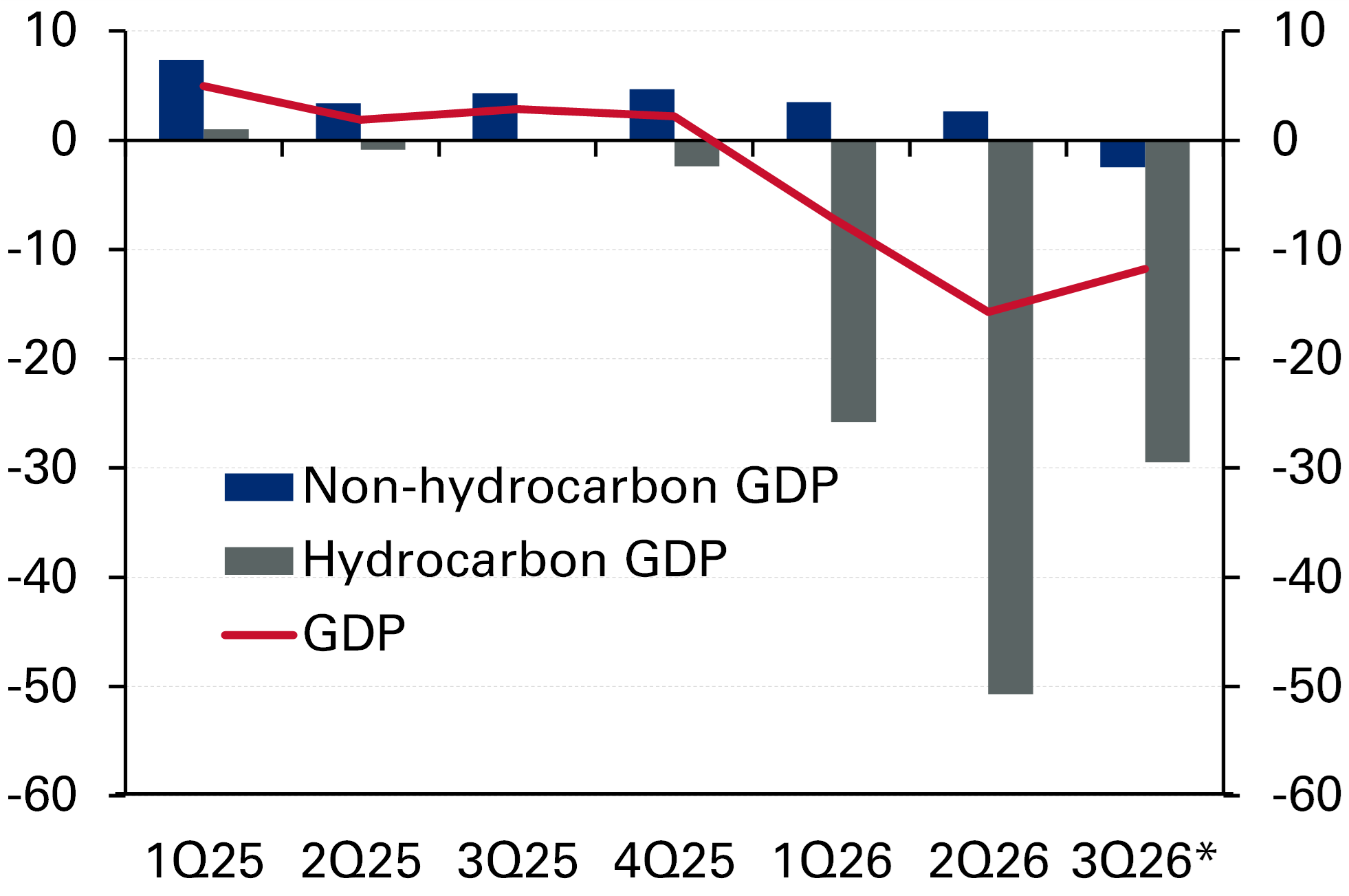
Qatar: GDP slump eases in Q3; IMF tweaks projected GDP fall in 2026. In its first flash GDP data release, the National Planning Council (NPC) estimated Qatar's GDP to have shrunk by 11.8% y/y in Q3 2026, an improvement from the 15.7% y/y decline posted in Q2. The less severe contraction was largely driven by the hydrocarbon sector, where output fell 30% y/y, compared to a 51% y/y drop in the previous quarter. While the NPC did not provide detailed production or export statistics, JODI data suggests that hydrocarbon production and shipments continued to recover during Q3 as operating conditions and export flows improved. By contrast, the non-hydrocarbon economy contracted by 2.5% y/y, reversing Q2's 2.6% y/y expansion. Weakness likely reflected lower tourist arrivals and softer manufacturing activity amid the ongoing regional conflict. Nevertheless, according to the NPC, wholesale and retail trade as well as accommodation and food service activities continued to grow, supported by domestic demand. A similar improvement in the near-term outlook was reflected in the latest assessment by the IMF, which revised its 2026 GDP contraction forecast to 14.5%, an improvement of 1.1 percentage points from its October estimate. The Fund also highlighted Qatar's medium-term strengths, including planned LNG capacity expansions and continued implementation of the Third National Development Strategy, with growth projected to average around 6% during 2028-31. However, the IMF sees risks remaining tilted to the downside, particularly from a renewed escalation in regional tensions or a prolonged disruption to LNG production and export routes.