
 +965 2292 4888


Daily Economic Update
27.10.2026
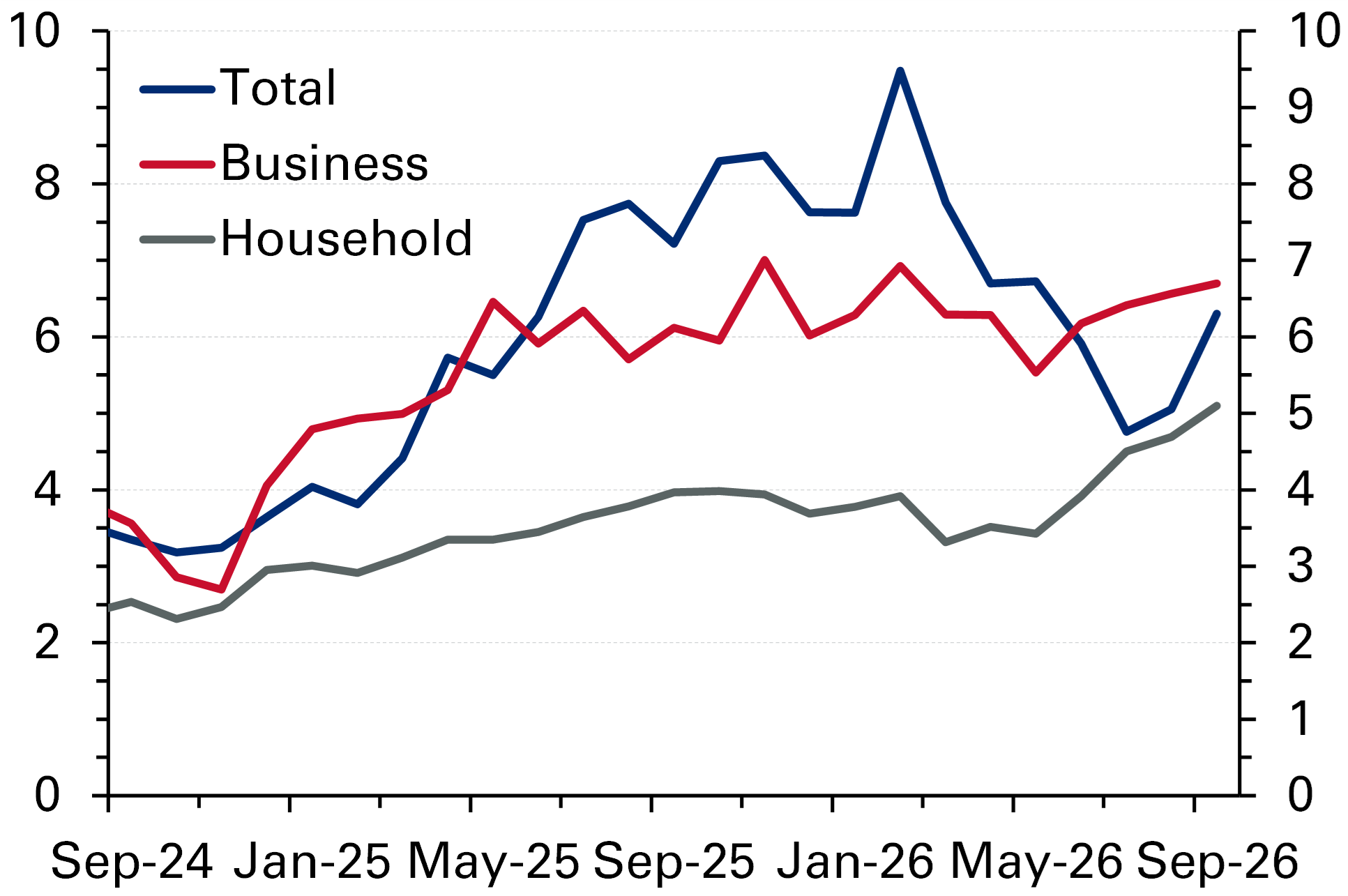
Kuwait: Domestic credit growth accelerates in September, driven by broad-based lending gains. Central Bank of Kuwait data for September show domestic credit rose a solid 1.0% m/m following a 0.9% gain in August, pushing the annual growth rate up to 6.3% y/y from 5.1%. The increase was broad-based, led by higher household borrowing (+0.8% m/m; +5.1% y/y), business credit (+0.7% m/m; +6.7% y/y), credit to banks and financial institutions (+1.5% m/m; +5.5% y/y), and a strong rise in credit for the purchase of securities (+3.1% m/m; +10.2% y/y). Within business lending, growth was supported by stronger credit expansion in construction, other services, public services, and the real estate sector while the trade and the oil & gas sectors saw monthly declines. Meanwhile, credit to non-residents declined for the first time in three months (-1.2% m/m), with annual growth easing further to 7.0%. On the liabilities side, residents’ deposits rose by a robust 1.1% m/m in September (+10.8% y/y), driven by strong increases in public sector (+4.8% m/m) and government deposits (+1.6% m/m), alongside a modest rise in private sector deposits (+0.2% m/m). Non-resident deposits also increased (+1.6% m/m; +14.5% y/y), reversing the decline recorded in August. Overall, September data point to resilient credit conditions despite the impact of the regional conflict on non-oil activity, with lending growth becoming more broad-based across households, businesses and financial institutions.
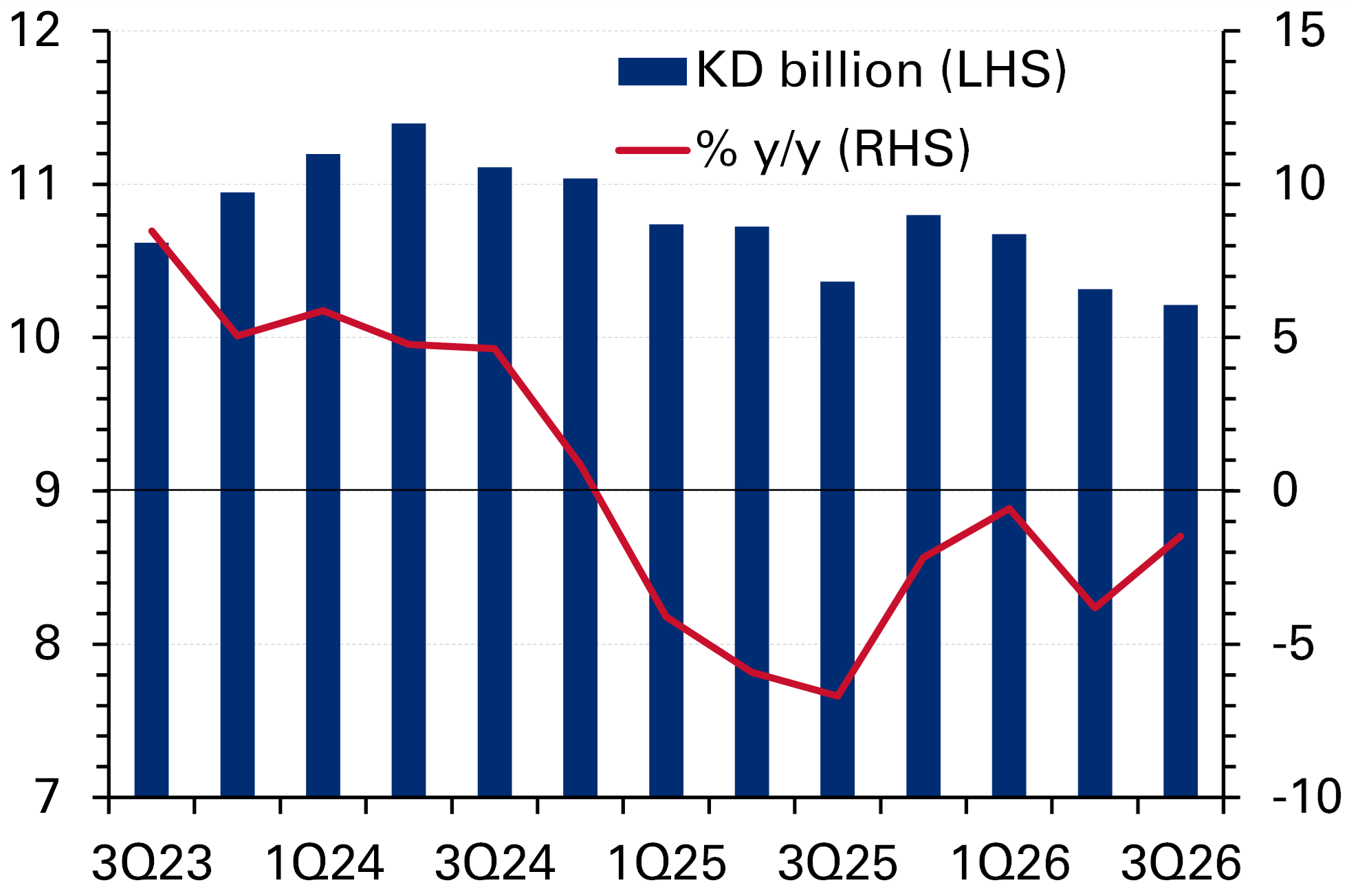
Kuwait: Q3 sees slower decline in consumer card spending while digital adoption remained strong. Central Bank of Kuwait (CBK) data showed local electronic payment transactions (by KD value), a proxy for consumer spending, falling by 1.5% y/y in 3Q 2026, slowing from a steeper drop of 3.8% in the previous quarter. This is seventh consecutive quarter of negative growth, driven once more by a drop in ATM transactions (-8.1% y/y), while point-of-sale and gateway transactions increased (+0.1%, 0.4%). Meanwhile, WAMD transactions (not included in total electronic transactions) rose sharply by 32% y/y (10% q/q), a trend which we expect will continue well into the coming year with the discontinuation of the parallel pay-by-link personal payment method, a CBK measure to enhance electronic payment security. On a quarterly basis, card spending fell for the third consecutive quarter, but the rate of decline eased to -1% from -3.4% q/q in 2Q. Overall, the 3Q26 data suggest an improvement in underlying consumer spending trends. Excluding ATM withdrawals, local spending growth turned positive in 3Q26 (+0.6% y/y) for the first time in nearly two years, suggesting that a recovery in household consumption may be gaining traction and that the apparent weakness in headline payments data partly reflects the ongoing substitution of cash withdrawals with digital payment alternatives, particularly WAMD.
Egypt: Parliament authorizes the President to support Saudi Arabia. The House of Representatives has authorized President Abdel Fattah El Sisi to take “the necessary measures” to help Saudi Arabia defend its territory, sovereignty, and holy sites against external aggression. Parliament approved the mandate by a two-thirds majority following three closed sessions held on 18, 19, and 26 October, at the President’s request and in line with the National Defense Council’s decision on 18 October. President Sisi described Egypt’s potential role as defensive when he requested the authorization on 17 October. Speaking at the Egypt Forum last week, he stressed that any intervention would remain limited to defending Saudi territory, suggesting that Egypt would not launch attacks against the Houthis in Yemen.
Saudi Arabia: Trade surplus narrows for third consecutive month. The merchandise trade surplus narrowed by 21% y/y to SAR15.6 billion in August, marking a third consecutive monthly decline, following falls of 25% in July and 10% in June, according to GASTAT. Merchandise exports fell by 11.5% to SAR87.2 billion, while imports declined by 9.1% to SAR71.6 billion. Oil export revenues dropped by 12.5%, reducing oil’s share of total merchandise exports to 70% from 70.8% a year earlier. Non-oil exports, including re-exports, also fell by 9.1%, largely due to a 34% decline in re-exports, with shipments of machinery, electrical equipment, and parts plunging by 63.6%. Non-oil exports covered 36.5% of imports, broadly unchanged from a year earlier. The decline in export values is notable given that Brent crude averaged around $91/bbl in August, compared with approximately $67/bbl a year earlier. This suggests that lower export volumes, despite the higher prices, were a key driver of the decline in oil export revenues. Shipping disruptions and the need to reroute shipments may therefore be weighing on trade flows, limiting the benefit of higher oil prices while export volumes remain constrained. Plastics, rubber, and related products remained the largest non-oil export category, accounting for 22.6% of total exports and rising by 7.5% y/y. Chemical products followed, representing 20.9% of exports. On the import side, machinery and electrical equipment accounted for the largest share at 26.2%, despite a 19.8% decline, while chemical imports rose by 2.7% to represent 9.6% of the total.
Bahrain: Inflation rises to its highest since December 2022. Consumer price inflation edged up to 3.1% y/y in September from 3.0% in each of the previous two months, reaching its highest level since December 2022. The increase was mainly driven by faster price growth in transport (11.6% y/y versus 7.8% in August). Prices also rebounded in alcoholic beverages and tobacco (3.4% versus -0.7%), furnishings and household equipment (0.9% versus -1.4%), and communication (0.2% versus -0.2%). Meanwhile, deflation in clothing and footwear eased slightly to 9.1% from 9.4%. In contrast, price growth slowed in food and non-alcoholic beverages (8.0% versus 8.1%), recreation and culture (2.9% versus 10.1%), restaurants and hotels (0.8% versus 1.1%), and miscellaneous goods and services (2.5% versus 3.2%). Education prices were unchanged, following a 2.8% increase in August, while housing and utilities costs fell by 1.3%, compared with a 1.1% decline in the previous month. On a monthly basis, consumer prices rose by 0.7% m/m in September, accelerating from 0.2% in August.
US: Fed Chair Warsh has a golden opportunity to fortify his credibility as well as the Fed’s. The FOMC kicks-off today its two-day meeting with the futures market probability of a rate hike at a mere 10%. With inflation above the 2% target for more than five years now (latest CPI inflation at 3.7% y/y), projections for it to accelerate further and not falling back to target anytime soon, a stable labor market, and Chair Warsh mentioning in the September Fed meeting press conference that he would be “hard pressed to describe current financial conditions as restrictive”, there is in fact a strong case, in our opinion, for the Fed to hike rates tomorrow. It is hard to find a proper economic justification for waiting until December to hike rates – which carries a probability of around 82% currently – as opposed to hiking tomorrow (we note the existence of the mid-term Congressional elections next Tuesday, which would be a non-economic reason to hold rates). The key reasons the probability to hike tomorrow is as low as 10% are because two influential FOMC members (the FOMC Vice Chair Williams and the Fed Board Vice Chair Jefferson, who together with the Fed Chair form the so-called troika) had given comments suggesting that there is no urgency to hike in October, followed by Chair Warsh not pushing back against these views in his IMF-meetings appearance around 10 days ago, which drove the probability lower after being above 70% before. Whether these comments were coordinated or not with the Fed Chair is key, noting that for the Fed Chairs preceding Warsh, the troika’s views were usually coordinated. If these views were coordinated, the goal was certainly to influence the market’s expectation around the October interest rate decision, a purpose that was well achieved. One the one hand, if these comments were coordinated, then Chair Warsh’s proclaimed opposition to giving forward guidance should not be taken very seriously; it does not make much sense to refrain from giving forward guidance personally but to give that guidance indirectly via the so-called powerful Fed troika. On the other hand, if these comments were not coordinated, then Chair Warsh has a golden opportunity to fortify his credibility (and the Fed’s), through convincing his FOMC colleagues to hike rates tomorrow. This would be the case because, first, he would be doing a justifiable thing from a monetary policy perspective and second, he would be true to his words that he is genuinely against giving forward guidance. Importantly, if that were to happen and rates are hiked, Chair Warsh would have dealt a severe blow to the weight of any future forward guidance that will be provided by members of the so-called Fed troika.
China: Industrial profits resilient in September, supported by strong gains in technology and energy related sectors. Profits at industrial firms rose 15.5% y/y in 9M2026, easing from 15.7% y/y in January-August. However, profits increased 14.4% y/y in September alone, accelerating sharply from 4.2% in August and ending a four-month slowdown in monthly growth. The strongest gains continued to come from high-tech manufacturing and the electronics sector, where profits roughly doubled amid robust demand linked to AI, semiconductors and computing infrastructure. At the same time, energy and commodity-related industries also provided significant support, with profits in mining rising 38% y/y and coal mining profits increased 57%. That said, the data underscore the divergence between strong profitability in tech, energy and upstream industrial sectors and weaker conditions in more demand-sensitive parts of the economy, suggesting that subdued domestic demand remains a key constraint on a broader-based recovery.