
 +965 2292 4888


Daily Economic Update
14.07.2026
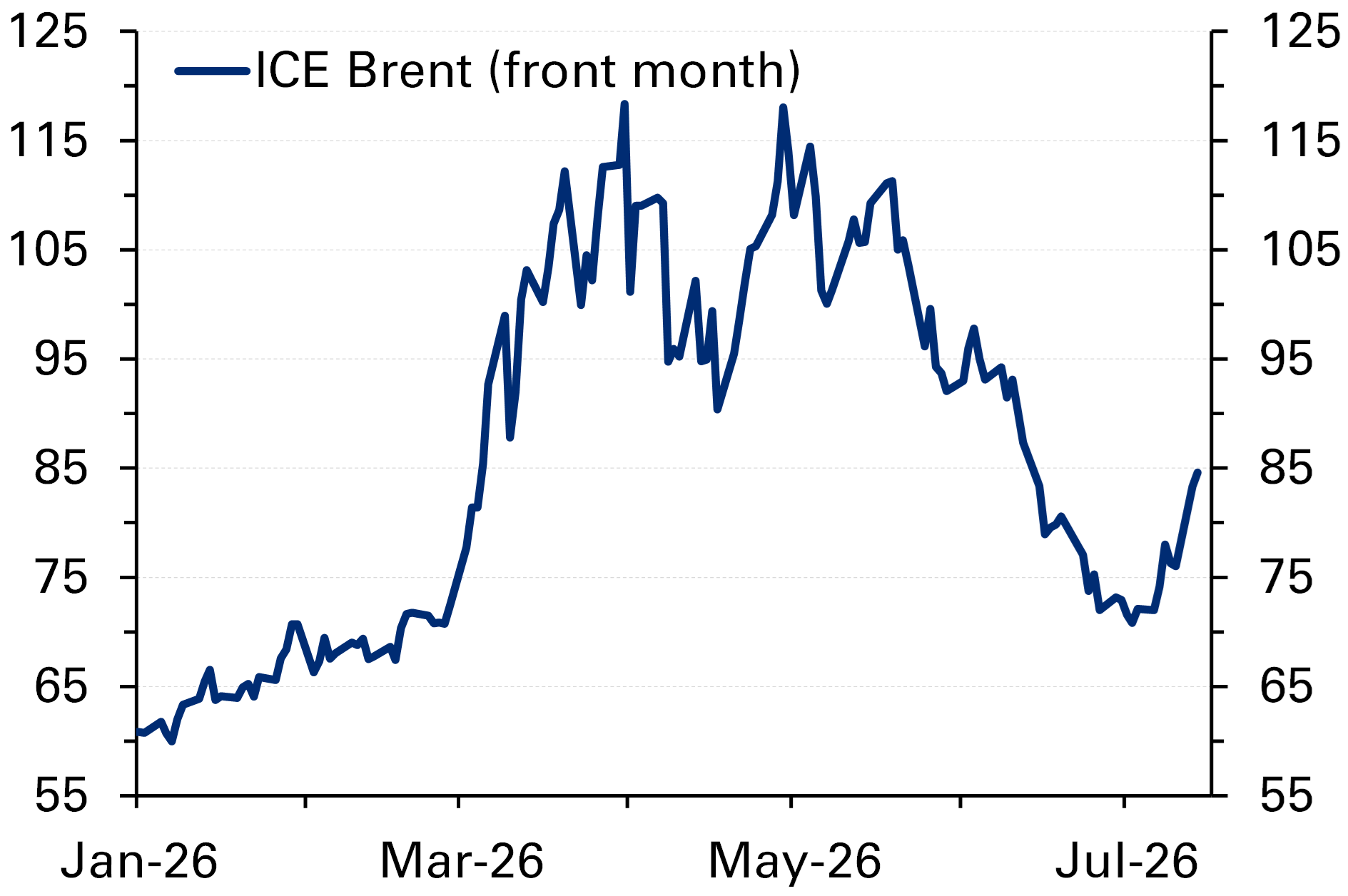
Oil: Prices surge amid rising regional tensions. Brent crude futures rallied sharply on Monday on rising geopolitical risk, gaining almost 10% to $83.3/bbl (+36.9% ytd) as the US and Iran continue to up the ante in tit-for-tat strikes and, effective today, the US reimposes its naval blockade on Iranian ports and oil terminals. In response, Iran has once more closed the Strait of Hormuz. Prices were up again this morning in Asian trading, by 1.5% to $84.6/bbl—the highest level in a month. Recent actions are imperiling oil supplies through the Strait, which had only begun to recover last month. Tanker tracking data reportedly showed the number of vessels transiting the Strait falling to a two-month low amid multiple attacks on commercial tankers. US President Trump announced, in turn, that the Strait remains open but that the US would charge a 20% “fee” on all cargo ships in exchange for providing security through the SoH. With oil prices at current levels, a 20% fee would equate to a $17/bbl charge per oil tanker transiting the Strait, substantially higher than the $1-2/bbl charge the IRGC had demanded previously. Furthermore, the conflict is threatening to extend to the Red Sea, with Yemen's Houthis reportedly launching missiles towards Saudi Arabia in retaliation for the bombing of Sanaa airport by the Saudi and internationally recognized Yemeni government, ostensibly to prevent a delegation of Houthis arriving back in the country from Iran. Concerns are mounting that the Bab El-Mandeb Strait could face the same fate as the Strait of Hormuz, which would threaten international shipping and especially Saudi Arabia’s oil exports from Yanbu. The latest escalation has effectively reversed much of the progress achieved since Iran and the US signed their MoU in mid-June. Meanwhile, OPEC, in its just-published July oil market report, lowered its 2026 oil demand growth forecast by 190 kb/d to 780 kb/d, marking the third consecutive downgrade amid continued economic disruption linked to the current conflict. The revisions were concentrated in China and India, where demand growth forecasts were reduced by 110 kb/d and 60 kb/d, respectively. Despite the downgrade, OPEC’s oil demand forecast remains well out of sync with the IEA’s, which had earlier pegged a global oil demand contraction this year of 1 mb/d. For 2027, OPEC revised its demand growth forecast higher by 210 kb/d to 1.73 mb/d. On the supply side, June data showed a significant recovery in OPEC+ production. Crude output (excluding the UAE) rose by 1.4 mb/d m/m, led by Kuwait (+880 kb/d), Iraq (+446 kb/d) and Iran (+155 kb/d), while Saudi production unexpectedly declined by 99 kb/d. The UAE, now outside OPEC+, increased production by 1.64 mb/d m/m to a record 3.8 mb/d. While regional output recovered during June, the latest deterioration in security conditions threatens to derail progress entirely, and especially if the conflict escalates further to potentially include energy infrastructure.
UAE: ADNOC accelerates global expansion through LNG growth and strategic acquisitions. Abu Dhabi National Oil Company (ADNOC) has reinforced its global energy growth strategy through a series of major initiatives that included LNG production, trading, and downstream expansion. The company signed a 15-year agreement with Japan’s Inpex to supply 1 million tonnes per annum (mtpa) of LNG from the Ruwais LNG project, further advancing the commercialization of the project, which is scheduled to start its operations in 2028. The deal follows ADNOC’s launch of a new global LNG marketing and trading platform in Abu Dhabi Global Market (ADGM), integrating the LNG marketing, trading, and shipping activities of ADNOC Gas, and ADNOC Trading to support a targeted 47 mtpa LNG portfolio by 2035. These moves reflect ADNOC’s ambition to capitalize on rising global LNG demand while positioning Abu Dhabi as a leading energy trading hub. In parallel, ADNOC Logistics & Services announced a $900 million order for four new liquefied natural gas (LNG) carriers to be built in China and delivered in 2029, expanding the company’s LNG fleet. Collectively, these announcements are in line with the UAE national agendas and frameworks including We the UAE 2031 vision, the UAE Energy Strategy 2050 and the National Investment Strategy 2031.
Egypt: Government moves closer to new state-owned listings in the EGX. The Egyptian government is finalizing procedures to list four additional state-owned companies on the Egyptian Exchange (EGX) as part of its broader privatization and state ownership reform program. This should bring the total number of companies that have been temporarily listed to twenty from the thirty companies targeted under the current program, including firms from both the public business and petroleum sectors. The temporary listing process is intended to improve transparency, governance, and disclosure standards ahead of potential strategic sales or public offerings. The government also highlighted the growing role of the private sector, which has accounted for more than 56% of total investments over the past three years, with the authorities aiming to increase this share to 65% over the coming years. To further encourage listings, the Ministry of Finance is considering introducing a tax incentive of up to 15% discount for companies that choose to list on the stock exchange, in a move aimed at deepening capital markets and broadening private sector participation. Separately, the government reiterated plans to raise $3-4 billion from international debt markets during the current fiscal year as part of its strategy to diversify funding sources and manage external financing needs.
US: Fed Governor Waller warns about inflation and says that monetary policy is “at a crossroads”. In a speech, Fed Governor Waller warned about elevated inflation but cautioned against “fighting the last war,” saying that “we are at a crossroads for policy, and the appropriate action will depend on incoming data”. He mentioned that AI demand/investments as a root cause for why inflation has remained stubbornly above the 2% target. Waller believes that there is still “a credible case for inflation to begin to fall back” but added that there is an “equally plausible” scenario where inflation could stay elevated, “requiring tighter monetary policy in the near term.” If inflation drops for several months, which is “still a reasonable outcome, I would then continue to hold the policy rate at its current target range.” We note that given less communication by Fed Chair Warsh, the comments by key FOMC members, such as Governor Waller, are bound to receive more attention than previously. Given the renewed escalation in the Middle East, markets tumbled on Monday with the S&P 500 dropping 0.8% and US treasury yields rising across the board with the two-year and 10-year yields up by around 5 bps.
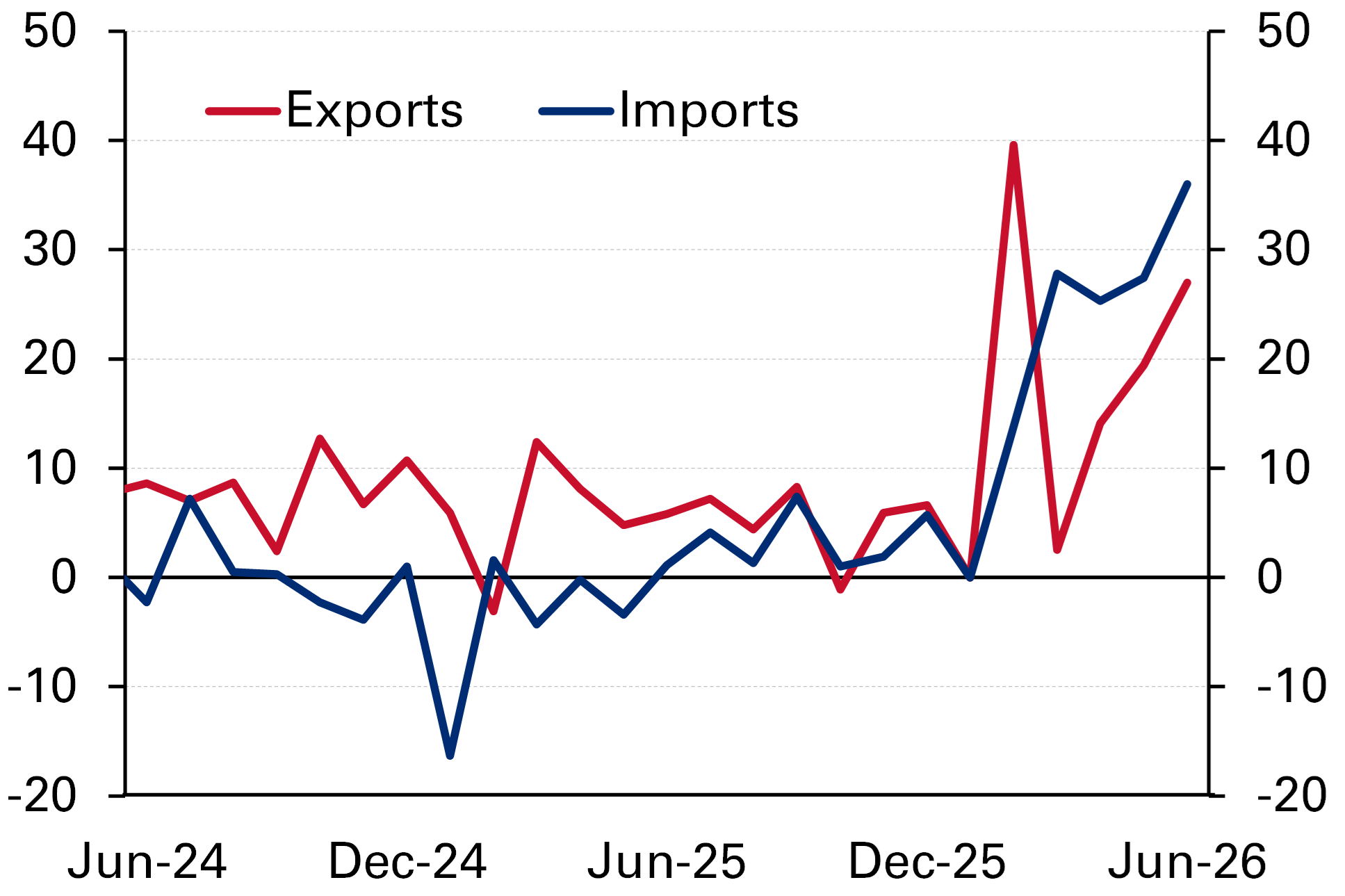
China: Growth in exports and imports surges in June, supported by AI-related demand. China’s exports rose 27% y/y in June, accelerating from 19% in May and comfortably exceeding market expectations. Imports also surprised to the upside, increasing 36% y/y in June, up from 27% previously, bringing the trade surplus to around USD126 billion. The stronger-than-expected performance was supported by robust demand for AI-related technology products, including semiconductors and electronics, alongside front-loaded shipments amid uncertainty over the outlook for US-China trade relations. While the data highlight the resilience of China’s high-tech manufacturing sector and the growing importance of external demand as a driver of growth, they also underscore the increasingly uneven nature of the recovery, with export-oriented industries continuing to outperform domestic demand.