
 +965 2292 4888


Daily Economic Update
25.10.2026
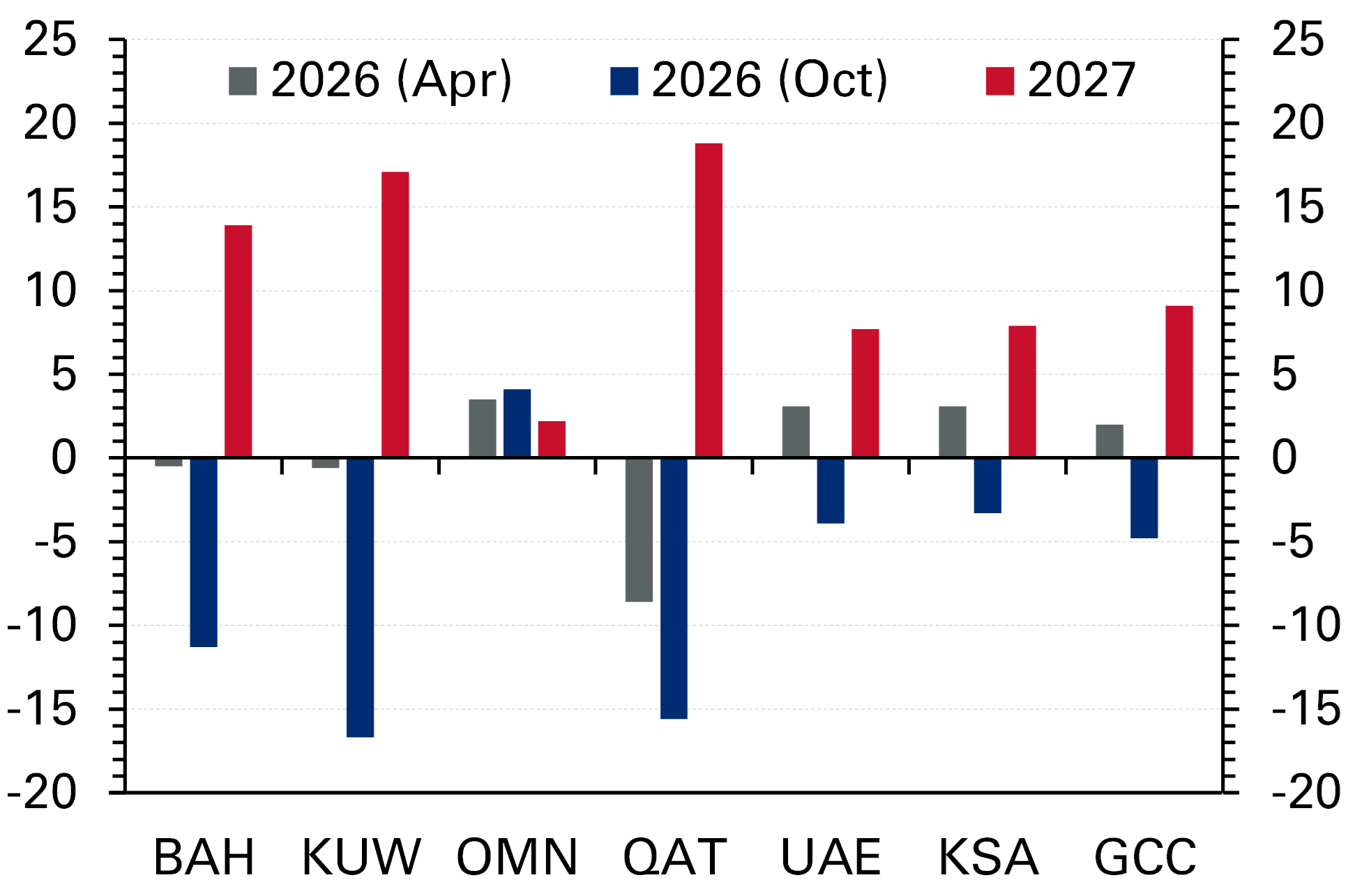
GCC: IMF revises down economic growth forecast as conflict disruption deepens. The IMF sharply downgraded its growth outlook for the GCC in its just-released Regional Economic Outlook, projecting an aggregate contraction of -4.8% y/y in 2026 from its April forecast of +2.0%. The revision reflects the deepening economic impact of the regional conflict, which has disrupted hydrocarbon production, trade, shipping, logistics, tourism, and business confidence. The downgrade is concentrated among the Gulf economies most exposed to disruptions in energy production and exports through the Strait of Hormuz. Growth forecasts were cut significantly for all countries except Oman, which was revised up to 4.1% from the previous 3.5% on account of its geographic situation mostly outside of the Gulf. The most severe downward adjustment were for the economies hardest hit by production constraints, such as Kuwait (to -16.7% from -0.6% in April) and Bahrain (to -11.3% from -0.5%), followed by Qatar (-15.6%), the UAE (-3.9%), and Saudi Arabia (-3.3%). Saudi Arabia and the UAE benefited from greater diversification of export routes and more limited infrastructure damage, although both are still expected to enter recession. While GCC countries have acted quickly to preserve trade and logistics networks, support firms and households, and maintain financial stability, non-oil activity has also weakened, particularly in tourism, transport, and trade-related sectors. As a result, aggregate non-oil growth is projected to fall to -0.8% in 2026 before recovering to 4.5% in 2027. The IMF projects a strong rebound in 2027, with overall GCC growth accelerating to 9.1%, supported by the normalization of energy production and trade flows. However, the report cautions that cumulative output over the medium term will remain below pre-conflict expectations, suggesting lasting economic impact despite the recovery. Meanwhile, inflation is projected to rise from 1.7% in 2025 to 2.7% in 2026, while lower hydrocarbon exports and weaker trade flows are expected to narrow the GCC current account surplus from 5.0% to 1.3% of GDP and widen the fiscal deficit from 0.8% to 2.3% of GDP, underscoring the broader macroeconomic costs of the disruption.
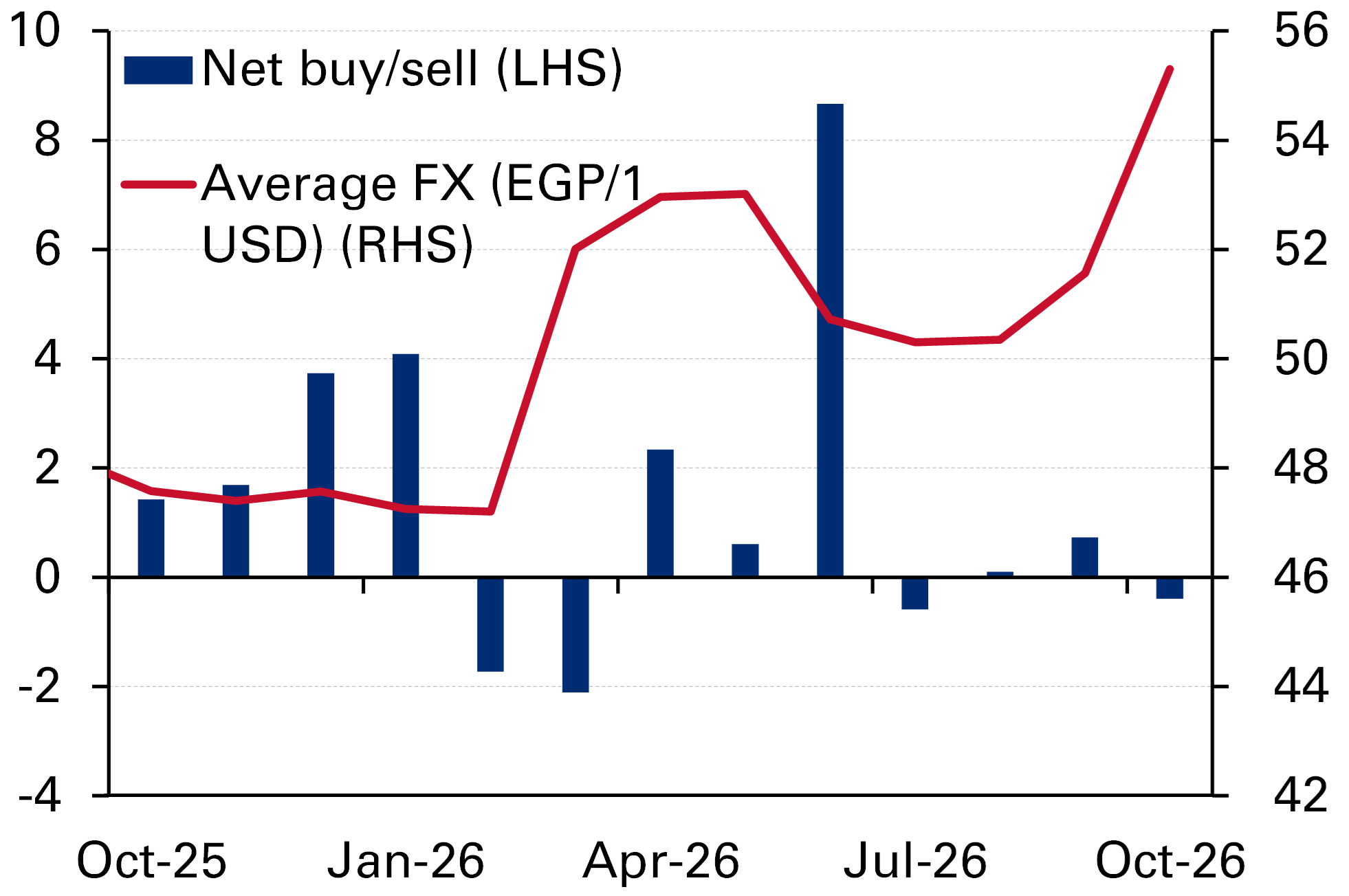
Egypt: Pound weakens past EGP 55 as foreign outflows accelerate. The Egyptian pound weakened beyond EGP 55/USD at Thursday’s close, pressured by carry trade outflows, Brent crude prices rising above $111/bbl and escalating regional tensions, particularly renewed Houthi attacks on Saudi Arabia. Foreign investors withdrew around $1.9 billion from the secondary market for local debt instruments last week, adding to pressure on the currency. The depreciation highlights the role of the Central Bank of Egypt’s flexible exchange-rate policy in allowing the pound to adjust to shifts in foreign capital flows and external conditions. Unlike previous arrangements, which could enable investors to benefit from exchange-rate differences when entering and exiting the market, greater flexibility allows the currency to absorb these pressures rather than placing the burden entirely on official foreign reserves.
US: S&P PMIs robust in October but price pressures intensify to reach an over four-year high. The S&P Global flash PMIs in October remained robust overall though growth in services activity somewhat eased. The manufacturing gauge rose to a 53-month high at 56.0 from September’s 55.9, but the services measure softened to a still-solid 57.9 from 58.8 as domestic demand continued to be strong while exports also rose. A growing backlog and accelerating new orders helped employment rise further, with the pace staying near the highest rate since June 2022. However, amid rising energy prices, tariffs and supply-chain-related issues, cost pressures intensified, with the selling price gauge climbing to the highest level since August 2022. The latest PMIs further confirm that US economic activity remains resilient, helped by the ongoing AI-linked spending boom, but with ongoing inflationary concerns that should keep the Fed’s bias hawkish at the upcoming FOMC meeting later this week.
Eurozone: October’s PMIs signaled a moderation in growth momentum; Moody’s left its France credit rating unchanged. The flash HCOB Composite PMI eased to 51.9 in October from 53.1 in September, indicating that private-sector activity continued to grow but at its slowest pace in five months. While both manufacturing (52.4 in October from 52.9 in September) and services (51.7 from 53.0) remained in expansion territory, the survey pointed to softer output growth and a loss of momentum in new business inflows compared with September’s strong performance. Businesses also reported continued increases in both input costs and output prices, suggesting that underlying inflationary pressures remain present. Separately, Eurozone consumer confidence weakened further in October, with the European Commission’s flash indicator falling by 1.1 points to a lower-than-expected -17.9 from a downwardly revised -16.8 in September. The decline points to persistent caution among households and leaves sentiment well below its long-run average, suggesting that consumers remain concerned about the economic outlook despite resilient labor market conditions. Meanwhile, despite all the headwinds that France is witnessing, Moody’s on Friday kept its credit rating unchanged at Aa3, maintaining the negative outlook as well. We note that the spread between France’s 10-year bond yield and the German one has risen to multi-year highs, standing at around 165 bps on Friday, though edging down from Thursday’s level.
UK: Business activity expands at the fastest pace since February but other data weak. The S&P Global flash composite PMI in October rose to an eight-month high of 53.1 from September’s 52.0 on broad-based improvements as both the manufacturing and services gauges strengthened more than forecast to 52.8 and 53.1 from 51.9 and 52.1, respectively. New orders rose at a robust pace, with some firms attributing higher sales to AI-linked demand as well as overall resilient economic conditions, helping businesses increase headcount for the first time since September 2024, albeit marginally. However, as seen elsewhere, amid rising energy prices and higher raw material costs, inflationary pressures were stronger, which tempered optimism and intensified headwinds. We note that the UK economy has remained resilient thus far in 2026, defying predictions of a slowdown, despite the adverse impact of the US-Iran war. Growth rates continue to be modest though it is still outperforming most G7 peers. However, signaling volatility and softness in the economic trajectory, retail sales volumes in September fell by more than forecast at 0.4% m/m after an upwardly revised increase of 0.7% in August. The ONS cited that the unseasonably warmer weather contributed to declining autumn-related clothing sales, pulling down overall consumer spending during the month. Additionally, indicating a worsening mood, the Gfk consumer confidence index in October dropped to the second lowest level in three years at -24 from -13 in September amid rising cost-of-living pressures.
Japan: Inflation strengthened in September, exceeds BOJ’s 2% target, while business activity continued to expand at the start of Q4. Japan’s headline CPI and core CPI (excluding fresh food) both rose to 2.1% y/y in September, up from 1.9% and 1.7%, respectively, in August. The core inflation measure returned above the Bank of Japan’s 2% target for the first time in nine months, but came in line with expectations, while the closely watched “core-core” measure, which excludes both fresh food and energy, accelerated to 2.4% y/y from 1.9%, its strongest pace in six months. The pickup in inflation was driven by higher import-related costs and the indirect pass-through of elevated energy prices linked to ongoing geopolitical tensions, although government fuel subsidies continued to help contain some of the upward pressure. Overall, the September CPI data points to firmer domestic price pressures and supports the view that inflation remains sufficiently resilient to keep the Bank of Japan on a gradual policy normalization path. Despite the recent strengthening in inflation, financial markets continue to anticipate no change in policy at the October 30 meeting. Separately, Japan’s flash composite PMI was unchanged at 52.3 in October, marking a nineteenth consecutive month of expansion. Services activity strengthened, with the services PMI rising to 52.0 in October from 51.3 in September, while the manufacturing PMI eased to 53.3 from 54.1, its lowest level since March. Underlying survey details showed softer growth in both new orders and export demand, while employment growth slowed. Meanwhile, price pressures remained elevated, with input cost inflation accelerating amid higher raw material and labor costs; however, output price inflation eased, suggesting some compression in firms’ margins.