
 +965 2292 4888


Daily Economic Update
28.10.2026
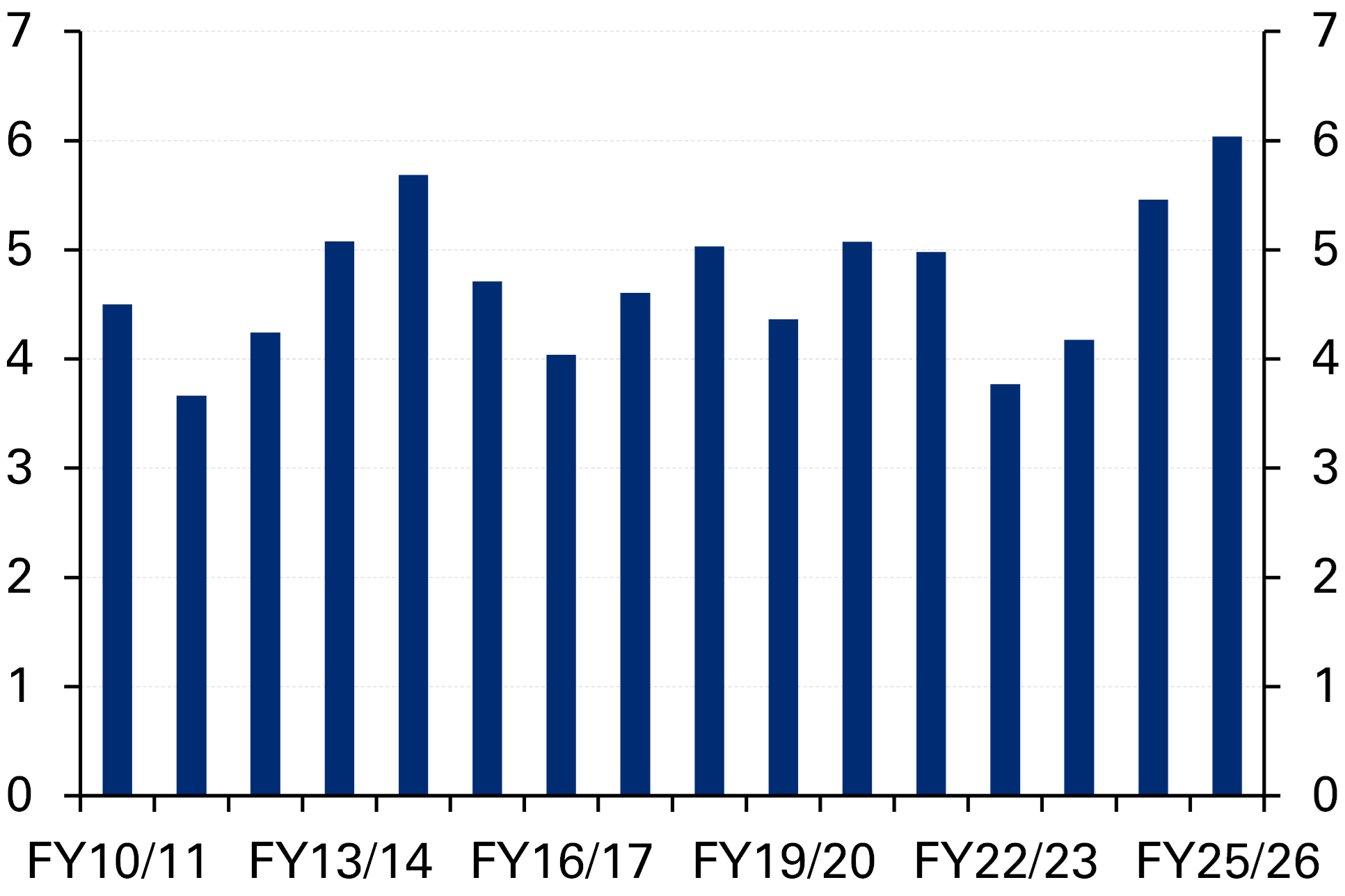
Kuwait: Excise tax law approved, helping to diversify fiscal revenues. Kuwait has approved a draft law to implement excise taxes on tobacco products and energy drinks at 100%, carbonated beverages at 50%, and sweetened drinks based on sugar content. The measure is expected to generate approximately KD 200-250 million annually (around 0.5% of GDP), helping to expand non-oil revenue sources (which were 6% of GDP in FY25/26) and align Kuwait with other GCC countries that have already implemented excise taxes under the GCC unified tax agreement. The additional revenue remains modest relative to Kuwait’s oil income and is unlikely to materially close the government’s structural funding gaps on its own. Nevertheless, it represents a small but meaningful step toward revenue diversification and a more sustainable fiscal framework by broadening the tax base, reducing dependence on oil, and supporting longer-term fiscal sustainability goals. The tax is also intended to discourage consumption of products associated with adverse health outcomes, potentially generating public health benefits alongside fiscal gains. Businesses in the tobacco, food and beverage, retail, and hospitality sectors will face new compliance and reporting requirements, while consumers are likely to see higher prices for affected products. Although the cabinet has approved the framework and referred it for final approval, no official implementation date has yet been announced, but rollout could occur around FY2027/28.
Egypt: Oil storage capacity outpaces funding for strategic reserves. Egypt has built storage facilities capable of holding 33 million barrels of oil but lacks the $2.5bn needed to fill them, President Abdel Fattah El Sisi said at the Egypt Forum 2026. Once fully stocked, the facilities could cover six to eight months of the country’s needs. However, the government has not disclosed current inventory levels or a timeline for filling the tanks. The funding shortfall reflects competing demands on scarce foreign currency. Egypt cleared $6.1bn in arrears to international oil companies in June, removing a major obstacle to investment in domestic production, and has since established a system to pay foreign oil partners nearly $240mn per month. The president said the state had allocated around $7bn to foreign partners over two years, in addition to the roughly $3bn needed monthly for petroleum imports. These competing commitments leave limited room to build reserves against potential supply disruptions. Separately, Egypt aims to establish a strategic crude reserve of 16 million barrels by year-end, including 10 million barrels from Libya and 6 million from Iraq, at an estimated cost of $1.36bn. Based on assumed prices of around $85/bbl, this estimate excludes shipping, insurance, and storage costs. The reserve is intended to keep refineries supplied when shipments are delayed, although building inventories gradually, potentially through supplier credit or deferred-payment arrangements, may be more feasible given the funding constraints.
Saudi Arabia: New commercial law allows teenagers to conduct business. The Cabinet has approved a new Commercial Transactions Law comprising 271 articles, aimed at improving the business environment and providing greater legal certainty for commercial activities, contracts, and negotiable instruments. Under the new law, individuals aged 15 and above can engage in commercial activities, provided they obtain authorization from a guardian, custodian, or the court. According to the Ministry of Commerce, the law consolidates provisions previously covered by three separate statutes: the Commercial Law, the Commercial Papers Law, and the Commercial Books Law. By bringing these rules together into a single legal framework, the legislation aims to simplify commercial regulations, clarify business obligations, and align Saudi Arabia’s commercial practices with international standards. It will also complement the Civil Transactions Law, supporting a more consistent legal framework for businesses and investors.
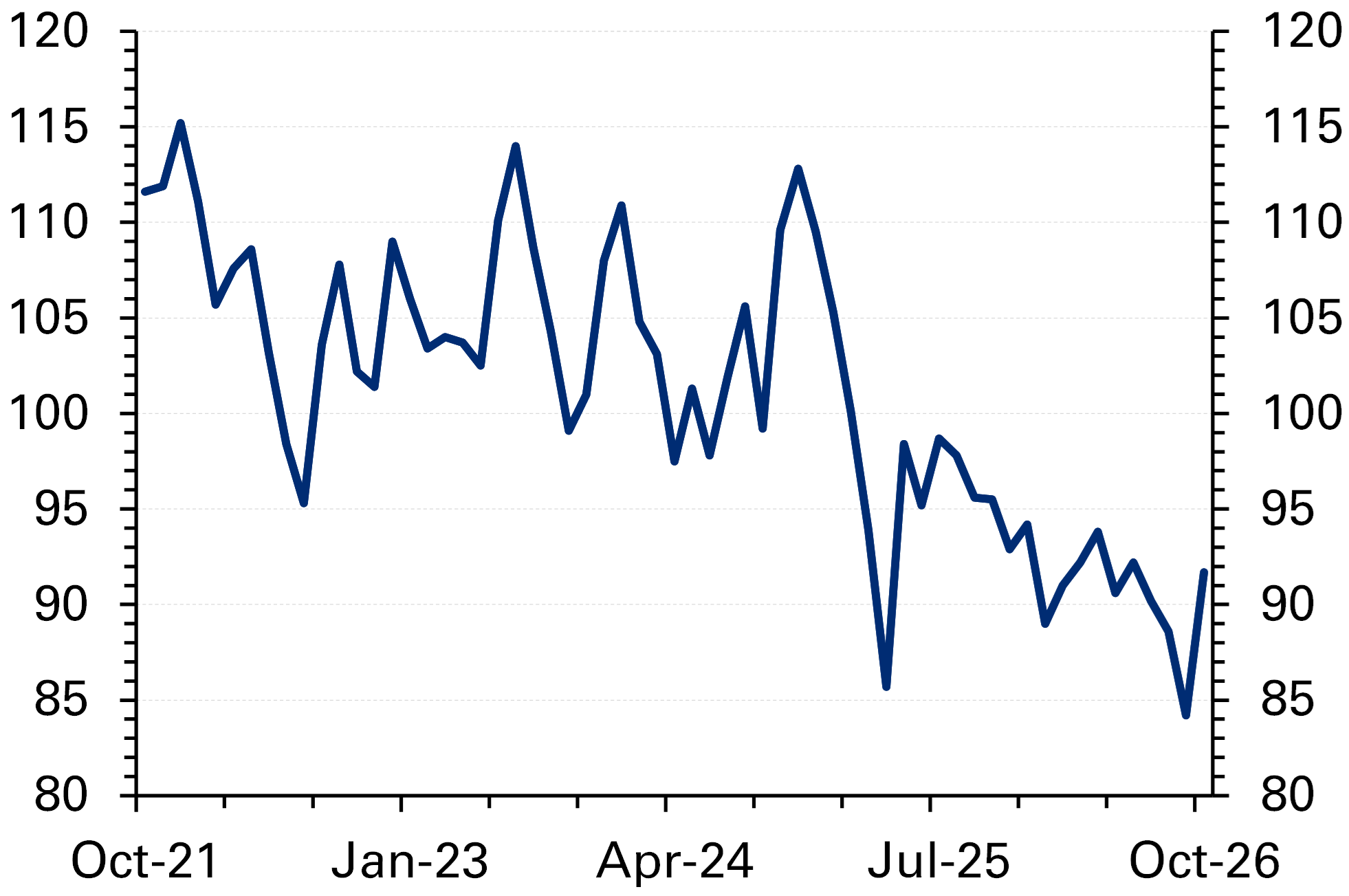
US: Consumer confidence improved in October, but the trend remains lackluster. The Conference Board consumer confidence index rose to a four-month high of 91.7 in October from September’s 84.2 on broad-based improvements across the present situation and expectations subcomponents. Views about employment conditions improved as more respondents saw jobs were “plentiful” while the number saying jobs were “hard to get” was unchanged, widening the difference between the two metrics—a key gauge of consumer perception about the labor market. However, write-in responses reflected household concerns about rising costs of groceries and energy goods. The survey also noted that October’s recovery in confidence was in line with the recent decrease in gasoline prices, but the index overall remains much below the 2021-24 average of 107. Despite the US economy growing at a solid pace (GDP growth forecast of 3.2% in Q3, data due this Thursday), modest consumer confidence levels signal that economic growth is concentrated in narrow pockets. Separately, annual growth in house prices accelerated to an over one-year high of 2.7% in August, up from 2.5% in July, according to the S&P Case Shiller 20-city index. On a monthly basis, prices increased (+0.3%) for a fifth-straight month. Still, worsening affordability amid steeply elevated mortgage rates and high inflation is impacting demand and limiting the rise in residential property prices. Finally, durable goods orders in September increased by 1.8% m/m after August’s 0.1% rise. Core goods (excluding aircraft and defense) orders, a key measure of business investment, continued to power ahead, rising by 0.5% m/m, though down from 1.6% in August.