
 +965 2292 4888


Daily Economic Update
14.09.2026
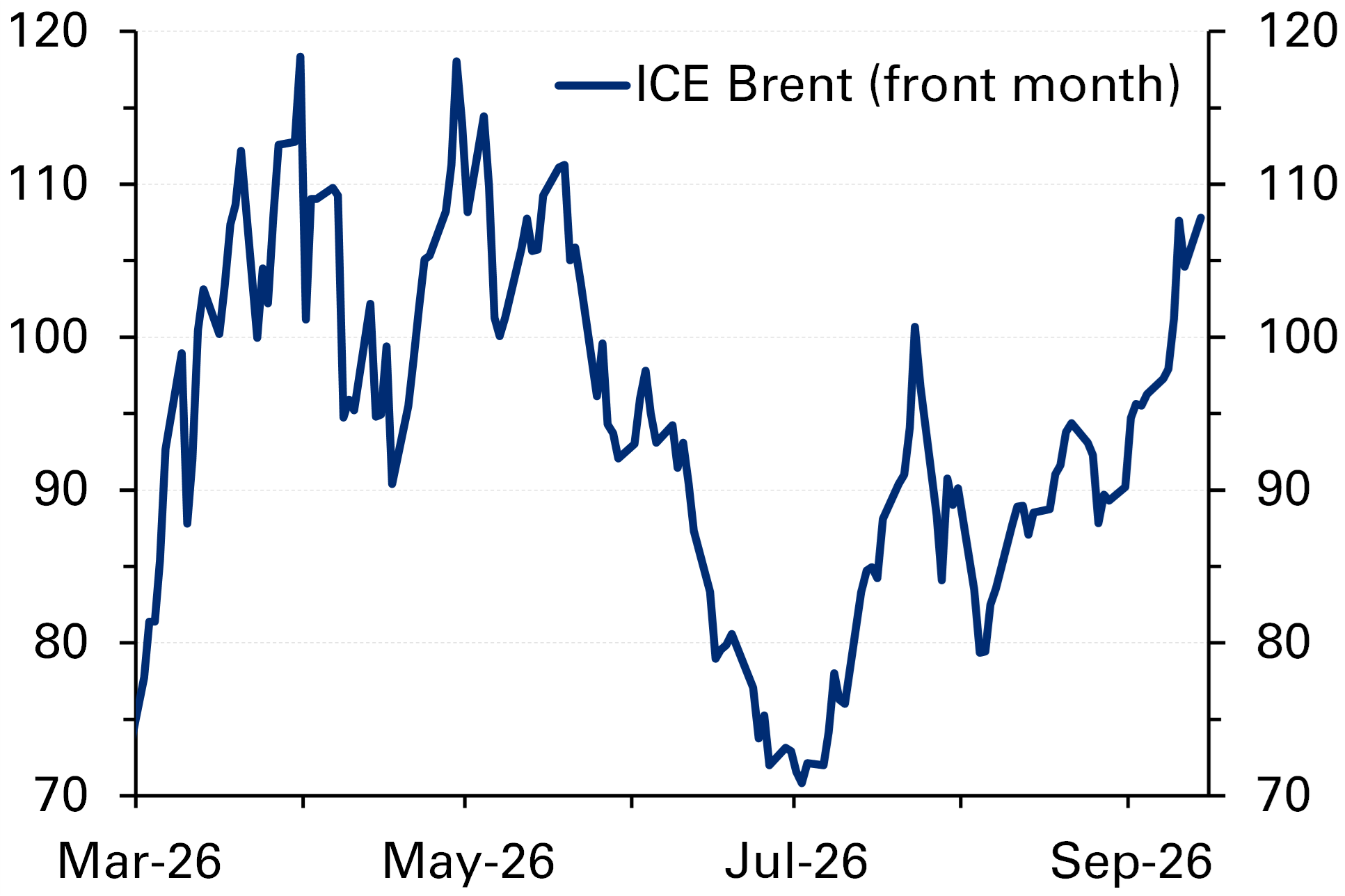
Oil: Prices surge after weekend Houthi advance, targeting of Saudi energy facilities. Brent futures have risen more than 3% this morning in Asian trading, topping $108/bbl and retracing their steps before Friday’s dip lower ($104.6/bbl; +8.6% w/w), following a tense few days marked by strikes on Saudi energy infrastructure by Houthi and Iran-aligned militias, while talks between Iran and GCC countries over Hormuz scheduled for today were postponed. Houthi strikes on Saudi Aramco’s 400 kb/d Jazan refinery on the Red Sea coast and fuel storage facilities in Najran and Abha as well as an attack on the King Khaled air base in Khamis Mushait were followed by drone strikes on pumping stations attached to Saudi Arabia’s crucial 7 mb/d East-West oil pipeline, forcing the pipeline’s closure on Friday and the suspension of 4-5 mb/d of Saudi crude exports destined for world markets. The attack on the pipeline was determined to have come from Iran-backed militias operating within Iraq rather than from the Houthis. Houthi forces, meanwhile, made further gains along Yemen’s Red Sea Coast, capturing the key port of Mokha from the Yemeni National Army, which is supported by Saudi Arabia, and reaching Perim Island near the Bab el-Mandeb chokepoint. This has left the Iran-backed group with effective control over Yemen’s entire Red Sea coastline, adding a second prong to Iran’s ability to threaten shipping through both the Middle East’s strategic waterways. At the Strait of Hormuz, renewed military exchanges between the US and Iran saw further disruption to shipping, with attacks on vessels using the southern shipping lane, on the Omani side, causing transit volumes to fall sharply. According to Argus, only 10 vessels crossed the Strait on Thursday, equivalent to roughly 7.5% of pre-closure traffic levels. Supply disruptions were increasingly evident in OPEC's latest production data, for August. Saudi crude output fell to 6.24 mb/d, its lowest level since 1990, although supply-to-market remained higher at 7.12 mb/d, suggesting inventories were being drawn down to offset lost production. Elsewhere, DoC production (OPEC+) rose by 297 kb/d m/m, supported by a strong recovery in Iraqi output (+664 kb/d to 3.4 mb/d), improved Kazakh production (+159 kb/d to 1.8 mb/d) following repairs to CPC-related disruptions, and a further increase in Kuwaiti output to 1.9 mb/d. On the demand side, OPEC lowered its 2026 demand growth forecast by a further 200 kb/d to 400 kb/d, marking a fifth consecutive downgrade, while still expecting growth to rebound to 2.4 mb/d next year. The International Energy Agency (IEA) adopted a more bearish stance, forecasting a 2.5 mb/d decline in oil demand this year before a partial recovery in 2027. Despite weaker consumption, global oil balances remain in deficit, with the IEA estimating supply is down 5.7 mb/d y/y and inventories continuing to be drawn down rapidly to bridge the deficit.
Global: Key central bank meetings main matter this week as Fed/BoJ seen hiking and BoE holding. In the US, the FOMC will meet on September 15-16, and market pricing currently indicates a high probability (85%+) of a 25bps rate hike following the elevated inflation prints last week. Attention will be on Chair Warsh’s post-meeting conference; a key matter will be whether he maintains some clarity as seen in Jackson Hole or reverts to the vague and obscure communication posture that plagued his first two post-meeting Fed conferences. New dot-plot and macroeconomic projections will also be published. Markets will also take note of President Trump’s reaction to the high-likelihood rate hike. In terms of economic data, retail sales in August (Wednesday) are seen rebounding by 0.9% m/m after an unexpected drop of 0.6% in July. In the Eurozone, industrial production (Wednesday) is forecast to decline in July (-0.7% m/m) for the first time since January. In the UK, the BoE meets and the expectation is more towards maintaining the bank rate at 3.75% on Thursday, but the bank may signal a tighter policy stance ahead amid rising energy prices and inflation. The unemployment rate (Tuesday) is forecast to tick up to 5% in the May-July period from 4.9% in the April-June period, while regular wage growth is seen steady at 3.5% y/y. CPI inflation for August (Wednesday) is seen rising further to 3.1% y/y from July’s 2.9% and core to 2.7% from 2.6%. In China, key economic data for August will be released on Tuesday, with industrial production expected to rise by 4.8% y/y (+4.5% in July), retail sales to increase by 0.8% y/y (+0.6% in July), and the decrease in fixed-asset investment to widen to 7.1% y/y in 8M2026 (-6.7% in 7M2026), alongside house prices and the unemployment rate. Finally in Japan, attention will be on Bank of Japan’s policy decision (Friday), where rates are expected to be raised by 25bps to 1.25%. Inflation for August is also due on Friday, where the core rate is seen steady at 1.8% y/y.
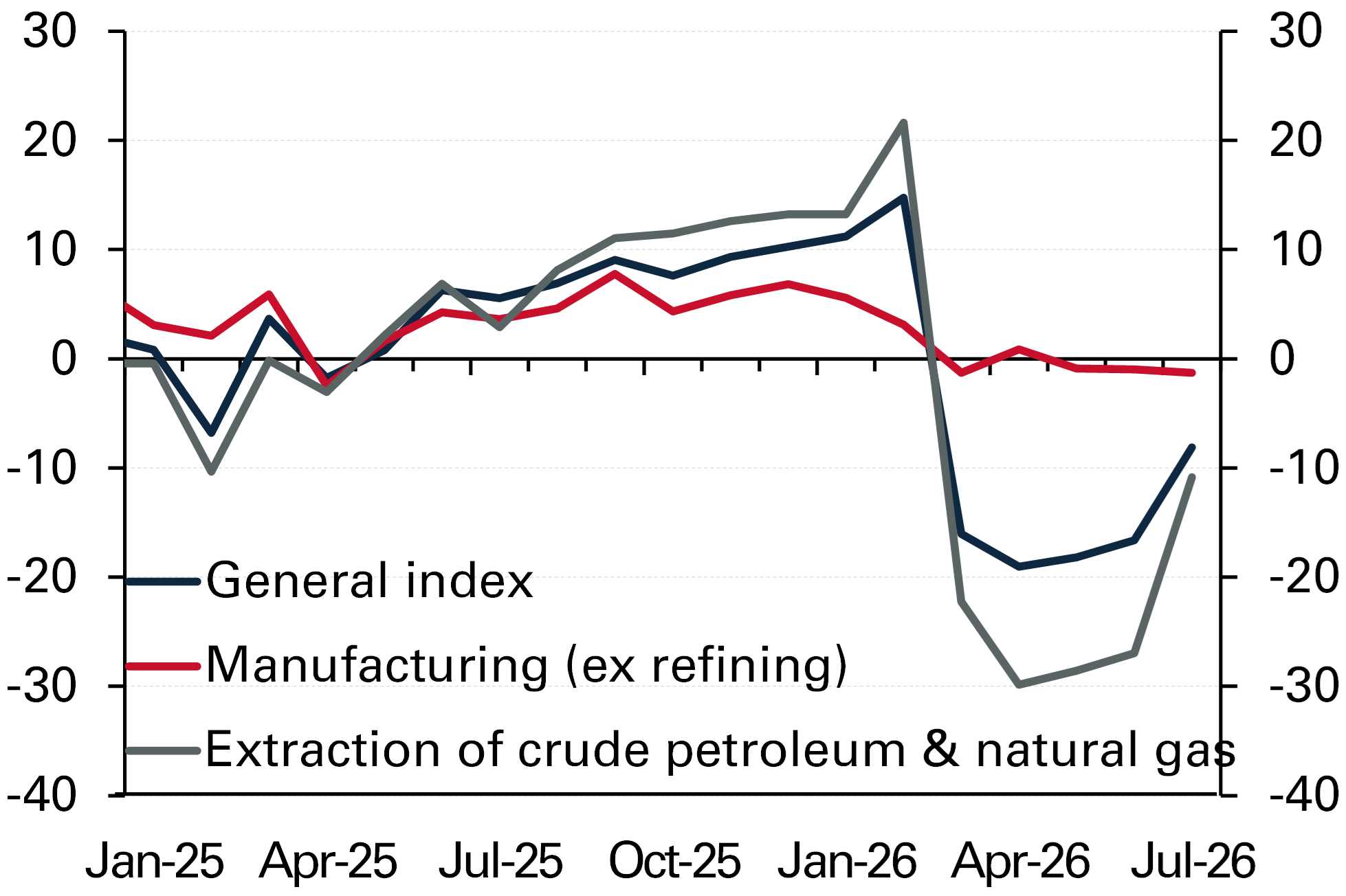
Saudi Arabia: Industrial output sees softer decline as oil activities improve in July. According to GASTAT, industrial production decreased by 8.1% y/y in July, mainly due to declines in mining and quarrying (-10.9%) and manufacturing (-5.8%), particularly in refined petroleum products and chemicals. The decline was the mildest since February after four consecutive months of double-digit contraction, helped by a strong monthly rebound in mining activity (19.0% m/m), modest growth in manufacturing (1.3%), and continued expansion in utilities. Oil-related activities fell 11.4% year-on-year, while non-oil activities were broadly stable, declining only 0.3%, highlighting that the weakness in industrial production was concentrated in the oil sector, whereas non-oil sectors showed greater resilience. The monthly rebound suggests an improvement in industrial momentum compared with June, driven largely by higher oil production and stronger mining activity – although the oil sector looking ahead would likely be negatively impacted by the recent conflict developments highlighted above. At the same time, continued growth in electricity, gas, water, and waste-management activities indicates sustained domestic demand and ongoing support from non-oil sectors of the economy.