
 +965 2292 4888


Daily Economic Update
03.08.2026
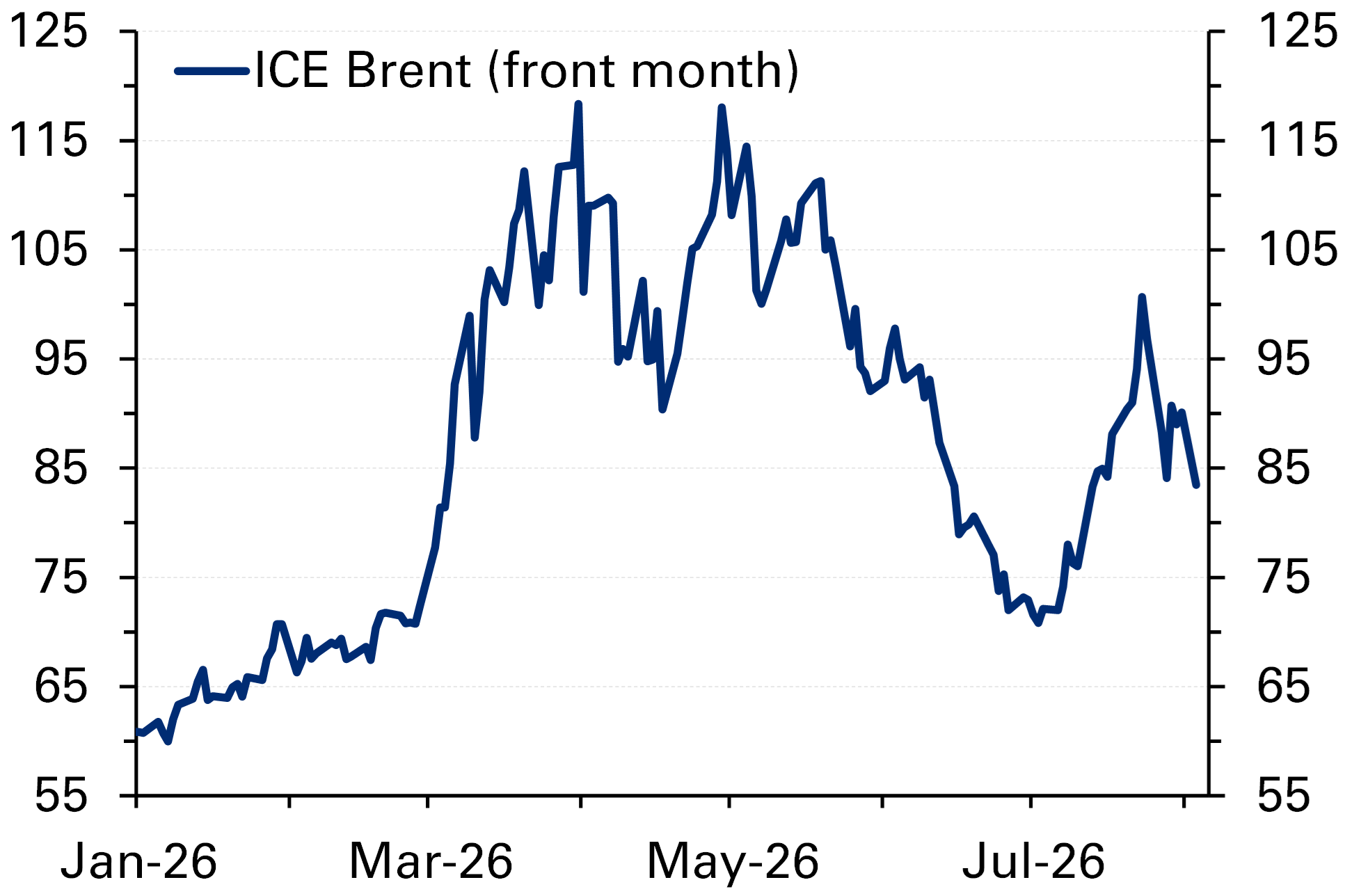
Oil: Prices under pressure as Trump announces new talks with Iran. Brent crude futures have come under heavy selling pressure in early trading today, falling around 5% to $83.5/bbl after US President Trump announced that new talks with Iran (likely via intermediaries) are set to begin today following his decision to call off a planned military strike over the weekend. Markets appear to be interpreting the move as a meaningful step toward de-escalation, extending the weakness seen last week after Brent settled down 6.9% w/w on Friday as both Washington and Tehran appeared increasingly focused on avoiding a further escalation in hostilities. Despite the recent correction, crude prices ended last month sharply higher, with Brent closing July up 24% m/m, marking the largest monthly gain since March amid a sustained increase in regional tensions, repeated exchanges of strikes, and concerns over disruptions to oil exports and shipping routes across the Gulf and the Red Sea. Meanwhile, comments by Iran's Foreign Minister indicating that discussions with Oman regarding the Strait of Hormuz are in their final stages also weighed on market sentiment as progress on this front could pave the way for a reopening of the Strait and help facilitate a broader reduction in tensions between the US and Iran. Supply-side developments were also in focus. OPEC+7 agreed yesterday to increase production targets by a further 188 kb/d in September, completing the unwinding of the voluntary production cuts announced in April 2023. While much of the increase remains largely theoretical given current export constraints, the higher quotas provide producers affected by the conflict with additional scope to raise output once shipping conditions are normalized. Beyond September, market expectations are centered on OPEC+ maintaining production levels broadly unchanged, with decisions regarding 2027 group-wide output policy likely deferred until December’s meeting.
Global: US July jobs report and China’s July trade data key economic releases this week. In the US, July’s non-farm payroll report is due on Friday, with the consensus forecast at +91K jobs, improving from a disappointing 57K in June. The unemployment rate is seen ticking up to 4.3% from 4.2%. Job openings in June (JOLTS data on Tuesday) are expected to drop to 7.25 million from 7.59 million in May. The ISM manufacturing PMI (later today) is projected to rise to 54 in July from 53.3 in June, while the equivalent services gauge (Wednesday) is seen inching up to 54.2 from 54 but more focus will be on the price sub-indices given the latest rebound in energy prices. Several FOMC officials will speak this week, and given the communication posture adopted by Chair Warsh, their views should attract greater-than-usual attention. In the Eurozone, retail sales for June (Thursday) are forecast at +0.1% m/m, following +0.2% in May. In the UK, the Lloyds House Price Index for July (Friday) is projected to increase by 0.2% m/m, matching June’s pace. In China, trade data for July is due on Friday with the trade surplus expected to narrow to around $112 billion from $126 billion in June. Finally in Japan, employees average cash earnings for June will be released on Wednesday, with growth expected to accelerate to 3.4% y/y from 3.2% in May while household spending (Friday) is seen growing 0.9% y/y in June, following May's 0.4% decline.
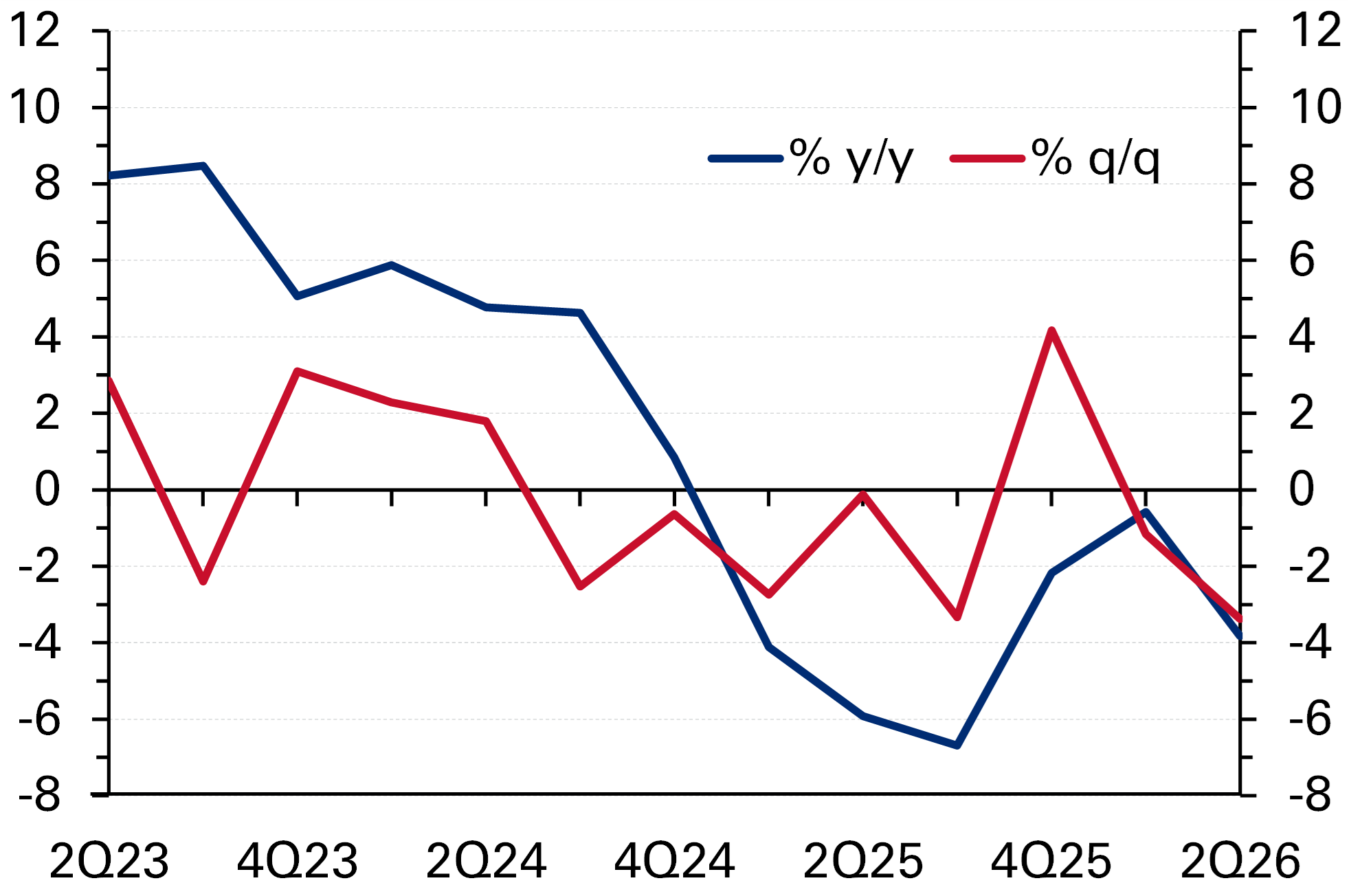
Kuwait: Electronic payments continued to fall in Q2. Central bank data showed local electronic payment transactions (by KD value), a proxy for consumer spending, falling by 3.8% y/y, from 0.6% y/y in Q1 and marking the steepest decline since Q2 25. On a quarterly basis, cards spending fell for the second consecutive quarter, with the decline accelerating to -3.4% q/q from -1.2% in Q1. The decline was led by 8.5% y/y drop in ATM transactions, followed by electronic gateway payments and point of sale transactions which fell by 5.1% and 0.3% y/y respectively. Meanwhile, WAMD transactions (not included in total electronic transactions) rose sharply by 43% y/y (10% q/q), a continuation of the trend observed since inception in June 2024 reflecting a strong uptake by users, although a slower pace than the average of previous quarters. Overall, the data points to a renewed slow-down in spending compared to the pre-conflict trend which showed early signs of recovery in Q4 2025 after a more than year-long sequence of negative quarterly growth. With that said, the negative effect of the conflict on cards spending appears to be modest, especially when excluding the pre-existing trend of declining ATM (cash) usage due to the mainstream adoption of digital alternatives, suggesting that consumer sentiment has held up reasonably well despite conflict disruptions.
Egypt: IMF approves new disbursement for Egypt, while warning on reform delays. The IMF has approved the seventh review of Egypt’s Extended Fund Facility (EFF) and the second review under the Resilience and Sustainability Facility (RSF), unlocking approximately $1.8 billion in additional financing ($1.5 billion under the EFF and about $0.3 billion under the RSF). The IMF noted that Egypt demonstrated resilience amid regional geopolitical tensions, supported by exchange rate flexibility, energy price adjustments, fiscal discipline, and strong external inflows from remittances and tourism. The IMF also noted that economic activity remained robust, with GDP growth reaching 5.0% in Q3 FY2025/26 (Q1 2026), while full-year growth is projected at 4.6%. Looking ahead, the IMF expects growth to moderate slightly to 4.4% in FY2026/27 due to lingering effects of regional uncertainty and weaker investment. Inflation, which eased to 14.3% in June 2026, is projected to rise temporarily to around 16.7% in H2 2026 before gradually converging toward the central bank’s target range (currently 7% (±2%) from Q4 26). The current account deficit is estimated at 4.5% of GDP in FY2025/26 but is expected to narrow as oil prices normalize and Suez Canal revenues recover.