
 +965 2292 4888


Daily Economic Update
30.08.2026
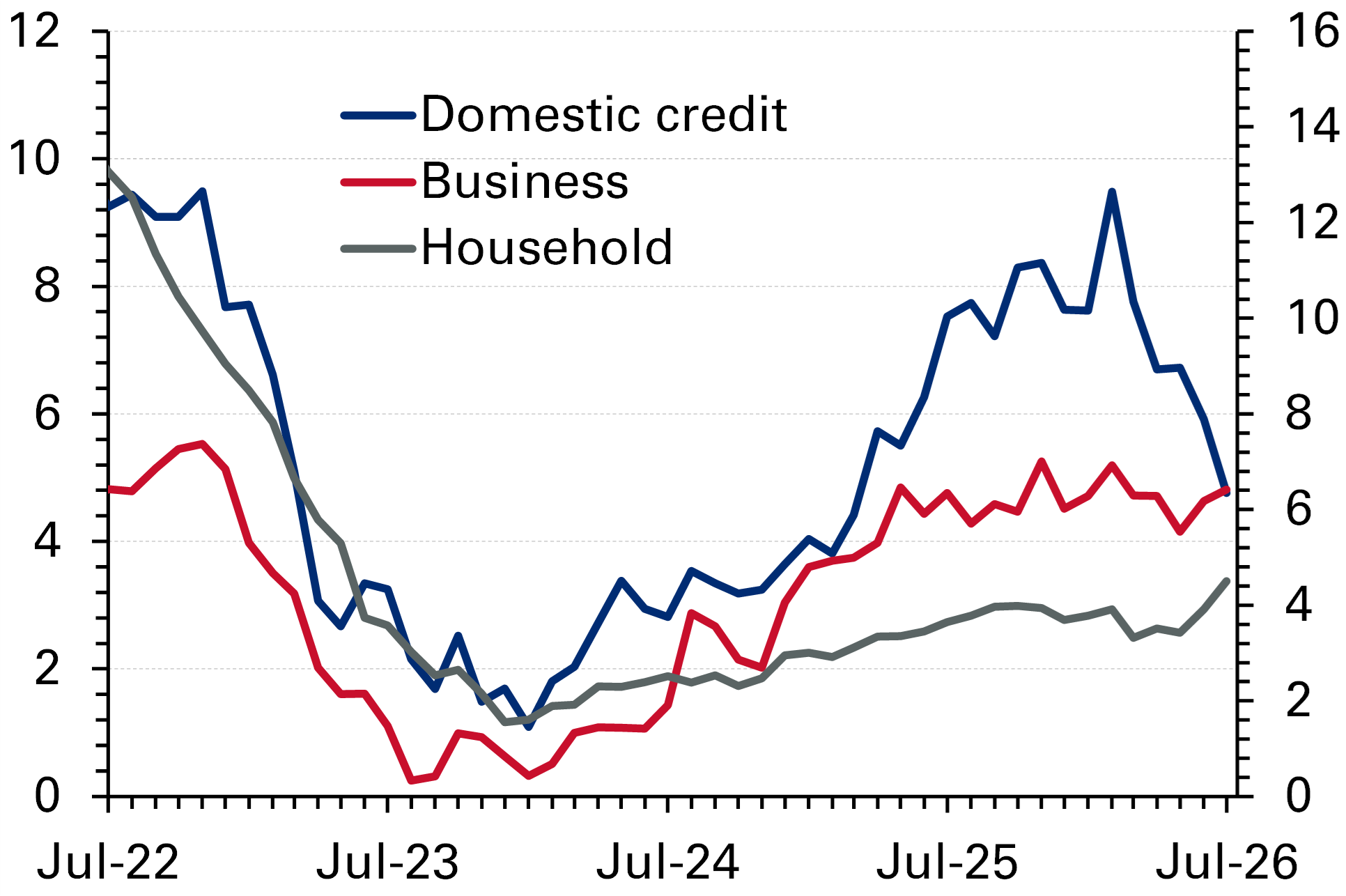
Kuwait: July business and household credit growth quickens, though total domestic credit contracts. In the Central Bank of Kuwait’s latest monthly statistical release, both business and household lending posted strong monthly gains, the former with 0.7% (+6.4% y/y; +4.9% ytd) and the latter with 1.2% m/m (+4.5% y/y; +2.8% ytd). The increase in business credit in July was the fastest since pre-conflict February, driven by a notable acceleration in credit demand from the ‘other services’ (+3.4% m/m; +17.3% y/y), oil and gas (+2.5% m/m; +23% y/y) and the industrial and construction sectors. The expansion in household credit growth, meanwhile, was the fastest in almost four years, supported by a strong uptake in installment loans (+1.4% m/m; +5.6% y/y). That said, for total domestic credit, July’s figure represented a decline (-0.2% m/m; +4.8% y/y)—the first since March—on a sharp decline in lending to banks and financial institutions with credit for the purchase of securities also falling in the month. Credit to non-residents, however, returned to growth (+1.9% m/m). On the liabilities side, resident deposit growth remained steady at 0.6% m/m in July (+9.8% y/y), bringing YTD growth to 6.9%. This increase was driven by a rebound in private sector deposits (+0.3% m/m; +1.7% y/y) and a strong rise in government deposits (+3.7% m/m; +33.5% y/y), which more than offset the 0.4% m/m decline in public sector deposits. Meanwhile, non-resident deposit growth moderated, with annual growth easing to 17.6% y/y, its slowest pace since April 2025. Looking ahead, continued resilience in business and household lending should help underpin underlying credit activity, though uncertainty linked to the ongoing conflict in the Gulf remains a factor affecting business sentiment that is worth watching.
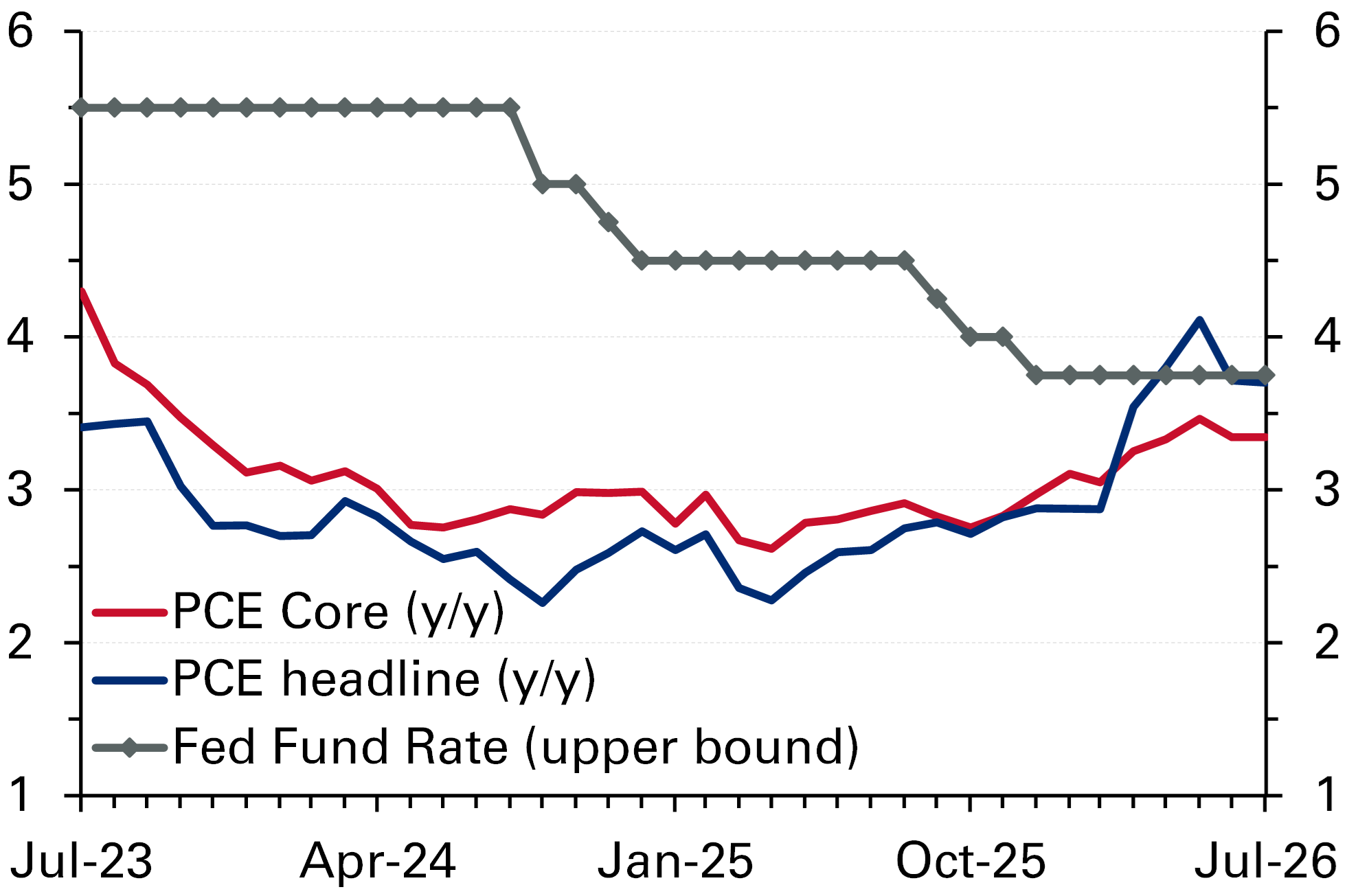
US: Warsh delivers a hawkish, clearer speech than previously; short-term yields and market pricing for a September rate hike climb. Fed Chair Warsh, in a keynote speech at the Jackson Hole Symposium, highlighted that despite recent, better-than-expected inflation readings, underlying trends haven’t meaningfully improved, while he believed that the labor market was “consistent with full employment”. He emphasized that until the Fed is confident that “underlying inflation is moving to our objective, clearly and at sufficient speed” they “have work to do”. Importantly, he expressed that he “would be hard pressed to describe broad financial conditions as restrictive”. Also clearing confusion about the Fed’s main inflation gauge after his ambiguous messaging at the FOMC’s July meeting press conference, Warsh stated that “the Fed’s price stability objective of 2%, as measured by the PCE price index, is a firm, fixed target”. Talking about the Fed’s use of its balance sheet, he underscored that “unconventional policies to spur economic activity may suit genuine crises but should otherwise be used sparingly, if at all”. Overall, Warsh struck a hawkish tone and a clearer one than in his previous speeches, departing from his usual style of keeping communications vague about the Fed’s reaction function as well as his take on inflation and the economy. Though he stopped short of endorsing an interest rate hike soon, the futures market probability moved sharply in favor of a 25-bps hike at the FOMC’s September meeting at over 60% at one point before paring back to 57% on Friday versus just 35% on Thursday. The market pricing now signals around 50% probability for two hikes by end-2026. Still, the upcoming non-farm payroll and CPI reports for August would be crucial ahead of the next FOMC meeting on September 15-16, shaping policymakers’ decisions. Yields on 2Y UST bonds (which are more sensitive to the changes in the Fed policy rates) climbed by around 12 bps on Friday while 10Y ones saw a relatively softer increase of around 5 bps.
US: PCE inflation in July steady but elevated; job growth in April 2025-March 2026 revised slightly downward. Both headline and core PCE inflation readings for July remained elevated and were unchanged from June at 3.7% y/y and 3.3%, respectively. On a monthly basis, core PCE inflation rose to 0.2%, up from June’s 0.1%, while a core services measure (excluding housing and energy) stood at 0.3% m/m, signalling high underlying inflation. Separately, GDP growth in Q2 was unchanged in the second estimate at 1.5% (annualized), but slower than the 2.1% recorded in Q1. However, personal consumption growth was revised higher to 3.4% from 3.2% in the previous estimate, improving from just 0.5% in Q1. Moreover, indicating strong domestic demand, the key measure of final sales to private domestic purchasers, rose by the highest pace in over three years at 4.2% (+3.9% in the first estimate) after 1.7% in Q1, boosted by robust household spending and ongoing solid business AI/tech-related investments. Meanwhile, non-farm payrolls in the 12-month period through March 2026 were revised down by a combined 79K as per the BLS’s preliminary benchmark revision, pushing down the average monthly job growth to 11K (on a non-seasonally adjusted-basis) instead of the earlier reported 18K during the period. The BLS will publish the final revisions along with the updated monthly data for the benchmark year (April 2025-March 2026) in February 2027. After showing signs of recovery in early 2026, job growth has again weakened, with 3M average growth standing at 20K per month as of July, signalling renewed softness. Simultaneously, the unemployment rate is also low at 4.1%, underscoring a decreased hiring but low firing landscape.
Eurozone: ECB’s July meeting minutes signal further tightening remains possible as inflation risks remain tilted to the upside. The ECB's July meeting accounts (released on 27 August) showed policymakers remained concerned about the inflationary impact of the Middle East energy shock. While the Governing Council unanimously kept interest rates unchanged following June's 25-bps hike, members stressed that the pause should not be interpreted as the end of the tightening cycle, noting that the full inflationary effects of higher energy costs have yet to materialize. The accounts also revealed a hawkish undercurrent, with some policymakers arguing they would not have opposed a further rate increase in July given the risk of inflation remaining above target for longer. On the growth side, the ECB viewed the Eurozone economy as more resilient than expected, supported by private consumption, digital and AI-related investment, defense spending, and a gradual recovery in exports, although elevated energy prices and geopolitical uncertainty continue to pose downside risks.
Bahrain: GDP contracts for the first time in five years amid regional conflict though non-oil activity held up. Bahrain’s economy contracted by 3.8% y/y (-15.3% q/q) in Q1 2026, reversing a 4.6% expansion in the previous quarter, according to the Ministry of Finance and National Economy. This marked the first contraction since Q1 2021 and the steepest decline since Q3 2020. The downturn was largely driven by a 37% y/y (-29% q/q) contraction in oil activities, primarily due to restrictions on maritime traffic through the Strait of Hormuz, which affected the Kingdom’s export capacity. Meanwhile, the non-oil sector grew by 2.2% y/y (-13.4% q/q), down from 7.4% in Q4 2025, and accounted for 90% of total GDP. Nine out of 13 non-oil sectors recorded positive growth, including the financial and insurance services (+8.6% y/y) and public administration sectors (+3.6% y/y), though the manufacturing sector weakened (-2.5% y/y) as did the transportation and tourism sectors, which contracted by 15.6% y/y and 13.4% y/y, respectively, reflecting the impact of the regional conflict in March.