+965 2292 4888


Qatar Outlook
15.11.2026
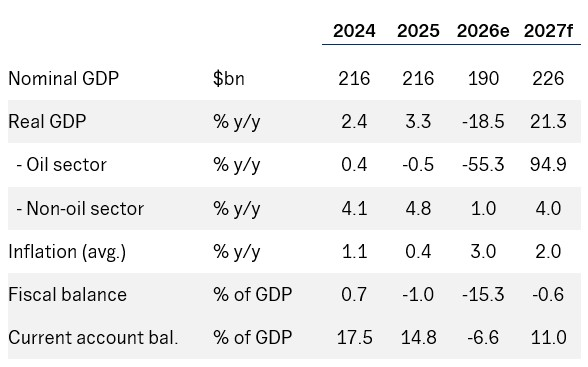
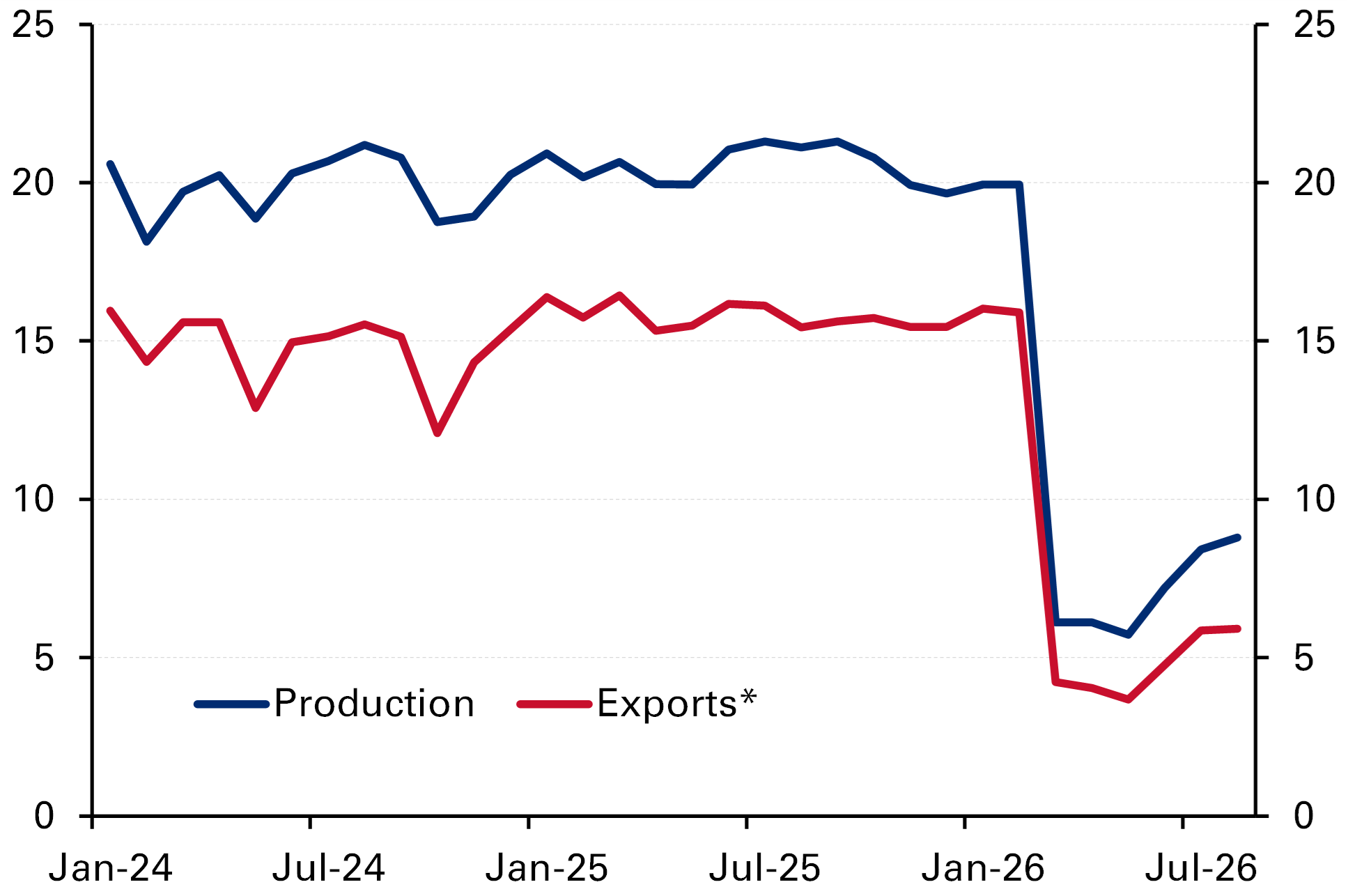
LNG output disruption leads to severe downturn: The economy has been severely impacted by the fallout from the US-Iran war, emerging as one of the worst-hit countries in the region. GDP is on track to contract by around a fifth this year as hydrocarbon output declines by 55%, driven by a 75% drop in LNG exports since January reflecting the attacks on gas infrastructure and shipping disruptions in the Strait of Hormuz. While the non-hydrocarbon economy has so far avoided recession (+3.1% y/y in H1 2026), effects of the conflict remain evident across several sectors. Manufacturing output contracted by 8% y/y in H1 2026, while tourism, a key pillar of the government's diversification strategy, has been weighed down by heightened security concerns and weaker visitor inflows. PMI readings and credit growth have also moved into contraction territory, pointing to softer business activity, while lower revenues have prompted cuts to government expenditure – particularly capital spending – removing an important source of economic support. Nevertheless, substantial fiscal buffers continue to underpin economic resilience (see below), with wages & salaries outlays still up y/y in H1 and helping to sustain household spending. Key service sectors of the non-oil economy (including finance, real estate and public administration) have been less affected by trade and supply chain pressures, business confidence is well off its lows and CPI inflation, although elevated at 4.1% y/y in August, has been contained by energy price controls.
Growth to rebound next year, boosted by recovery in LNG production: The economic outlook is closely linked to conflict developments, but in our baseline LNG exports return to 80% of pre-conflict levels in H1 2027, with reconstruction work on damaged trains pushing a full recovery to later on in line with official statements. Overlaying this, the massive North Field East expansion is assumed to start coming online after mid-2027, eventually taking LNG capacity from 77 mtpa to 110 mtpa (incorporating the currently damaged trains). These two concurrent developments could see hydrocarbon GDP almost double in 2027, percolating out to the non-hydrocarbon sector and delivering the government a fresh revenue windfall. An unwinding of conflict pressures on sectors such as tourism, manufacturing and trade will be the driving force behind the 4% rebound in non-hydrocarbon GDP forecast for 2027. The government also remains committed to rollout of the 2024-2030 National Development Strategy, which focuses more on targeted diversification (in sectors such as manufacturing, logistics and tourism) and productivity gains than the huge infrastructure rollout delivered in the years running up to the World Cup.
Return to broad fiscal balance expected in 2027: The fiscal position is set to record a large deficit in 2026 and then rebound close to balance in 2027 as hydrocarbon exports normalize. Oil & gas revenues slumped 97% y/y in Q2 26 but sizeable non-hydrocarbon receipts are a stabilizing factor. Spending was cut 23% y/y in Q2 26 with large capex outlays (about 30% of all spending in recent years) offering flexibility. Even in the event of further deficits we see considerable fiscal headroom going forward. Public debt has been cut to a moderate 43% of GDP in 2025 from 58% in 2021, while the QIA has an estimated $500-600bn (>260% of GDP) in SWF assets. The 2027-28 LNG expansion could also plausibly add revenues of 5% of GDP/yr.